http://www.nfuonline.com
The Voice of British Farming
Bank Watchdog
Royal Highland Show
find out about joining us here 120257

Site tools

Farming and genetics

25 Nov 2011
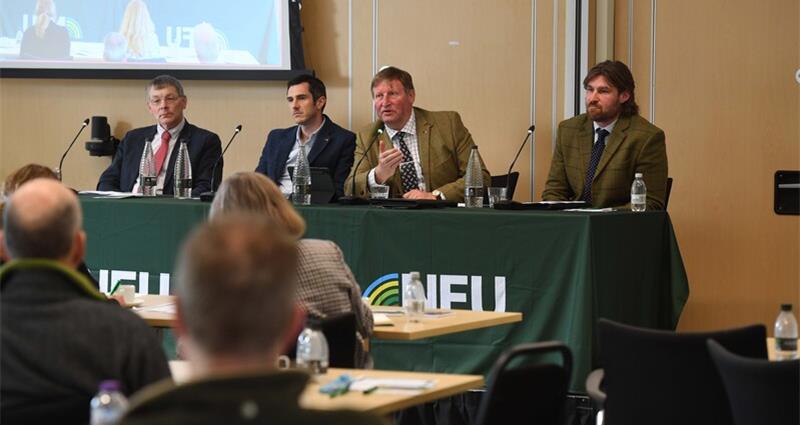
At the beginning of November I went to the LEAF Marque annual President's day conference - much to the disgust of my fellow directors who feel I should be selling things instead of swanning around enjoying myself on the 34th floor of the HSBC building in Canary Wharf.

It turned out to be a really interesting (if counterintuitive) morning with presentations on soil conservation from ASDA, saving water from Molson Coors and the launch of the LEAF Water Management tool by Jim Paice.

The most interesting presentation of the lot was one on the 3 stages of GM from Professor Sir David Baulcombe. I've tended to be a GM sceptic as it has appeared that the amount of spraying hasn't gone down on the round-up ready strand, yields haven't gone up, farmers have become more dependent and the companies that produce these products have created a de facto monoculture with the IP owned by them which augurs badly for food security on both counts.

If my time as a biologist taught me anything it's that if you routinely subject the environment to pest killers - whether it's round-up or antibiotics you end up with resistant organisms. MRSA, avian flu, round up resistant super weeds. Considering how many times it's happened you would think someone in the regulatory mechanisms would have clocked it by now. In fact there's an interesting and balanced account of experiences to date from one of my fellow NFU bloggers here.

In the Professor's extremely interesting talk he identified 3 stages of GM.

Phase one is the current generation which rests on two main techniques - the insertion of a round-up resistant gene into Soya, rapeseed, maize, alfalfa and sugar beet and the insertion of the bT gene which produces an anti-corn borer toxin into maize and cotton.

In addition, anti virus genes have been inserted into zucchini, peppers and papaya and a version of rice with added vitamin A is expected to be planted in 2013. In the US most of these crops are 85% + GM.

The Professor said that it would be quite straight forward starting from were we are now to apply virus resistance to all major plant groups but getting this through the regulatory maze made it problematic.

What he called the second phase of GM comes about because gene sequencing techniques have advanced to the point that any genome can be sequenced in a day at a trivial cost for a business.

Apologists for GM have always insisted that it's not different from traditional plant breeding.

For Generation one plants where transgenic modification has occurred with bacterial genes being inserted into higher plants this is of course nonsense. However with generation 2 we have the possibility of real cis genic (i.e. genes from the same organism) being used and the statement becomes a much more accurate reflection of reality.

You can identify visible markers for specific genes that you want and breed for those. Further by being able to sequence you can select directly for the genes themselves without having to wait for the plant itself to grow to maturity. Some useful things could be done here which would actually improve the plant itself - something that the original excursions into round up ready and bT didn't do. Things like improving drought resistance, increasing the number of root hairs, additional metabolic pathways etc.

This really is an acceleration of natural process. It has the advantage that you don't lose the original characteristics of the plant which could be reinserted later. I could well be convinced that this could be a way forward if it improved flavour, yield and truly produced better plants.

In Generation 3 the Professor believes we could create whole new organisms. Personally I would be wary of this although a perennial nitrogen fixing wheat would be pretty cool.

Natural selection operates by the interaction of an organism with the totality of the ecosystem (at least in principle). This has a complexity developed by self interaction over many millions of years. I wouldn't like to bet that a scientist working for say Monsanto would be able to second guess the behaviour of a new organism in the wild.

The chances of ending up somewhere we might not want to be seem quite strong particularly regarding the notorious elasticity of the US regulatory authorities when confronted by a multi-national in full cry. The existing evidence of genetic flow and super weeds that we already have to deal with seem to me to argue in favour of caution here.

Interestingly the Professor despite being very pro GM techniques felt that the need for scientific management of crops, the issues of genetic flow and the existing IP regime were issues that really need to be addressed if these techniques are to be truly beneficial to the quest for food security. I rather think he's right.

He gave a great summary and I hope I've done it justice. At the very least it was a welcome change to listen to a talk on this topic that generated more light than heat.

As a finale there was a very interesting discussion afterward between the Professor and one of the more organic farmers there. It’s available on You Tube here
Feedback

Click here to have your say. Comments may be used in NFU publications.

No comments have been made.

  • Get great recipe ideas from the Love Chicken websi
  • Follow us on Twitter
  • NFU Employment Service - find out more here
  • Latest news on renewable energy
  • Visit the Great British Beef website
  • Visit NFU Sugar.com
  • Join NFU Pro now
  • Access Business Guides and more here
Cereals 2012