NFU member’s Bomber Oak serves as living war memorial to sacrifice and resilience
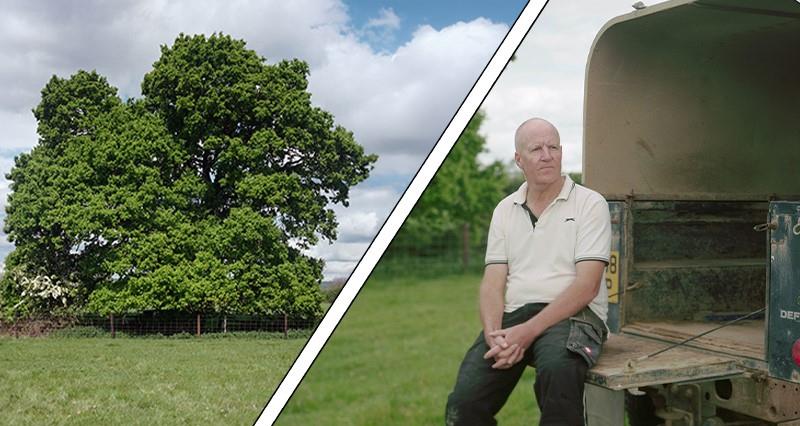
(L-R) The 180-year-old Bomber Oak and member Andrew Brown. Photograph: Andrew Brown.
Remembrance Sunday is taking place on 8 November. Hear about the importance of resilience and the terrible cost of war as NFU member Andrew Brown shares his family’s story.
Two old oak trees on NFU member Andrew Brown’s Rutland family farm serve as living memorials to the men and women who bravely served their country both at home and abroad during times of great uncertainty.
One tree survived a WWII plane crash; another was planted in memory of a brother lost during WWI.
Still baring the scars and carrying the memories of those who strove to protect the nation through hard work and sacrifice, we are reminded, now more than ever, the importance of our own resilience.
Site of 1945 plane crash
The 180-year-old Bomber Oak on Andrew’s family farm stands as a memorial to the crews who flew and fought in World War II and has an amazing but tragic survival story to tell.
The oak’s top was taken clean off after an Allied plane crash in 1945 claiming two lives.
The World War II bomber containing Australian airmen suffered a training flight engine failure, hit the tree and crashed soon afterwards.
Andrew, a former NFU regional chair, said he believed two airmen had lost their lives and there were five survivors.
The Caldecott farmer said he always remembered his grandfather, Walter, telling him about the bomber and the oak tree.
Walter kept a war diary, and on Monday, 30 April 1945, there is an entry which states: ‘Found plane had crashed through top of oak tree in Big Meadow’.
“The tree is a tribute to the brave people in Bomber Command and to the Australian airmen who travelled halfway across the world and lost their lives to keep us safe from the Nazis.”
NFU member Andrew Brown
Scars of war
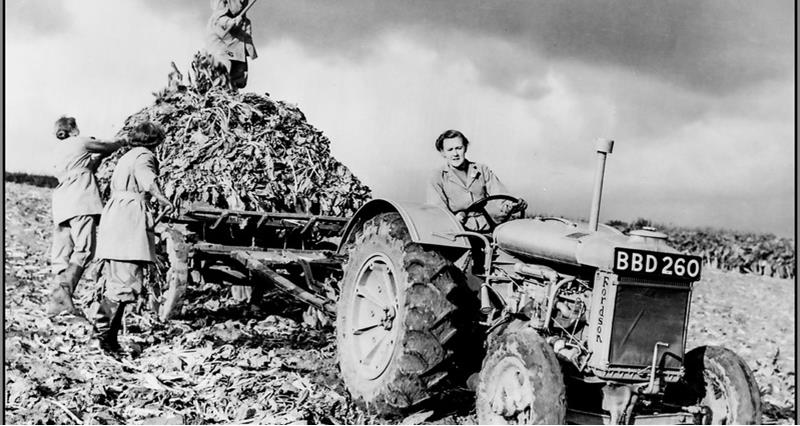
Andrew Brown said: “It came days after another plane crashed on our land and a few days later a glider crash landed in the same field with two Jeeps in it.”
He said that for some time afterwards his family would find little bits of Perspex in the ground, probably from the bomb aimer’s blister.
The bomb aimer’s blister or nose blister is the transparent, dome-shaped Plexiglass or Perspex enclosure located in the lower nose section of World War II-era heavy bombers, like the Lancaster.
“Even now,” he said, “you can see that some of the branches are a slightly different shape, which after 80 years shows how hard it must have been hit.
“The tree is a tribute to the brave people in Bomber Command and to the Australian airmen who travelled halfway across the world and lost their lives to keep us safe from the Nazis.”
The landscape remembers
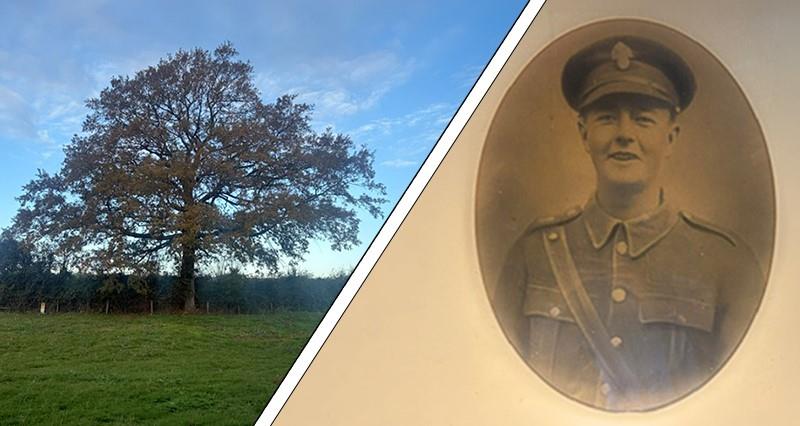
A further oak that stands tall on the family farm was planted by Andrew’s grandfather, Walter, upon returning from World War I, in memory of his brother George.
Both brothers went to war and took part in the Battle of the Somme, the bloodiest event in British military history.
George sadly lost his life on 5 November 1918, just six days before the signing of the armistice on 11 November, which effectively ended the war.
He died under machine gun fire near Mons in Belgium.
George’s father received a letter from the OC (Officer Commanding) of his Company which read:
Throughout the day your son’s coolness and courage was a splendid example to all ranks, and on that day I lost one of my smartest and best men. I have had him buried in a peaceful little French orchard, where he will remain undisturbed by the ravages of war.
Standing strong against the odds
A few months ago, the Bomber Oak was one of 10 trees across the UK shortlisted for the National Tree of the Year in a Woodland Trust competition.
The contest celebrated trees that have survived an array of challenges but still stand strong against the odds.
Although The Bomber Oak missed out to a wych elm in County Down, called the Bendy Tree, it remains a poignant Rutland memorial to the servicemen who fought and did not make it home in World War II.
While the Brown family oak remembers George and all who lost their lives in the Great War just decades before.