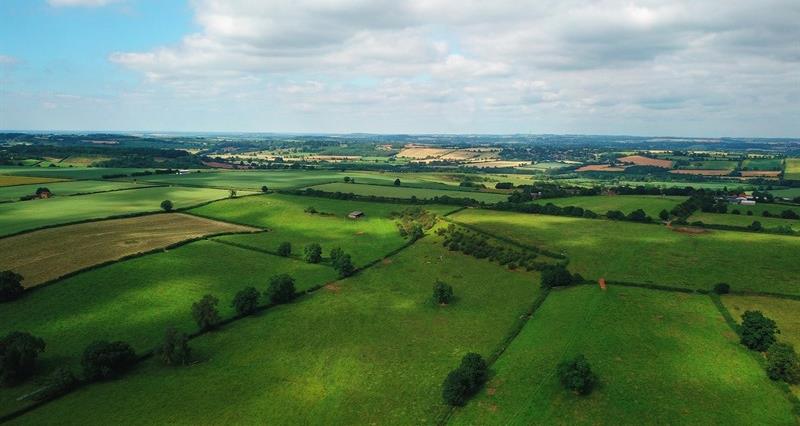
The framework states: ‘Some farmers, developers and planners are already demonstrating that it is possible to deliver multifunctional and efficient land use and we want to encourage more to take up this challenge.’
Defra's document sets out why change is needed and how it can be achieved if we use land more efficiently. Its purpose is to help inform decisions, rather than telling people what to do with their land.
"Important questions also remain on a long-term vision for food and farming."
NFU President Tom Bradshaw
Last year, Defra ran a ‘national conversation’, a consultation, on its framework which the NFU responded to, following extensive engagement with our members. We called for a framework underpinned by sound science and evidence, with food production at its heart.
Challenges remain
Responding to the publication of the framework, NFU President Tom Bradshaw said: “It’s positive to see an explicit recognition of multifunctional land use and a commitment to maintain food production within the framework. This commitment, alongside the repetition from Defra that food security is national security, is vital as the global geopolitical situation continues to become more uncertain with the war in the Middle East and ongoing war in Ukraine.
“The Land Use Framework is a step in the right direction, but challenges remain about delivering against the ambitious objectives as the first 2030 milestone approaches. Delivering on all objectives with existing land is an ambitious aim and will require clear guidance, the right policy framework and incentives, to avoid unintended outcomes and ensure that all farmers and growers are able to meet the ambitious productivity objectives within the framework.
“Important questions also remain on a long-term vision for food and farming. From the 25-year Farming Roadmap to the delivery of the Farming and Food Partnership Board, we want to work with government to drive these policies forward to create confidence and profitability for farming and growing businesses and ensure 2026 sees British farming achieve all it is capable of.
“We will work through the detail of the framework and will continue to engage with Defra with further feedback from farmers and growers.”
Four key principles
Defra wrote that many of the consultation responses said that land was being used inefficiently, locking us into “false choices” between infrastructure and nature, homes and food.
The department said its analysis showed “we have enough land to deliver all of our objectives, provided we use it in a more efficient and multifunctional way”.
Defra Secretary Emma Reynolds said the framework “makes a clear, long-term commitment to maintain overall food production in England, to underpin our future food security and drive economic growth”.
The framework includes four principles to guide better land use decision-making:
- Multifunctionality: Land use should be planned and managed to deliver greater benefits across a range of outcomes, tailored to local priorities and opportunities and environmental pressures.
- Right use, right place: Land should be used in ways that align with local context.
- Future-ready decisions: Land use decisions should take a long-term view, taking account of the best available evidence, and aiming to meet the needs of the present without compromising the ability of future generations to meet their own needs.
- Adaptive by design: Land use policy and delivery should be flexible to evolve and respond to changes.
Ambitious objectives
The framework marks 2030 and 2050 as key milestones for progress. By 2030, it says farmers and growers will have clarity on the long-term opportunities for their land and policy on food production.
It predicts that, by this point, many farmers will be stacking multiple income streams on top of food production; ELMs (Environmental Land Management schemes) will be key to this. By 2050, agricultural land will be managed to ‘prioritise sustainable food production and environmental benefits’.
The government is confident that there is enough land to deliver its objectives without reducing domestic food production or compromising on these objectives. To do this, food production will need to increase in line with historic averages, which the government believes is feasible according to its projections.
Commitments on food production
The framework makes a clear, long-term commitment to maintain overall food production in England by increasing productivity and profitability through:
- Developing sector growth plans, beginning with horticulture and poultry.
- Using the new Farming and Food Partnership Board to bring together senior leaders from farming, food production, retail, finance and government, and drive growth, productivity, and long-term profitability across the farming sector. This will inform the Farming Roadmap, due to be published later this year.
- Introducing flexibility for farmers to trial agroforestry without being locked into permanent change.
- Building climate impacts and adaptation into policy design through ELMs and the Climate Resilience of Agriculture project.
- Providing up to £50m funding over the next four years for water infrastructure, local collaboration and trials of farming with a higher water table.
How is land use set to change?
To meet future climate, nature, food production and development targets, a shift in land use is expected.
The key projected changes are:
- 5% of land will see changes in farming practices while remaining primarily focused on food production.
- 9% will shift towards climate and nature outcomes (eg, habitat creation, carbon sequestration), with only limited food production.
- 2% will be used for renewable energy infrastructure, some of which to be used alongside food production.
- 2% will be needed for urban expansion.
Wider land management change for resilience is expected to occur on all farmland, though this is not quantified.
Next steps
The Farmer Collaboration Fund will open for applications later this year, with up to £30 million worth of funding across three years. This will facilitate collaboration between farmers to support a wide range of actions, including land use change activity.
The government will also establish a 'Land Use Unit' in Defra to produce the first single map of national spatial priorities. This will give a unified picture across food production, nature recovery, water, climate change, infrastructure, housing and growth.
A map of Defra’s public spending on land management, nature restoration and land use change will also be published within the next 12 months.
See a timeline of our lobbying work:
NFU publishes Building Farming's Resilience report
NFU publishes its report Building Farming’s Resilience, calling for a multifunctional Land Use Framework that gives food production equal priority with environmental delivery. The report is published for the NFU's Conference.
New Environmental Improvement Plan published
Defra publishes its revised Environmental Improvement Plan. This prompts renewed calls for a multi-functional Land Use Framework that gives food production equal priority to environmental delivery.
NFU launches vision for the uplands
The NFU launches its uplands report, demonstrating how government, farmers and partners can work together to achieve a confident, sustainable future for the businesses at their heart.
The report calls for a national, multi-functional land use strategy that balances priorities and avoids conflicting pressures on uplands areas.
NFU President gives evidence
At a special Efra Committee evidence session on the Land Use Framework, NFU President Tom Bradshaw highlights the need to invest in homegrown food production and recognise that food security is critical to the nation’s resilience.
NFU publishes its response to the consultation
In its consultation response, the NFU has said that, in order for the government to deliver on its commitment that food security is national security as well as targets and commitments for housing, infrastructure and the environment, any Land Use Framework must be underpinned by sound science and evidence, with food production at its heart.
NFU hosts regional meetings
Approximately 30 NFU national and regional meetings are held to gather views of members.
NFU members also attend Defra regional workshops on the Land Use Framework consultation.
NFU calls for multi-functional Land Use Framework in its Blueprints
The NFU publishes its Blueprints, calling for a multi-functional Land Use Framework that manages the risk of significant competition between land use categories, based on robust scientific evidence, and avoids long-term or irreversible change to the productive capacity of farmland
NFU launches survey to gather member views
The NFU launches and online survey for its members to help inform its response to Defra's consultation.
Consultation launches
The government has launched a ‘national conversation’ on its Land Use Framework with a view to developing a new, strategic approach to land use in England.
Launching the consultation today, Defra Secretary Steve Reed set out a focus on maximising the potential of multiple uses of land – a key NFU ask – incentivising multi-functional land use that includes food production, non-food production (such as for energy) and delivering for nature, while unlocking opportunities for private finance.
NFU publishes key policy asks
The NFU publishes its policy asks ahead of the government's consultation on a Land Use Framework.
The NFU is conscious that there are huge demands being made on land including the needs of agricultural production (food and non-food), for leisure and recreation, requirements for biodiversity net gain, protected landscapes, and the need for economic and residential development alongside national strategic infrastructure.
Given the finite land area of the UK, and the importance of UK food security in volatile times, we believe that it is important that our countryside remains a multifunctional and dynamic space.