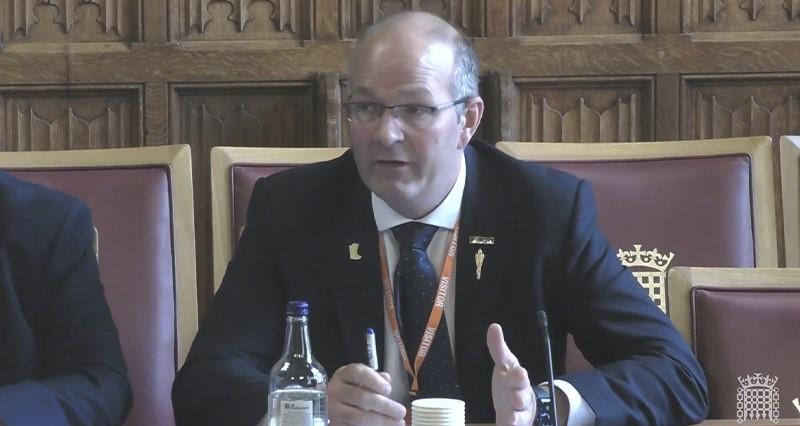
The President appeared in front of Peers during an evidence session for the House of Lords European Affairs Committee discussing the government’s intention to ‘dynamically align’ with certain EU legislation under a prospective SPS (Sanitary and Phytosanitary) agreement.
Dynamic alignment means that both parties operate from a single rule book for certain areas of legislation. Under the terms of the agreement currently being negotiated, this will be the EU rule book, and Great Britain will align with both current and future relevant EU legislation.
Asked about the potential economic impacts of the proposed agreement, Tom noted the importance of the EU market for British agriculture. He stated that, in 2025, the bloc was responsible for 68% of our agri-food exports and 69% of our agri-food imports by value.
However, Tom added, the sector’s exports to the continent have fallen since 2019, in part because of the introduction of post-Brexit certification requirements and routine border checks.
While the removal of these checks and certificates would benefit horticultural growers importing young plants and could help rebuild the market for British agricultural products in Europe, Tom noted that it would take time to rebuild demand for British produce and supply chains within the EU.
The NFU continues to champion the UK’s network of agri-food attachés who work to open up new markets and bring down barriers for British agri-food products in Europe and around the world.
Importance of transitional arrangements
Baroness Ashton of Upholland asked what steps need to be taken before all issues associated with realignment with the EU would be delt with. Tom said ensuring that farmers and growers have sufficient time to adapt to EU legislation, particularly in areas where rules in GB have diverged from those in the EU since Brexit, remained a vital issue.
Tom raised the importance of ensuring that farmers are given sufficient time to adapt to EU PPP (Plant Protection Product) legislation. In particular, he highlighted the need to ensure that farmers are given sufficient time to use up any products they may already have on farm that may no longer be approved in the EU and the importance of ensuring that crops grown with these PPPs continue to be legal to sell after harvest.
The NFU has been lobbying for a ‘variable pace transition period’ which would see GB align with EU legislation in a phased approach, with farming and growing businesses given more time to adapt to those areas of EU legislation that differ most significantly from the current rules in GB.
Risks of the SPS agreement
Lord Jackson of Peterborough asked what risks the proposed SPS agreement posed for farmers and growers.
Tom responded that it is important that negotiations result in a fair deal for British farmers and that the government should ensure that negotiations are not rushed.
He pointed to areas where EU legislation has diverged from those in GB, including controls for avian influenza, and said that it is essential that the government takes the time to negotiate workable solutions in these areas.
Without securing these solutions during initial negotiations, it would be unlikely we’d get them in the future, Tom warned.
The President also highlighted the need for UK negotiators to push to ensure that, where GB has positively diverged from EU legislation, progress is not lost. This includes ensuring that, should a bTB vaccine be approved, farmers in GB are able to vaccinate their cattle under EU legislation so long as this does not negatively impact our ability to trade internationally.

Tom also explained the NFU’s ask for an exception to dynamic alignment, or carve out, for the Precision Breeding Act (2025) in England to allow farmers and growers to continue to benefit from world-leading British research.
British influence and parliamentary scrutiny
The President went on to explain the importance of securing meaningful influence upon EU decisions and the legislation that will apply to producers in GB under the SPS agreement.
He urged the government to ensure that their experts, scientists, diplomats, negotiators and regulators are all ready to be involved in EU decision making at earliest possible opportunity to ensure that rules that are currently under discussion in the EU properly reflect the needs of British farmers and growers.
Tom also highlighted the need for the effective consultation mechanisms to enable industry stakeholders and the UK and devolved parliament to influence the government’s approach to influencing future EU legislation.
He went on to say that the government should ensure that proposed EU legislative changes are properly scrutinised by Parliament and that, in the event of a disagreement between the EU and UK Government, the agreement should ensure that there is a genuinely meaningful process of arbitration. In the case of serious and exceptional disagreements the UK Parliament must, Tom said, have the ability to withhold consent and act as a ‘backstop’ to protect the UK’s national interest.
We continue to make representation of our members’ interests with the negotiators and MPs, having just submitted our concerns and priorities in the UK-EU negotiations with the House of Commons Trade and Business Committee.