
Frans de Boer says he sees potential for a bright future for the industry, despite present challenges.
He said: “I think there is a very exciting future ahead in farming for young people coming into the industry. Farming is embracing new technologies and at the forefront of efforts to tackle climate change, while feeding the nation.”
A farming pioneer
A pioneering figure in the industry, Frans was the first farmer in the UK to become involved in crimping grain maize for animal feed, which he did as a contracting service as well as direct sale to dairy and beef farms including feeding the family’s own 220-strong dairy herd.
The process was well established in northern Europe when Frans introduced it into the UK in October 2000 and has grown in popularity in this country as a technique to improve yield and deliver high nutritional value while reducing costs.
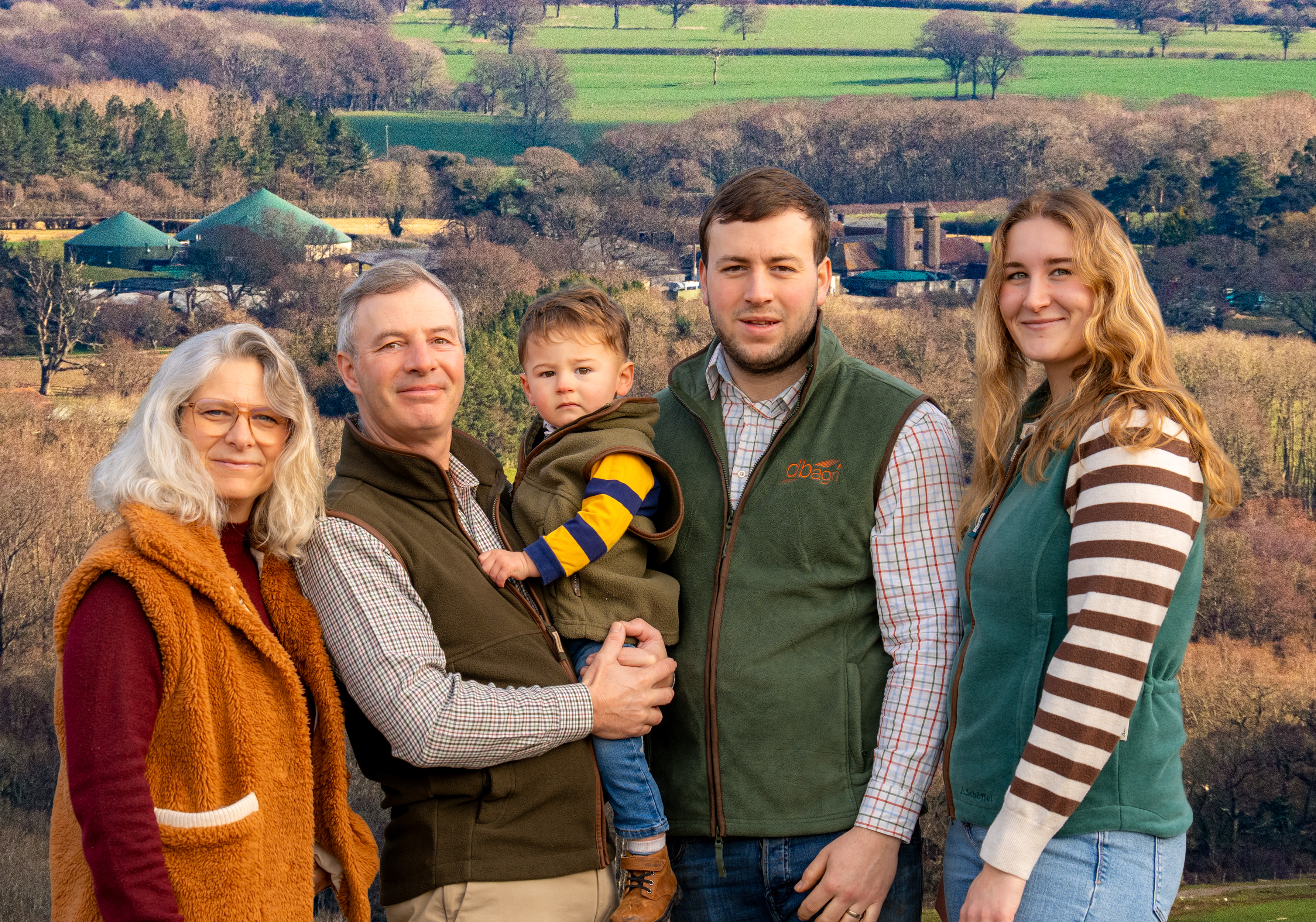
Frans manages a mixed 340-hectare family farm, near Horsham, with his wife Georgina, son Archie, daughter Jessica, daughter-in-law Issy, as well as staff members Ben Kilner, who operates the farm’s anaerobic digester plant, and Olly Keen, who is a farm worker and machine operator on the arable enterprise.
On the arable side, the farm grows maize, rye, wheat, and barley. Archie and his wife Issy run a sheep enterprise, with 800 stores and a herd of 40 pedigree Zwartbles, which are primarily fed on cover crops during the winter.
At 26, Archie is already NFU Horsham branch chair and a member of the NFU Membership Development Programme, a scheme designed to train and support potential farming leaders of the future.
Industry changing for the better
Frans said: “Family is everything to me and seeing my family take the business on and become a success in farming is what gets me up in the morning.
“My father did well in farming, my generation has had it tough, but the industry is changing, I think for the better, but it will take time”
Frans, a third-generation farmer, was born in The Netherlands and spent his early childhood growing up on his father Ype’s dairy farm in Friesland, in the north of the country.
His family moved to West Sussex when he was six, in 1977.
The move enabled his father to double the size of the dairy farm businesses but, due to challenges with supply chain fairness, the dairy farm gave way to arable in 2004. The dairy unit now houses an anaerobic digester plant which turns animal waste and energy crops into renewable energy.
Need to tackle food waste
Frans has always been passionate about supporting the environment and also feels strongly about food waste.
He said: “There must be more scrutiny into how food waste ends up back in the land, to ensure the most environmentally friendly methods are used and to stop microplastics from getting through.”
Frans, who has served as NFU West Sussex Vice Chair for two years, said increasing incidents of floods and droughts, along with rural crime, are among the main concerns he hears from NFU members.
He said: “I will make sure the voices of West Sussex farmers and growers are heard.
“The geographical nature of West Sussex means we have a sporadic farming environment – there are not too many farms neighbouring one another, like in some counties, and this can be a challenge in creating a farming community.
“We have some very prominent, professional and forward-thinking farmers and growers in West Sussex, and that is a big benefit to us when lobbying local MPs and councillors.”
Praise for Andrew Strong
Frans has served as West Grinstead and District Ploughing and Agricultural Society chair and he is on the board of directors at Fram Farmers, a farmer-owned cooperative.
He praised outgoing NFU West Sussex Chair Andrew Strong.
He said: “Andrew has done an excellent job. I hope he will continue his great work in campaigning for more support for local abattoirs and on other issues.”