UK-EU SPS negotiations timeline
NFU launches survey to gather feedback from members
We ask members to take our survey on how alignment with the EU might affect them so we can best represent their needs to government.
BAB participates in discussion with DBT Committee
BAB Senior Policy Adviser, Jenny Brunton, participates in a discussion with Liam Byrne and members of the Department for Business and Trade Committee as part of a cross-sector industry group on the broad range of issues covered by the EU/UK reset.

NFU updates members on negotiations
NFU Head of Trade and Business Strategy Gail Soutar gives an update on the NFU’s international trade lobbying efforts and the state of play in the SPS Agreement to members and industry stakeholders at NFU Conference.
L-R: Former NFU Cymru President Aled Jones, NFU Head of Trade and Business Strategy Gail Soutar, and Dmitry Grozoubinski from the ExplainTrade consultancy. Photograph: Exposure Photography.
BAB attends Defra Secretary's Paris roundtable
BAB Director, Robin Manning, attends Defra Secretary Emma Reynolds’ roundtable in Paris to promote the SPS agreement with key French government and industry representatives.
NFU President discusses SPS agreement with Farming Minister
NFU President Tom Bradshaw puts the NFU's priorities to Farming Minster Dame Angela Eagle.
SPS roundtable with Defra Secretary
NFU Director General Terry Jones attends an industry roundtable with Defra Secretary Emma Reynolds to discuss the SPS agreement and the NFU’s negotiating priorities.
NFU members meet with government officials
Members of the NFU’s national Combinable Crops, Horticulture and Potatoes, and Sugar Boards meet with civil servants to discuss their concerns about the treatment of plant protection products within the SPS agreement.
Board members stress the importance of retaining a viable toolkit for plant protection and the necessity of transitional measures within the agreement to preserve access to innovative products now available in GB but not yet available in the EU.
NFU Council and national boards briefed
The NFU's international trade team and BAB (British Agriculture Bureau) brief the NFU's national boards and NFU Council on the latest developments with the UK and the EU, and the NFU's lobbying priorities in the negotiations.
NFU attends government transition workshops
Throughout January, NFU policy experts attend government-led transition workshops which aim to identify the key issues that agricultural sectors will face in aligning with EU regulations as part of the SPS agreement.

NFU gives evidence to the Business and Trade Select Committee
NFU President Tom Bradshaw gives evidence on the NFU’s priorities for the SPS agreement to the Business and Trade Select Committee.
Tom highlights the NFU’s desire to see British farmers' and growers' abilities to access innovative technologies, such as Precision Breeding, protected as well as emphasising the importance of ensuring that the UK maximises its influence within the decision shaping process in the EU moving forward.
Photograph: Parliament TV

NFU outlines key priority negotiation areas at Oxford Farming Conference
NFU Head of Trade and Business Strategy Gail Soutar presents at the Oxford Farming Conference, outlining the NFU's key priorities for the negotiations and calls for a pragmatic approach to implementation.
NFU Head of Trade and Business Strategy Gail Soutar. Photograph: Oxford Farming Conference.
NFU sets out asks for SPS agreement in EU Reset talks
The NFU is asking the UK Government to secure a variable paced, transitional arrangement with phased commencement dates for alignment. This will mean distinguishing between areas where trade barriers could be removed quickly, such as for the imports of key horticultural inputs, and those which require a greater time to adjust, such as rules around plant protection products which have diverged from the EU since Brexit.
The NFU is also asking for some exemptions from dynamic alignment. These include enabling continued access to precision breeding technologies and the ability to continue our bovine TB cattle vaccination programme, as well as technical adaptations within EU regulations for mycotoxin contaminants.
Use the links below to navigate around our key asks:
NFU Deputy President meets new Defra Secretary
NFU Deputy President, David Exwood, and BAB Director, Robin Manning, meet with incoming Defra Secretary Emma Reynolds to discuss NFU priorities for the SPS agreement on the cusp of the negotiations.
BAB meets Nina Carberry MEP
BAB Senior Policy Advisor, Kate Adams, meets with Nina Carberry MEP, lead lawmaker on UK relations within the European Parliament’s International Trade Committee as part of a cross-sector industry group on the broad range of issues covered by the EU/UK reset.
NFU updates its priorities
Following further engagement with the NFU’s national commodity boards, the UK Government, and the European Commission, the NFU’s Food, Farming and Environment Board adopts an updated set of negotiating priorities for the UK-EU SPS agreement.
NFU Council briefed
NFU International Trade team and BAB brief NFU Council on the latest developments with the UK and the EU and the NFU's lobbying priorities in the negotiations.
Negotiations begin
On 19 November, formal negotiations on a Common Sanitary and Phytosanitary Area begin between the UK and the EU. Both sides express a desire to negotiate at pace.
BAB Director meets Efra Committee
BAB Director, Robin Manning, meets with Alistair Carmichael and members of the Efra Committee to discuss NFU priorities for the forthcoming negotiation of the SPS agreement.
BAB hosts SPS agreement event
The BAB (British Agriculture Bureau) hosts a well-attended event in Brussels on the theme “Making Trade Better”.
The event features representatives from the UK and EU agri-food sectors, explaining in practical terms the SPS burdens that they face and a presentation by the Swiss Veterinary Counsellor to the EU on the EU/Switzerland food safety agreement.
The discussion is supported by policy statements from the EU Commission’s Veterinary Director and the Counsellor for Goods, Health and Natural Environment and Deputy Head of Mission of the UK to the EU.
NFU sets out negotiating priorities
Following the Common Understanding and engagement with the UK Government and the European Commission, the NFU’s Food, Farming and Environment Board adopts a set of negotiating priorities for the UK-EU SPS Agreement, reflecting the government’s decision to negotiate an agreement premised upon dynamic alignment.
The NFU engaged extensively with the government on these priorities prior to the beginning of formal negotiations between the EU and the UK.
Meeting with Cabinet of Commissioner Sefcovic
NFU Cymru President Aled Jones, UFU President William Irvine, NFU Deputy President David Exwood, and their teams meet with members of the Commissioner Sefcovic Cabinet to discuss the Common Understanding between the EU and UK and the farming unions’ priorities ahead of the negotiations.
NFU meets with negotiators
NFU officeholders, national commodity board chairs and senior staff meet with UK Government negotiators to discuss the outcomes of the Common Understanding and highlight key negotiation priorities for farmers and growers.
Common Understanding document agreed
On 19 May 2025, a Common Understanding document is agreed by the EU and UK in London.
It sets out the parties’ intentions to agree a Common Sanitary and Phytosanitary Area to reduce agri-food trade barriers through the principle of dynamic alignment with EU rules.
The NFU acknowledges that the future SPS agreement will not be based on equivalency and communicates with its members on the impact of this decision.
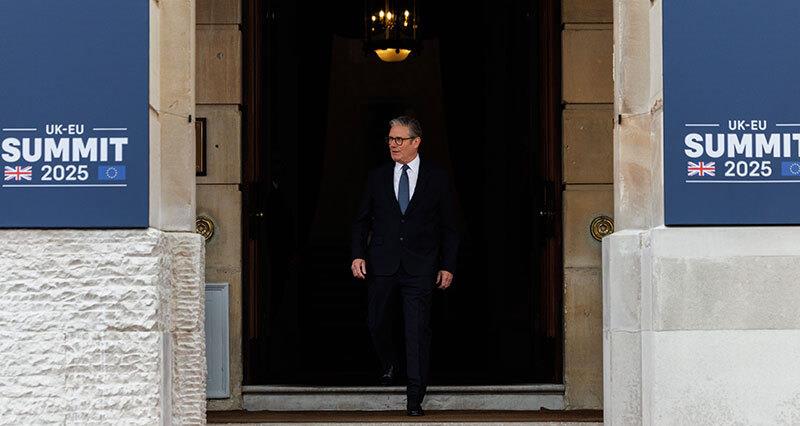
Photograph: Simon Dawson / No 10 Downing Street
NFU responds to the government's consultation on its trade strategy
From July onwards the NFU’s International Trade team lobbies the government to pursue an equivalency based SPS agreement with the European Union.
This includes submitting a response to the government’s trade strategy consultation, which also urged government to be cautious of agreeing “at all costs” to the terms of an ambitious SPS agreement and stressed the need for full consultation with industry.
NFU position on a Sanitary and Phytosanitary agreement
The NFU adopts a formal position calling for any future veterinary or SPS agreement to be based upon mutual equivalence of regulations.
This would recognise the UK’s unique starting point of largely continued alignment with EU regulations and minimise trade frictions while retaining domestic legislative autonomy.
The NFU starts lobbying Defra on the need for equivalency in a future SPS agreement with the EU.
Labour Party manifesto
In June 2024, the Labour Party publishes its general election manifesto. This contained a commitment to seek to negotiate a veterinary agreement with the European Union “to prevent unnecessary border checks and help tackle the cost of food”.