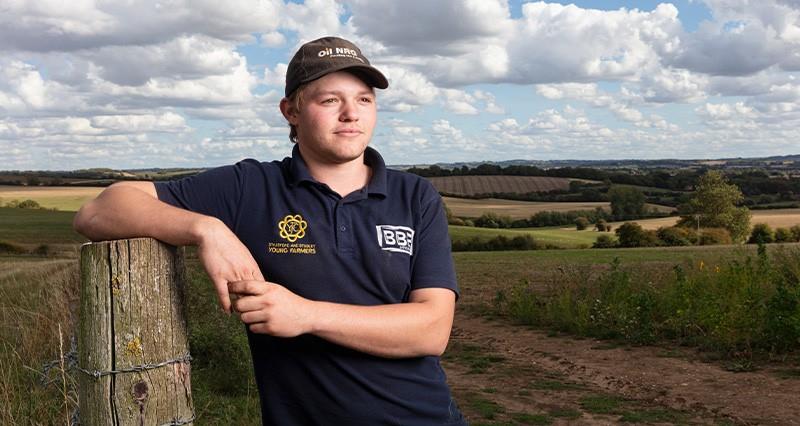
Life of late for farmer Jack Meadows has been one perpetual summer – but that’s not to say he’s had a holiday.
Early last year, Jack was scrolling on social media when he spotted a post from a recruitment agency looking for agricultural workers; and when he saw their employers were based in New Zealand, he knew this was the opportunity he’d been waiting for.
For years Jack had been telling his mates that he would “get out there” and see one of the ‘big three’ – America, Australia and New Zealand. So, after finishing up the harvest on his family farm near Stratford-upon-Avon, Jack jumped on a plane to the other side of the world and spent the latter months of the year doing contract work on arable farms, under the winter sun.
Speaking about his adventures, it’s clear the bright weather has rubbed off on him as he beams from ear to ear. “It was one of the best experiences I’ve ever had,” he says. “It was a real opportunity to go and see the world, and to see how they do things out there.”
Kiwi approach to crops
Jack’s partner farms were based on New Zealand’s North Island (Te Ika-a-Māui), which is renowned for its dairy, sheep and beef farming – as well as being home to an abundance of vineyards and fruit farms. Having worked with his father and grandfather on an 800-acre arable farm, mainly growing wheat, barley and oilseed rape, Jack was keen to learn the Kiwi approach to crops.
“What I found really interesting was how they would take a grass cut for silage off in September/October before breaking it up to plant their maize. They would then replant the grass back after silaging in March,” he explains.
“It’s a different approach to what we use. Sometimes here in the UK, it is possible to use an over-winter cover crop before maize, but very often a field gets left fallow and unproductive.”
Working mainly on grass and maize, Jack absorbed as much as he could from the experience and now has several bright ideas to apply to the family farm.
“It got me thinking about how we use cover crops,” he explained. “What we’ve found is that, with oilseed rape, if you plant it at the start of July then we tend to avoid the worst effects of flea beetles. They’re one of the big killers of oilseed rape, so it’s important to miss their period of high activity. However, there’s an obvious issue with this plan; planting in July is tricky as most years you haven’t even started harvest, and you need a fallow field to plant rape.
“When I was younger, all I wanted to do was farm. To be honest, I still don’t want to do anything else. The hard times can be really challenging, but it’s all part of the process.”
Jack Meadows
“I like the idea of having grass on the field that you can profit off, taking a cut for silage or hay or whatever you want, and then breaking it up and getting the oilseed rape in the ground for next year. It means, in theory, that we should have a better crop and we won’t need to leave the fields fallow, not producing any money.
“I’m yet to get Dad on board with the idea, so it might stay a plan for a while,” he laughs. “We’ll see how it ends up.”
Challenging harvest
While skies were blue down under, the UK experienced a particularly wet winter. Jack returned home in mid-April to find that some of their winter crops had stunted in their growth or died off altogether.
Spring and summer couldn’t provide any solace. Hot, dry weather – which led to drought and even wildfires for some parts of the UK – has had a significant impact on their latest harvest yields. Moisture in the ground from the wet winter months burnt off so quickly over the spring that, in Jack’s words, “it’s been a struggle to grow anything”.
When I spoke to Jack, he and his family had just finished up in the field for the season, and the outlook for this winter and next year remains uncertain.
“Grass crops that dairy need for sileage have been particularly affected,” Jack explains. “I’ve heard some businesses are about 30-40% down on what they should be at this time of year, which is quite substantial. How they are going to make up the difference for this winter… I don’t know.”
Their shed, Jack says, is also looking a little bare. “It’s a third full – and that includes the machinery parked in there,” he jokes with a grimace. Jack estimates that they are down 50% on straw yields and about 60% down on grain, compared to last year.
Many arable farmers across the UK have found themselves in a similar, tricky position. The latest data from AHDB suggests considerable variability in yields across the country, within regions and even farms. Commenting at the end of August, NFU Crops Board Chair Jamie Burrows said it had been “an extremely challenging harvest with some seeing better-than-expected yields, while others are facing significant drops, which will hit cashflows and put substantial financial pressure on their businesses”.
However, despite the challenges, it’s clear the bad weather hasn’t dampened Jack’s optimism, as he says, smiling: “We’ll plant the crops and hope that the weather comes right, as we always do.”
Passion for farming
Much of Jack’s confidence comes, he says, from his passion for farming. “I’ve never really thought of an alternative [to farming],” he explains.
“When I was younger, all I wanted to do was farm. To be honest, I still don’t want to do anything else. The hard times can be really challenging, but it’s all part of the process.
“I’ve heard some businesses are about 30-40% down on what they should be at this time of year, which is quite substantial.”
Jack Meadows
“A lot of my friends outside of the sector speak about how great their jobs are, that they have weekends off and that they get to go places with work. I think that’s great, but it still isn’t enough to tempt me to go and do an office job.
“I might be doing more work than they do, at least in hours, but I love it. It’s like they say, ‘if you love what you do, you’ll never work a day in your life.’”
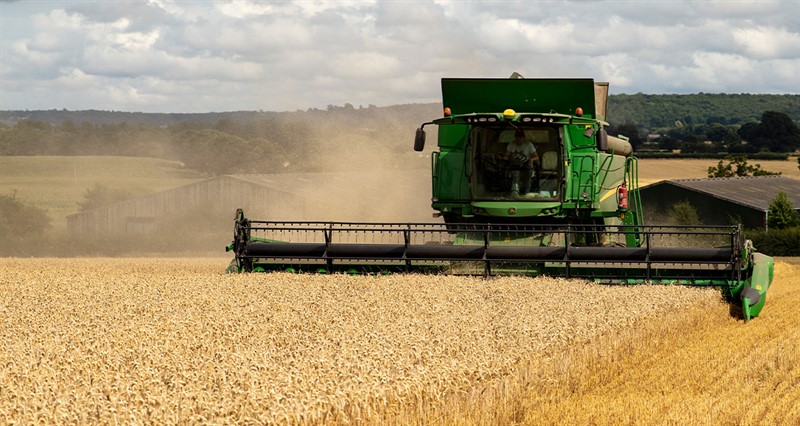
That is why Jack throws himself into any task that needs doing on the farm, whether its bailing, combining, mowing or doing maintenance work on machinery.
“I’m the youngest by quite a long way,” he says. “There’s me, my dad, my grandad and a farm worker – that’s our team. It means that I get to do a lot of different jobs and help where needed. It also means I’m the tech guy and they rely on me to keep up to date with what’s going on – particularly if there’s a new way to reduce costs.”
One of Jack’s latest projects involved using funding from the Sustainable Farming Incentive to get soil nutrient mapping technology set up on their tractors. Going forwards, the farm shouldn’t need to buy in as much fertiliser, which should, in theory, bring down costs and be better for the environment.
When it comes to future projects, Jack’s sights are set on another season abroad, but he insists that a permanent move there is off the table: “I’m going back to the same farms in New Zealand this winter to do another harvest, because it was so fantastic.
“If we decided as a family to sell up and get a farm out there, I’d move in a heartbeat; but I wouldn’t move there permanently myself. There’s so much for me here in the UK, it would be a lot to leave behind. I’ll stick to another summer out there for now.”