The report recommends the that the government increases the flood defence budget to at least £1.5 billion per year by 2030.
It states: ‘Without a shift from reactive to preventive spending, and from loosely coordinated action to clearly mandated delivery, future climate shocks will continue to impose avoidable costs on communities, infrastructure, and public finances.’
The report's publication follows an inquiry launched in December 2024 by the cross-party EAC (Environmental Audit Committee). As part of that inquiry, NFU Vice-president Rachel Hallos gave evidence, raising concerns about the lack of maintenance of flood management infrastructure.
She called for a clear, transparent strategy for water management, better engagement with local communities, and a proactive management plan for flood defence.
NFM and maintenance of existing infrastructure
The report recognises that farmers are part of the solution and echoes Rachel’s submission to the committee that farmers are willing to support NFM (Natural Flood Management) by hosting floodwater and using their land to reduce flood risk downstream.
However, they currently lack clear incentives and receive little formal recognition of these actions as public goods.
MPs call upon Defra to work with the EA (Environment Agency) and farming bodies to develop a standardised approach to compensate farmers for such actions. They have said that these efforts should be recognised as delivering public goods.
The report concludes that ‘nature-based solutions remain undervalued and underutilised in England’s approach to flood risk management’ alongside other engineered solutions and river maintenance work.
Long-term strategic plan needed
The NFU has also made it clear that farmers need confidence to deliver NFM projects on their land. Current, ELMs (Environmental Land Management schemes) don’t provide the certainty or support needed for long-term planning.
The report recommends that Defra, working with the Environment Agency, HM Treasury, and other key partners, should, ‘fully integrate nature-based solutions into flood, planning, and infrastructure policy by 2027, including economic support for landowners to incorporate flood resilience measures'.
NFU Vice-president Rachel Hallos also urged the government to introduce a long-term strategic plan for managing water scarcity and flooding events, taking a whole catchment integrated approach.
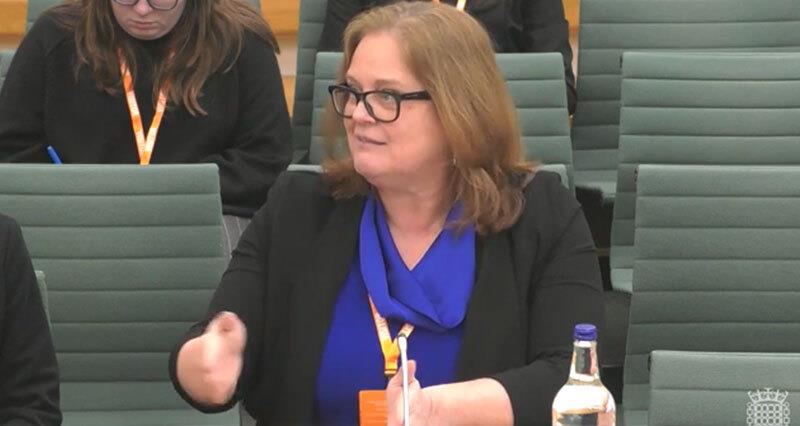
The report echoes this statement, and calls for a strategic approach that moves away from 'reactive, property focused schemes to long-term, locally led solutions at the level of entire river catchments, designed to reduce flood risk across communities and strengthen overall resilience'.
It adds: 'Above all, there must be clear government ownership of flood resilience, with a single overarching body providing national leadership, accountability, and coordination across agencies.'
It recommends making investment fairer, including for those in areas with fewer properties.
Schedule 3
One of the NFU's long standing asks is to enforce Schedule 3 of the Flood and Water Management Act 2010. This would make SuDS (Sustainable Drainage Systems) mandatory in all new developments. The report recommends bringing Schedule 3 into force in England ‘without further delay’.
This is part of a wider call for resilience to be embedded within planning, rather than the current system of just reacting after flooding happens.
Greater guidance and support
The report calls for clear guidance from the EA for riparian landowners on what they can and cannot do as well as the available support.
Rachel Hallos made this point during the inquiry. She said that better engagement is needed from the EA to reassure and educate members on the permitting process and their responsibilities.
Read the report in full at: Parliament.UK | Flood resilience in England.