At present, Great Britain holds equivalence status with the EU on organic products. However, under the future arrangement of dynamic alignment (where both countries agree on a single rulebook for certain areas of law), we will fully harmonise our regulations with the EU’s organic standards, including adopting any future amendments or updates.
EU organic legislation already applies directly in Northern Ireland under the Northern Ireland Protocol. Although the UK will no longer have voting rights within the EU’s regulatory processes, it will retain the ability to engage with and influence discussions through participation in relevant EU agencies and committees. Read more about the NFUs’ ask and approach to retaining influence.
What does dynamic alignment mean for trade in organics?
The key benefit of dynamic alignment moving forward will be the removal of the current requirement for Export Health Certificates, Phytosanitary Certificates and Certificates of Inspection when exporting organic products from Great Britain to the EU. This will reduce administrative burdens and simplify trade procedures for British producers.
How has EU organics legislation changed?
In 2022 the EU introduced a significant update to its organic regulatory framework. Due to the UK’s withdrawal from the European Union, this legislative update did not apply to GB organic producers. However, under the SPS agreement, it is anticipated that this legislation will become directly applicable in GB. The main changes include:
- Regulation (EU) 2018/848, which entered into full force on 1 January 2022, replaced the previous regulatory structure. Its scope has been expanded to include a broader range of products such as salt, cotton, wool, essential oils, rabbits, bees, and more.
- Group certification for small operators, as defined under Article 36, was introduced to simplify compliance for smaller businesses, with streamlined internal control rules. These uniform rules apply equally across EU and non-EU operators.
- Enhanced controls on traceability, compliance, and import checks, supported by a harmonised system and an updated list of recognised control bodies under Implementing Regulation 2022/2049.
- Revised production and labelling requirements, including stricter animal welfare provisions, promotion of seed diversity, limitations on permitted additives and flavourings, and clearer origin labelling obligations.
Sector by sector impact
Since the announcement, the NFU has been assessing the potential impacts to on-farm production under the SPS agreement. The NFU's food business unit team has been engaging with organic sector leads to understand the implications.
For all sectors other than poultry, the overall impact on day to day production is limited. However, the new regulation introduces clearer definitions, new thresholds, and more precise wording that producers should be aware of.
Concerns for organic laying hens
A key area of concern has been organic poultry and protecting two key derogations:
- The reliance upon the derogation that allows the use of non-organically reared pullets for egg production up to 18 weeks of age.
- The potential future loss of the 5% non-organic protein feed derogation for pigs and poultry.
EU legislation generally requires that organic livestock must be hatched and raised in accordance with organic production rules, with an exception possible for pullets under 3 days old.
In GB, there are no fully organic commercial pullet rearing facilities.
All organic laying farms therefore rely on pullets reared indoors under controlled health and biosecurity conditions, which are transferred to organic sites at the point of lay (around 18 weeks). From that point of transfer, the birds are then raised as organic laying hens. This system is maintained to ensure the health and welfare of the bird as well as to allow for critical vaccinations against diseases such as salmonella.
We are concerned that through dynamic alignment with new EU regulations producers in GB could lose access to the current derogation that makes this production system possible.
Rearing pullets organically from a day old is not currently possible within the GB organic poultry sector and would endanger the supply of domestic organic egg production.
The NFU is lobbying the government to protect the current derogation within the SPS agreement to allow non-organically reared pullets to be used in organic egg production in GB. Defra has confirmed the derogation will remain in place until December 2026.
The EU legislation also requires all organic livestock to be fed a 100% organic diet, though an EU derogation allows the use of up to 5% non-organic protein feed when organic protein feed is unavailable in sufficient quantities, and for piglets under 35 kilograms and young poultry. In GB, Defra has announced its intention to mirror the same derogation. However, both the EU and GB derogations are due to expire in December 2026.
Maintaining this derogation in the future, beyond December 2026, is critical to ensuring the welfare and productivity of organic poultry diets. This small proportion of non-organic protein feed, typically maise gluten or other protein concentrates, provides essential amino acids that are otherwise unavailable from organic sources.
Therefore, the NFU is lobbying the UK Government to look to preserve the current 5% non-organic protein feed derogation which applies to feeding piglets under 35 kilograms in weight and young poultry (under 30 weeks of age).
Poultry housing requirements
The updated EU regulation also introduces more detailed requirements for organic poultry housing, including perching, stocking densities, access to open air areas, and compartment design. These changes may create additional costs for some producers, particularly around perching for fattening poultry.
The section below summarises the key housing rules and parameters set out in the legislation.
Perches and raised sitting levels
Perches or raised sitting levels must be provided from a young age, in dimensions or proportions appropriate to the size of the group and the birds, as set out in Part IV of Annex I.
For fattening poultry (Gallus gallus) the following housing requirements under EU legislation are:
- Indoor stocking density: 21 kg liveweight/m².
- Perches/raised sitting levels.
- Minimum 5cm perch per bird, or minimum 25 cm² raised sitting level per bird.
- Outdoor area (fixed houses): 4 m² per bird.
- Outdoor area (mobile houses): 2.5 m² per bird.
Access to open air areas
- Pop holes must have a combined length of at least 4 m per 100 m² of indoor area.
Poultry houses with verandas (it’s not mandatory to have verandas)
- Pop holes from the indoor house to the veranda must have a combined length of at least 2 m per 100 m².
- The usable area of the veranda does not count towards indoor or outdoor stocking density calculations.
Subdivided poultry houses
For houses subdivided into separate compartments:
- Compartments must restrict contact between flocks.
- Birds from different flocks must not mix.
- For fattening poultry other than Gallus gallus, compartments must be separated by solid partitions from floor to roof.
Maximum flock size
For poultry houses subdivided into separate compartments in order to house multiple flocks, compartments should ensure that contact with other flocks is restricted and that birds from different flocks cannot mix in the poultry house.
Article 15, point 3 outlines the rules on maximum flock size.
The following maximum flock sizes in a single compartment of a poultry house shall apply:
- 3,000 parents Gallus gallus
- 10,000 pullets
- 4,800 fattening poultry Gallus gallus
- 2,500 capons
- 4,000 poulardes
- 2,500 turkeys
- 2,500 geese
- 3,200 male Peking ducks or 4 000 female Peking ducks
- 3,200 male Muscovy ducks or 4 000 female Muscovy ducks
- 3,200 male Mulard ducks or 4 000 female Mulard ducks
- 5,200 Guinea fowls.
Organic livestock and dairy
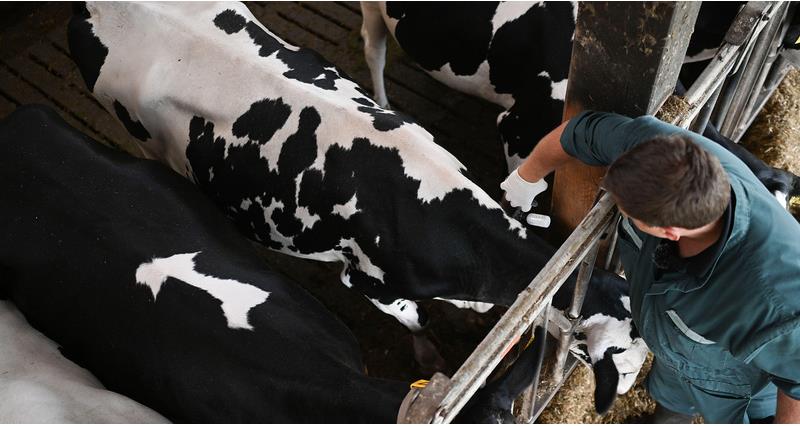
Access to pasture and animal welfare
The updated EU regulation strengthens expectations around outdoor access. It states that livestock must have “permanent access to pasture whenever conditions allow or permanent access to roughage”.
For most GB producers, this reflects existing practice. Access to pasture is already embedded in dairy contracts, welfare standards, and consumer expectations. The regulation also recognises that outdoor access is not always possible, allowing flexibility during:
- Poor weather.
- Unsuitable ground conditions.
- Situations where welfare would be compromised.
Case-by-case authorisations for routine practices
The regulation introduces a new requirement for certain routine husbandry practices – including tail docking of sheep, beak trimming in the first three days of life, dehorning, and disbudding – to be approved individually and only when justified by welfare, hygiene, or worker safety.
These interventions are long established in GB and widely recognised as important for both animal and human welfare, for example:
- Disbudding and dehorning to prevent injuries to cattle and handlers.
- Tail docking in lambs to reduce the risk of fly strike.
These practices are already governed by veterinary guidance and welfare codes. Requiring individual approval each time introduces significant administrative challenges:
- Disproportionate bureaucracy for small farms.
- Potentially dozens of approvals for larger farms.
- Delays that could compromise animal welfare.
The NFU has highlighted these challenges and called for a more proportionate, approach that maintains welfare standards without requiring repeated case-by-case authorisation.
Origin of organic livestock
The updated EU regulation states that organic livestock must be “born or hatched and raised on organic production units, without prejudice to the rules on conversion”.
This replaces the previous requirement that animals be “born and raised on organic holdings”.
The rules on conversion have not changed under the EU legislation, but it is worth noting the change. Farms may continue to bring in conventional young animals for breeding when establishing a herd or flock, provided they undergo the required conversion period and are reared organically from weaning.
Age limits remain unchanged:
- Cattle, equines, and deer: under 6 months.
- Sheep and goats: under 60 days.
This flexibility remains essential given the limited supply of organically-bred livestock in Great Britain.
Re-stocking percentages
Regulation (EU) 2018/848 has formal re stocking limits. While the percentages themselves are not concerning, their inclusion is important for producers to note.
A key derogation remains in place; under point 1.3.1 of Annex II, non-organic animals may be used to renew or reconstitute a herd or flock in cases of high mortality or when organically reared animals are not available. This remains vital for hardship cases such as TB-related restocking.
The regulation now sets specific limits:
- Non-organic young animals may be introduced for breeding when a herd or flock is being established for the first time.
- Up to 10% of adult equine or bovine animals may be renewed using non-organic adult males or non-organic nulliparous females.
This 10% limit may be increased to 40% with approval from the competent authority if:
- The farm undergoes a major extension.
- The farm replaces one breed with another.
- A new livestock specialisation is introduced.
Feed percentage requirements
The updated EU regulation also changes the required proportions of organic, regional, and in-conversion feed. These adjustments aim to strengthen local sourcing and support organic feed supply chains.
Key changes include:
- At least 70% of feed must come from the farm itself or the same region (previously 60%).
- Up to 25% of rations may come from second year in conversion feed (previously 30%).
- Up to 20% may come from first year in-conversion feed if sourced from the same farm.
- Combined in-conversion feed must not exceed 25%.
Crop and horticulture inputs
Organic crop and horticultural production is also affected by updated specifications under Regulation (EU) 2018/848. Based on discussions with industry stakeholders, we do not anticipate disruption to supply chains or additional costs for producers. But several input materials now have revised thresholds or have clarified wording.
The following section outlines the key products affected and the updated requirements producers will need to be aware of.
Key products:
- Seaweed and seaweed products.
- Soft ground rock phosphate.
- Aluminium calcium phosphate.
- Basic slag.
- Gypsum.
Seaweed-based inputs
Seaweed plays a vital role in organic horticulture. Under the revised EU regulation, only seaweed that is either organically produced or harvested in a sustainable manner (as outlined in point 2.4 of Part III, Annex II) may be used.
Phosphate-based fertilisers
Inputs such as soft ground rock phosphate, aluminium calcium phosphate, and basic slag are now subject to revised thresholds, requiring:
- Higher percentages of P₂O₅.
- Reduced particle sizes.
Sulphate (Gypsum)
Used widely as a soil conditioner, calcium sulphate will now need to meet:
- Higher concentrations of CaO and SO₃.
- Finer particle specifications.
Ethylene use in organic production
What has changed?
Under the Regulation (EC) 834/2007 and Regulation (EC) 889/2008, ethylene was authorised for a wide range of post harvest purposes.
Under the new EU legislation, the permitted uses of ethylene have been significantly reduced.
Uses no longer permitted in the EU
The following ethylene applications were previously allowed but are not included in the new EU organic rules:
- Ripening other climacteric fruits (except bananas).
- Sprout suppression in onions.
- De leafing in ornamental crops.
Because these uses were not carried forward into the new regulation, they are no longer authorised in EU organic production.
Where can ethylene be used?
Ethylene continues to be permitted in the EU for sprout suppression in potatoes.
Who is affected?
These changes may impact:
- Growers and storage operators using ethylene for onion sprout suppression.
- Ripening facilities handling organic tomatoes and pears.
- Packhouses using ethylene to achieve uniform ripening.
Next steps
The regulatory landscape continues to evolve. The team at BAB, alongside the NFU’s organic sector lead, Cara Rhodes, are closely monitoring developments.
Led by the NFU’s International Trade Team, we also continue to proactively lobby and engage the government to ensure that the SPS deal reached is the best possible outcome for our members.
Detailed guidance and updates will be provided on this page as further information becomes available.