Announcing the NFU’s key asks, NFU President Tom Bradshaw said: “Ultimately, this deal should enable smoother trade with our largest trading partner. Alignment in many areas will help remove friction and unlock trade. But there are some areas which need to be treated carefully to minimise disruption to Britain’s farming sector and some which need to be excluded completely.
“We have given clear direction to the government’s negotiating team on what we believe is needed to benefit British food production and farm businesses. At the centre of this are appropriate transition periods specific to individual policy areas and some necessary exemptions to help safeguard areas of progression and innovation.
“It’s important we get this right, so British farmers aren’t unduly bound by rules which restrict our ambitions for food production. Alongside securing necessary exemptions, it’s vital that the UK has a meaningful role in the rule-shaping process in the future and that the voices of British farmers and growers are represented in future discussions.
“It’s up to the government now to back its farmers around the negotiating table and we’ll continue to work with them as talks progress.”
Keep track of our lobbying work as negotiations between the UK and EU on an SPS (Sanitary and Phytosanitary) agreement progress.
UK-EU SPS negotiations timeline
NFU sets out asks for SPS agreement in EU Reset talks
The NFU is asking the UK Government to secure a variable paced, transitional arrangement with phased commencement dates for alignment. This will mean distinguishing between areas where trade barriers could be removed quickly, such as for the imports of key horticultural inputs, and those which require a greater time to adjust, such as rules around plant protection products which have diverged from the EU since Brexit.
The NFU is also asking for some exemptions from dynamic alignment. These include enabling continued access to precision breeding technologies and the ability to continue our bovine TB cattle vaccination programme, as well as technical adaptations within EU regulations for mycotoxin contaminants.
Use the links below to navigate around our key asks:
NFU updates its priorities
Following further engagement with the NFU’s national commodity boards, the UK Government, and the European Commission, the NFU’s Food, Farming and Environment Board adopts an updated set of negotiating priorities for the UK-EU SPS agreement.
NFU Council briefed
NFU International Trade team and BAB brief NFU Council on the latest developments with the UK and the EU and the NFU's lobbying priorities in the negotiations.
Negotiations begin
On 19 November, formal negotiations on a Common Sanitary and Phytosanitary Area begin between the UK and the EU. Both sides express a desire to negotiate at pace.
NFU sets out negotiating priorities
Following the Common Understanding and engagement with the UK Government and the European Commission, the NFU’s Food, Farming and Environment Board adopts a set of negotiating priorities for the UK-EU SPS Agreement, reflecting the government’s decision to negotiate an agreement premised upon dynamic alignment.
The NFU engaged extensively with the government on these priorities prior to the beginning of formal negotiations between the EU and the UK.
NFU meets with negotiators
NFU officeholders, national commodity board chairs and senior staff meet with UK Government negotiators to discuss the outcomes of the Common Understanding and highlight key negotiation priorities for farmers and growers.
Common Understanding document agreed
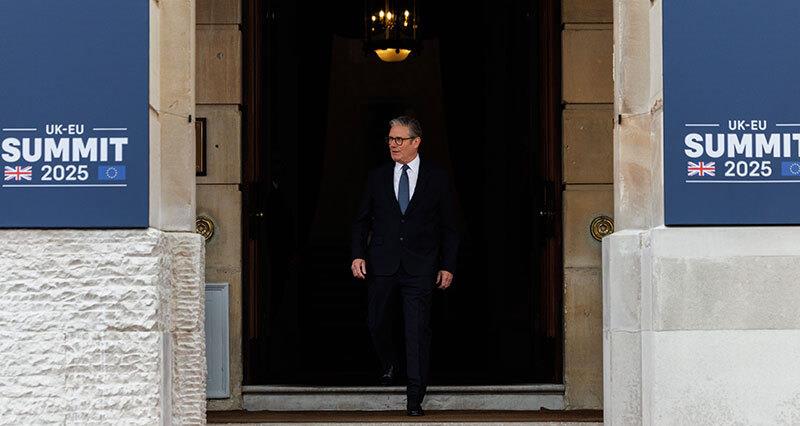
On 19 May 2025, a Common Understanding document is agreed by the EU and UK in London.
It sets out the parties’ intentions to agree a Common Sanitary and Phytosanitary Area to reduce agri-food trade barriers through the principle of dynamic alignment with EU rules.
The NFU acknowledges that the future SPS agreement will not be based on equivalency and communicates with its members on the impact of this decision.
Photograph: Simon Dawson / No 10 Downing Street
NFU responds to the government's consultation on its trade strategy
From July onwards the NFU’s International Trade team lobbies the government to pursue an equivalency based SPS agreement with the European Union.
This includes submitting a response to the government’s trade strategy consultation, which also urged government to be cautious of agreeing “at all costs” to the terms of an ambitious SPS agreement and stressed the need for full consultation with industry.
NFU position on a Sanitary and Phytosanitary agreement
The NFU adopts a formal position calling for any future veterinary or SPS agreement to be based upon mutual equivalence of regulations.
This would recognise the UK’s unique starting point of largely continued alignment with EU regulations and minimise trade frictions while retaining domestic legislative autonomy.
The NFU starts lobbying Defra on the need for equivalency in a future SPS agreement with the EU.
Labour Party manifesto
In June 2024, the Labour Party publishes its general election manifesto. This contained a commitment to seek to negotiate a veterinary agreement with the European Union “to prevent unnecessary border checks and help tackle the cost of food”.