
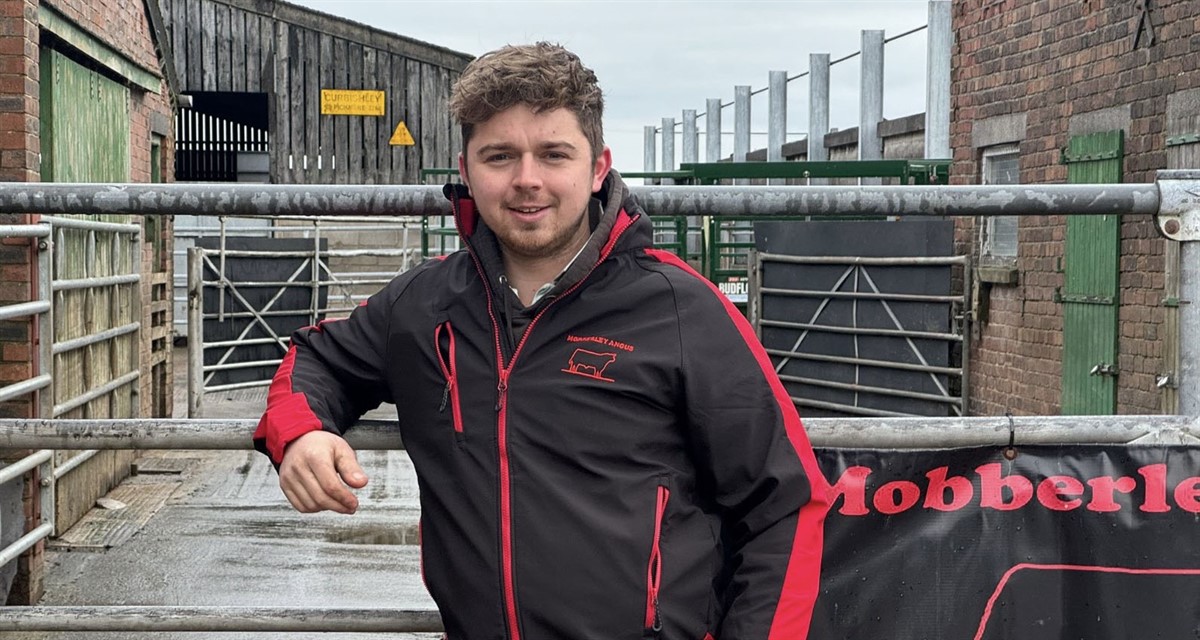
Despite not coming from a farming family, I have been fortunate to be part of the Mobberley Angus team for the past 13 years. The farm has clearly demonstrated the wider social benefits that farming can provide, yet these often go unrecognised by the general public on a daily basis.
Mobberley Angus gave me, as a new entrant, the opportunity to join a forward-thinking agricultural business and progress into a management role alongside my position as a farm business consultant at Harvey Hughes Rural Consultants. I have been involved not only in day-to-day decision-making but also in shaping long-term strategy. While I recognise how fortunate I have been, I firmly believe there is vast opportunity for new entrants to make a lasting impact within agricultural businesses. New entrants bring fresh thinking, challenge traditional practices, and harness accountability for existing business decisions, to ensure farms continue evolving alongside the wider agricultural industry.
During my time at Mobberley Angus, further opportunities arose to establish a small agricultural contracting enterprise, providing a round-baling service as our farming system developed. The transition to an outwintering system, utilising unwrapped hay bales, required investment in a round belt baler. This aligned with our commitment to reducing farming inputs and minimising plastic waste. Since then, the contracting business has grown, attracting like-minded clients seeking to simplify winter management while reducing input costs and labour demands.
Over the past 13 years, the farm has transitioned from a traditional 60-head suckler herd, operating set-stock grazing and relying on artificial fertiliser, to a low-input, forage-based system. Today, we calve 130 pedigree Aberdeen Angus cows within a holistic grazing framework, incorporating herbal leys across much of the farm and significantly reducing reliance on livestock housing. The result is a resilient farming system with minimal exposure to external inputs, as such artificial fertiliser has not been purchased for six years.
In our view, resilience stems not only from efficient livestock growth from forage, but more importantly from nurturing soil health and natural capital. By enhancing the ecosystems that work in partnership with our farming system, we are producing sustainable outputs with long-term viability.
Custodians of the land
I strongly believe the positive impact farming businesses have on the countryside often goes unnoticed by the general public. Yet the rural economy depends on farmers as custodians of the land, maintaining and enhancing landscapes for future generations. Whether it is cutting hedges bi-annually, applying nutrients responsibly, or maintaining habitat margins and buffer strips, these everyday actions contribute significantly to environmental stewardship — even if they rarely receive recognition.
One of the great strengths of UK farming is that no single system fits all. Every farming business is unique and, in its own way, contributes to the environmental and social benefits agriculture provides. From supporting trainee farm vets during lambing to offering opportunities to new entrants, farmers are continually shaping the future of the industry and positively impacting lives, often without fully realising it.
From my own experience as a new entrant, I have seen how farming businesses can evolve, support others and strengthen the communities around them. The benefits are vast both economically, environmentally and socially. As farmers, we should not shy away from telling that story.