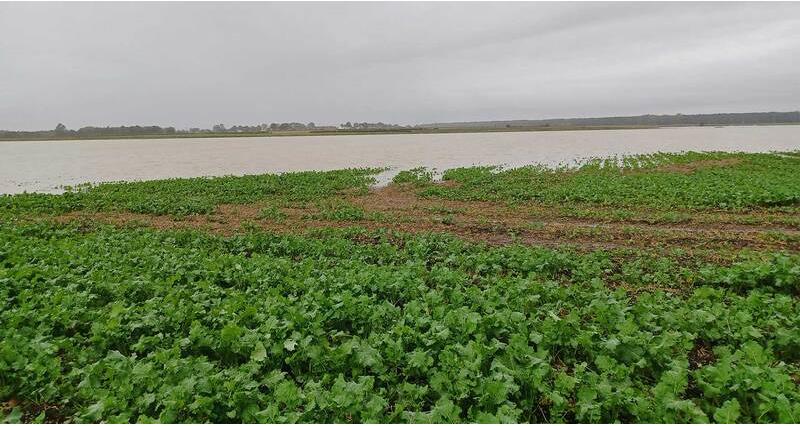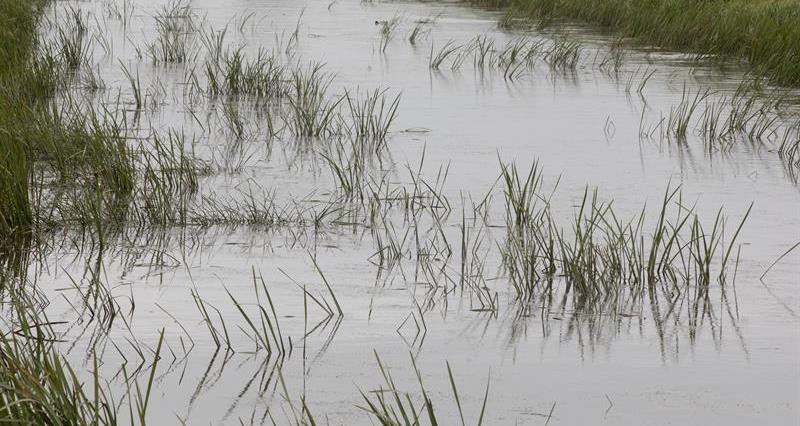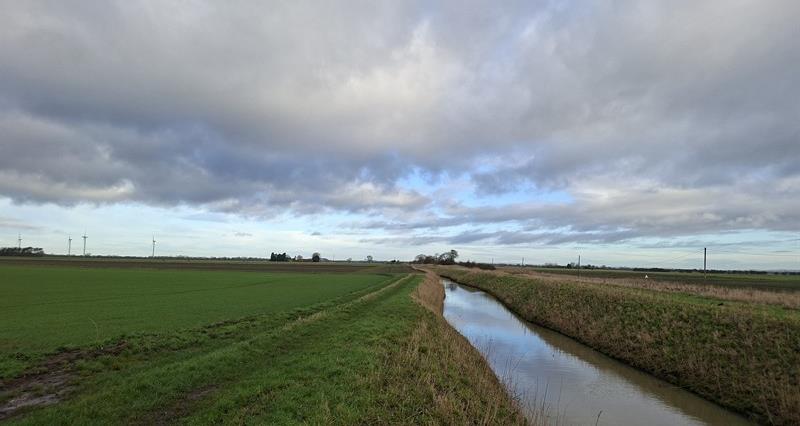
The NFU has had a long-standing ask for a review of the flood funding formula and we welcome the new approach outlined by the government.
The EA (Environment Agency) has now published the new guidance, which you can read in full at: GOV.UK | Applying the 2025 FCERM (Flood and Coastal Erosion Risk Management) funding policy: new project opportunity guidance and resources.
On this page, we outline what projects you can apply for funding towards, and how the application process will work.
Funding for natural flood management
The guidance is broken down into seven sections, including a strong focus on NFM (natural flood management), as NFM is seen as a way of reducing flood risk while also delivering multiple benefits to people, communities and the environment.
To support this, a minimum of 3% of FCERM investment will go towards NFM over the first three years and a minimum of 4% over the next 10 years (at least £300 million in NFM over 10 years).
The guidance doesn’t just apply to traditional RMAs (Risk Management Authorities), including the EA, local authorities, water companies and internal drainage boards, but now also includes non-RMAs. This now includes non-governmental environmental organisations, charities and landowners who can lead NFM projects.
When to apply
The next investment programme will open in 1 April 2026. The Environment Agency is hosting a number of webinars starting in early May to explain more and is expecting projects to start to be submitted from July 2026.
Throughout spring and summer 2026, further support materials will be released through a new Engagement HQ site for non-RMA NFM delivery partners.
Eligible natural flood management projects
NFM ‘standalone’ projects include interventions that protect, restore, or mimic the natural functions of catchments, floodplains, rivers and the coast to reduce flood risk.
These include river and floodplain management, woodland management, run-off management and coast and estuary management. Standalone NFM is where a flood risk reduction relies primarily or entirely on natural processes and is not in combination with an engineered defence.
NFM projects must:
- have maintenance plans with funding options in place, as this will not be funded through the FCERM investment programme
- have landowner support and agreements secured or close to being secured
- use LNRS (local nature recovery strategies) to identify opportunities and maximise the environmental benefits of NFM projects.
Where any of the eligible NFM interventions integrate with, or operate alongside, hard‑engineered flood or coastal defences, the project must be submitted as an in-combination project and process and not follow the standalone NFM process.
NFM interventions include:
- River restoration – eg, re-meandering, removing man-made features or reintroducing braided channels.
- Floodplain and floodplain wetland restoration.
- Leaky barriers.
- Offline storage areas.
- Woodland management.
- Run-off management.
- Saltmarsh and mudflat management.
- Sand dune management.
Ineligible interventions include:
- Construction of hard engineered flood and sea defences.
- Soil and land management.
- Other sustainable drainage.
- Beaver reintroductions.
- Beach nourishment.
- Submerged aquatic vegetation – eg, seagrass.
Nature-based credits
To calculate NFM benefits, the EA has produced a national NFM benefits method to calculate the surface water and river flood risk reduction and wider benefits.
Nature‑based credits (biodiversity net gain units or carbon credits) arising directly from NFM measures funded by the FCERM investment programme may be sold. These will help to secure additional project contributions to do more or fund future maintenance.
New mapping to determine flood-risk
To help target NFM measures to provide the greatest flood risk benefits, the EA has produced a set of national NFM heat maps. These maps will be improved as more evidence becomes available. This will be critical, as the current maps do not take account of:
- local features such as pumped catchments, washlands, large reservoirs, roads
- other local infrastructure including flood risk management assets.
This new dataset is therefore likely to help prioritise natural flood management placement and the early stages of project development. Farmers can access the maps online, and explore their local present day flood risk, possible surface water risk and the impacts of climate change.
The heat maps are available on the Defra Data Services Platform in:
- PDF format, organised by RFCC (regional flood and coastal committee) and Environment Agency area
- GIS (geographical information system) layer.
Asset refurbishment
Asset refurbishment can now be fully funded from FCERM GiA (grant in aid), if eligible for investment where significant renewal to one or more components in an existing asset is required.
This covers issues that asset maintenance cannot manage and that would be significant and permanent if not fixed. However, this does not include asset replacement.
Sustainable drainage projects
Otherwise known as SuDS. These projects that help manage surface water run-off are also eligible and can be used in combination with standalone NFM measures.
Coastal erosion projects
These projects are also eligible for funding where they are directly associated with the sea, such as beach nourishment (also referred to as beach recharge) when required to prevent an unacceptable reduction in the performance of the asset.
Where the intervention is not manageable through routine maintenance activities, this shall be classified as asset refurbishment.
Competitive funding
The EA is keen to reiterate that it is expecting more projects that are eligible for investment than there is funding available.
Projects will need to be prioritised based upon:
- value for money (prioritising projects with contributions from others)
- how they support economic growth
- speeding up building flood and coastal erosion schemes that reduce flood and coastal erosion risk
- how they support deprived areas, and protect homes, businesses and agricultural land across towns, cities and rural areas.
Value for money will form a critical part of any proposal, and projects will need to ensure they follow the value for money principles defined in the Green Book. Calculating benefits remains the cornerstone of the approach to FCERM funding. Higher benefits in terms of damages avoided usually applies to projects in places at higher risk of flooding, erosion, or both, and with a higher density of properties and infrastructure, and calculates the return on government investment (net present value) divided by the total Defra FCERM funding.
In addition, projects will be assessed against strategic objectives, including additional contributions (co-funding), deprivation and NFM aspects.
Projects that use FCERM investment money to attract extra contributions from public, private and charitable partners are more likely to be taken forward.
Flood and erosion benefits now include agriculture damages – ‘avoided damage to crops and agricultural land – the FCERM appraisal guidance for agricultural land takes account of individual floods, long term change and total loss of agricultural land – the damage values are updated annually, agricultural damages can be combined with ecosystem services damages to build a holistic picture of the impact on the land’.