Food security and fertiliser are inextricably linked.
Fertiliser is a key product in enabling farmers to reliably produce enough food to feed our population at scale, at pace and at an affordable price.
The conflict in the Middle East has brought that into sharp focus as farmers are left exposed to global price shocks, leading them to question future planting decisions.
This raises questions for food production as the price and availability of fuel and fertiliser continues to remain uncertain.
“This is more than a short-term shock; it has exposed a structural vulnerability to growing food.”
NFU Deputy President Paul Tompkins
More than a short-term shock
The war has led to the effective closure of the Strait of Hormuz, a key shipping lane carrying around 20% of the world’s oil and gas shipments and one fifth of the world’s global ammonia and urea supplies, sending shockwaves through global markets.
Global oil prices have surged as high as $120 barrel with red diesel prices swiftly following suit; NFU members have been reporting prices anywhere between 92 pence per litre to 138ppl since the start of the conflict.
Meanwhile, fertiliser prices have shot up by 32% (£404/t to £535/t) for AN and 44% (£455/t to £653/t) for urea since late February.
Natural gas accounts for 60%–80% of nitrogen fertiliser production costs and UK gas prices peaked at over 150 GBp/therm in March, roughly double pre-Iran conflict levels.
This is more than a short-term shock; it has exposed a structural vulnerability to growing food. We import 60% of our nitrogen, and, since the closure of our last ammonia plant in 2022, we are entirely reliant on imported ammonia feed stock in order to produce fertiliser at home.
An evidence-led approach
Despite these pressures, the role of fertiliser in UK food production is not up for debate. Our temperate climate, combined with efficient and effective use of fertiliser, allows us to achieve some of the highest wheat yields in the world.
If we are to continue to feed 70 million people every day, while using land efficiently as Defra’s recently published Land Use Framework demands, fertiliser remains essential to a resilient domestic food production system.
It is important to recognise that organic practices play an important role in supporting nutrient management planning and the wider circular economy, however, they cannot deliver the required yields alone. Research has shown that an integrated approach, using a combination of organic and mineral fertilisers, delivers higher yields than using either in isolation.
Also, precision and timing matter as much as volume to ensure we are maximising our yield returns while protecting the environment and land that we farm.
Trial and error approach to farm system transformation
At times of pressure, adopting alternative approaches is often suggested but is not straightforward.
Changes to farming practices require time, investment and a long-term commitment that is understood and supported by the wider supply chain, all while maintaining food supply.
For example, organic manures deliver genuine soil benefits and have an important role to play, but their nutrient release is slower and less predictable, and they work best as part of a planned, integrated nutrient management system.
Local conditions such as soil type, available markets, weather conditions, and viability of livestock integration will ultimately impact outcomes and productivity.
Economic pressures will always mean that farmers will strive to make better use of nutrients and it makes sense to always ensure manufactured fertiliser is used efficiently.
Farm business confidence ‘fragile’
The agricultural sector has already made significant progress in nitrogen management, with 57% of farms having nutrient management plans in 2024. Nitrogen fertiliser use has fallen by 50% since 1990, and nitrogen fertiliser balance has reduced by over a third during the same period.
But progress depends on confidence and right now, that confidence is fragile.
Compared to farmers in Europe and the US, English farmers have very little in terms of policy resilience from government to buffer them from shocks.
The last time we experienced price shocks at this scale was during Russia’s invasion of Ukraine four years ago. Back then, direct support was worth £1.4 billion. Today, as direct payments are phased out, delinked payments stand at just £20 million with a limit of just £600 per farm.
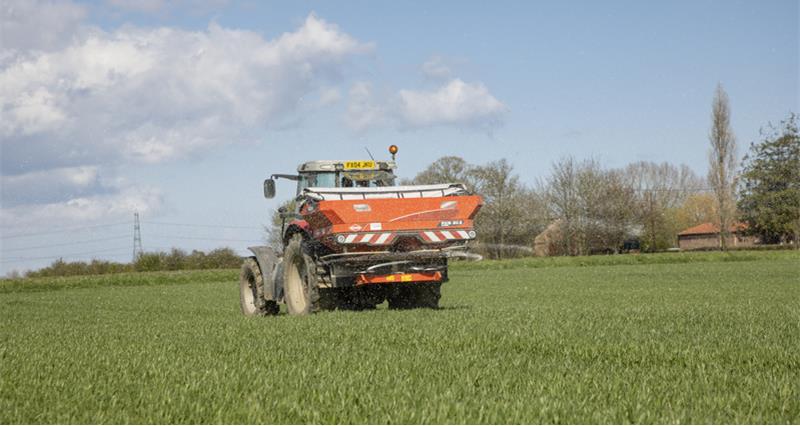
Meanwhile government plans to introduce a carbon border adjustment mechanism in January 2027 risk pushing up the cost of fertiliser, piling on more costs at a time of significant pressure. This is why the NFU has called for this tax on carbon emissions to be postponed, and for a market review to be conducted in 12 months’ time.
The solutions and the technology are out there. The Precision Breeding Act in England is one example of this, with the potential to develop drought-tolerant wheat and non-allergenic varieties. But businesses need the confidence to invest and the support of government so that we can make the most out of these opportunities.
One of our few certainties is that the world will be a less certain place for some time. Therefore, it has never been more important we focus on ensuring a secure, sustainable supply of food and that starts with recognising the essential role fertiliser plays in feeding the nation.