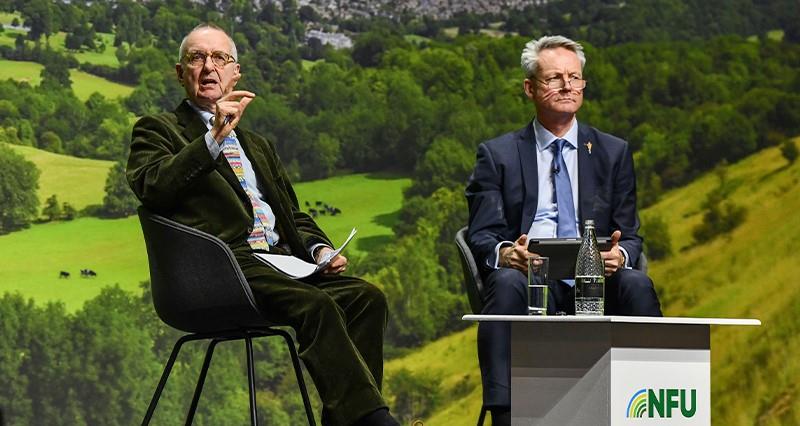
We cannot rely on current supply chains to produce our food and must build resilient networks, that was the message from Professor Tim Lang.
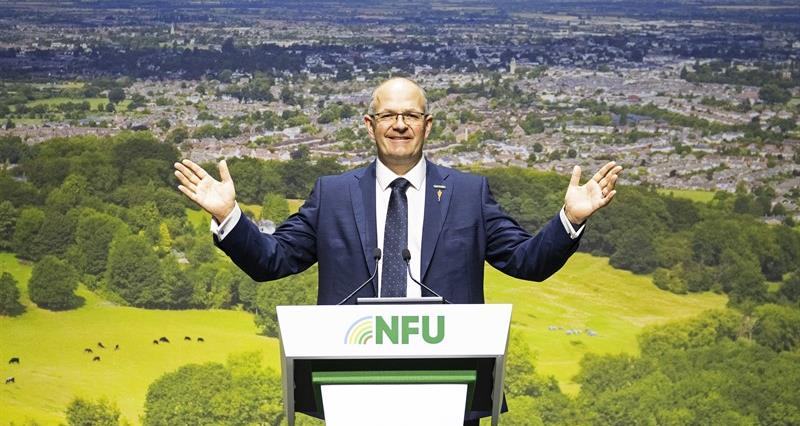
NFU Deputy President David Exwood said the question the first session posed – Are we taking food resilience seriously? – is one that feels increasingly urgent.
Prof Lang spoke about the fashion among analysts and economists who enjoy ‘disruptors’ to talk about ‘food shocks’.
In recent years, the UK food system has prided itself on being ‘just in time’ – especially during the Covid-19 epidemic. But now it needs to be less complacent, with a more ‘just in case’ mindset.

The number of food shocks the world is experiencing at present is being normalised and food is being weaponised in Gaza, Ukraine and Sudan.
Work to do
Prof Lang has spent two and a half years researching the Just in case: Narrowing the UK civil food resilience gap report, and his message to the farming community is “you have work to do”.
He said that Britain is about 60% self-sufficient in food production and we have shifted in 200 years from the empire feeding us to a more complex system of Europe feeding us. “The idea that others will feed us is hardwired into our psyche,” he said, adding that other countries are looking into storing food as a way of improving their resilience.
“The challenge I pose to you is could you feed your region if there was a shock?”
In a polycrisis world, Prof Lang suggests we need to move away from a supply chain based on consumer choice to one that looks at consumer needs – basically, simpler diets.
He points out that as society gets richer, people eat more meat – we have taken a feast day treat and made it into an everyday essential.
He said: “This does not mean a return to gung-ho, let-it-rip farming – environment is the infrastructure of food production, and we have a strong case for revisiting mixed farming.”
Food security and resilience act
NFU Poultry Board Chair Will Raw asked if he thought the government was taking food security seriously enough. The answer was a swift ‘no’.
Prof Lang replied that the government has identified one food risk in a list of 89 risks to British society. And the UK Government Resilience Framework puts all the onus on individuals taking action, which he described as ‘ludicrous’.
He said that the fact that our retail sector relied on 131 distribution centres made them a sitting duck in the event of a drone war.
“The NFU is going to find itself the champion of good food.”
Tim Lang, Professor Emeritus of Food Policy at the University of London
“I would like a food security and resilience act. We need to get real about storage, ‘just in time’ supply chains to ‘just in case’. We have to build redundancy back into systems – lean systems are vulnerable. We have to centre everything on the public.”
Prof Lang said we need to stop below-cost selling, build up food production and look into food storage.
Championing good food
In the Q&A session, horticulturalist Ali Capper asked where it left plain nutritious food in a world where food manufacturers were fortifying foods with weight-loss chemical GLP-1 rather than vitamins and minerals.
Prof Lang said that these drugs are reducing total demand for produce and the NFU is going to find itself the champion of good food.
Esther Rudge asked if there was still a place for the small family farm in a global network.
Prof Lang replied that a good thing about the family farm is its diversity. And what constitutes a small family fam in the UK is a huge one in sub–Saharan Africa, or southern France.
Meet the speakers:

David Exwood
NFU Deputy President (in post until 2026)
David farms south of Horsham in West Sussex with his wife and two sons over 1200 tenanted hectares in the heart of the Sussex Weald.
Starting in 1989 with 70ha the business now has arable, dairy beef, Sussex suckler herd and sheep enterprises. In 2003 the Farm Shop opened and sells a wide range of food from the Victorian stable yard at Westons.
He has served previously within the NFU as Branch Chair, West Sussex Council Delegate, South East Regional Chair as well as four years on Governance Board.
David was elected to the position of NFU Deputy President in February 2024.
Responsibilities
- EU and international relations
- Banking
- Biodiversity
- Food labelling
- Food safety
- Food service and hospitality
- Agricultural transition (productivity, ELMs, stability)
- Plant health
- Assurance schemes
- British Agriculture Bureau
- Health, safety and wellbeing
- Agricultural transport
- Uplands
- Tenants

Professor Tim Lang
Professor Emeritus of Food Policy, City St George’s, University of London
Since writing Feeding Britain (Pelican 2021), he’s focused on the state of civil food resilience, producing the Just in Case report for the UK National Preparedness Commission, urging more attention to public preparedness for food shocks.