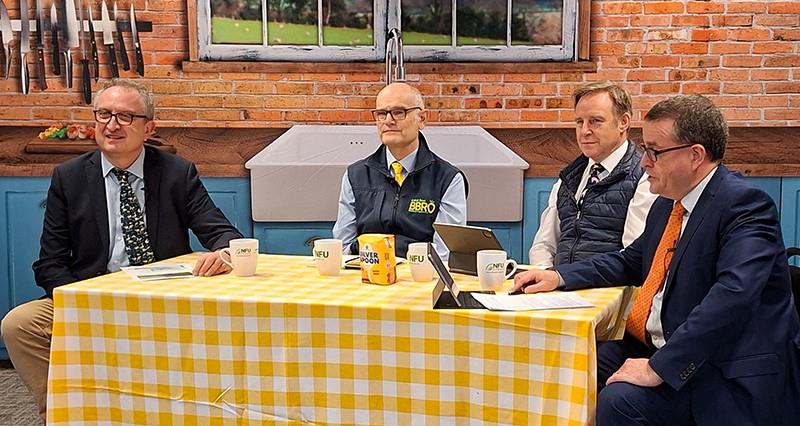
Chairing the session, Head of NFU Sugar Dr James Northen set the backdrop for the current challenges growers are facing. While 2025 was a good year for growers, it also brought with it much higher risks following Defra's decision to reject emergency authorisation for the use of Cruiser SB on sugar beet.
Now, in a post-neonicotinoid world, in the knowledge that Virus Yellows disease retains the potential to cause crop losses of up to 80%, the industry is asking the government to urgently look at its Virus Yellows resilience package and deliver additional support.
There have been promising developments across several areas, including gene editing, conventional breeding techniques and novel integrated pest management, but the industry now needs help to go further, faster.
“We are growing a crop with a much higher risk now,” said NFU Sugar Board Chair Kit Papworth. “When Minister Hardy said she wouldn’t grant the derogation for seed treatment, she committed to continuing to talk to us about our resilience package and to work with us as an industry, but those meetings just haven’t happened.”
Kit also cited concerns over the government’s recent decision to expand and extend the ATQ (Autonomous Tariff Quota) for raw cane sugar. The ATQ provides tariff-free access for sugar produced anywhere in the world which often derives a competitive advantage from having been produced in ways which simply would not be legal or possible in the UK.
This came as an extra blow to growers as they continue to contend with tighter regulation and an ever-diminishing plant protection toolbox.
What measures can growers take today?
Head of Scientific Endeavour at BBRO Professor Mark Stevens pointed to the multiple tolerant varieties on the BRRO Recommended List that are available for planting in the UK. “Varieties are coming and that’s really encouraging but all the other work that needs to support it through the integrated production system is critical,” he said. “The work we’ve done is looking at attractants, can we pull aphids away from sugar beet?”
Professor Stevens gave brassicas as an example, citing trials which have shown their capability to draw aphids away from sugar beet. “If you use inter-row barley as a windblow strategy, by turning the field green that can also dissuade the aphids,” he added. Spraying fields using different colours can also confuse aphids, making it harder for them to find the sugar beet crop.
“We are growing a crop with a much higher risk now.”
NFU Sugar Board Chair Kit Papworth
Climate pressures are exacerbating pest and disease challenges, the professor explained, not least beet moth. “The warm, dry conditions we had in 2022 and again in 2025 have led to this going from something we’d only look at in a textbook to having an impact on some of your farms,” he said.
The BBRO continues to monitor new pests and diseases, with its CropWatch network fundamental to pest surveillance.
Gene-editing solutions
The Precision Breeding Act, which came into force last year in England, has also meant that scientists can take advantage of gene-editing opportunities. A British Sugar-led consortium that the BBRO is involved in, alongside the John Innes Centre and Tropic Biosciences, is currently looking at making small edits within a sugar beet genome, ultimately to produce Virus Yellows resistant sugar beet.
The NFU has raised concerns that current negotiations on dynamic alignment between the UK and the EU must not result in these technological advances being lost, and continues to lobby for a carve-out on precision breeding legislation.
While gene-editing promises to deliver huge value for the sugar sector, Prof Stevens warned that we are on a journey, and it could be up to eight years before we see these varieties in the field.
Lessons learned from abroad
General Manager at ITB (Institut Technique de la Betterave) Vincent Laudinat detailed how growers are combatting pests and diseases in France where the use of neonicotinoids is also banned. He highlighted SBR (Syndrome des basses richesses) and RTD (Rubbery Taproot Disease) as emerging concerns for sugar beet growers in France, both of which are spread by planthoppers.
SBR has seen a rapid resurgence since 2023 in France and causes a reduction in sugar content. It is also hosted in potato, onions and carrots.
RTD, while not yet in France, has been detected in Slovakia, Hungary, Croatia, Austria and Germany and is also hosted in many other plants. “We’ve got to work together more and more in Europe as more pests appear,” Mr Laudinat said.
While French growers currently have no effective control measures, a five-year €7.5 million project is considering resistant varieties (some of which are already approved in Germany), crop rotation, chemical options, soil tillage and natural predators.
Posing the question, ‘How can we rebalance production, economy, ecology and our population expectations?’ Mr Laudinat cited education as being critical to gaining public support.
“We are facing an extremely challenging time for the agriculture sector. Less than 3% of citizens work in agriculture. When you teach farming in schools, you don’t teach about production. Education for me is a key point, you’ve got to start extremely early – it’s essential for our countries otherwise we will be importing all our food.”
Looking ahead
Professor Stevens told growers to look out for the Rothamsted Virus Yellows forecast in the first week of March. He is anticipating it will predict a similar situation to 2025, with aphids not migrating until the beginning of May. However, while the UK has experienced cold temperatures in January and February, this could be set to change this weekend, and this may impact the scale of forecast pressure.
Watch the session back below:
Meet the speakers from this session:

Dr James Northen
Head of NFU Sugar
He is a former director at the Institute of Grocery Distribution and adviser to Arla Foods and the Food Ethics Council.
He works closely with the NFU Sugar board to shape the organisation's policy and plays a crucial role in price negotiations.

Kit Papworth
Norfolk | NFU Sugar Board chair | BBRO Executive Board | Sustainability
Kit has specialised in combinable crops and sugar beet. He is on the BASIS professional register and is responsible for the farm’s agronomy and crop recording, health and safety and HR. LF Papworth Ltd won the Norfolk Champion Farms competition for 2004, 2005, 2008, 2009 and 2014.
Kit was a board member of Anglia Farmers for 12 years and was chair from 2011 to 2014, retiring from the board to chair the subsidiary AF Logic until its sale in 2017. He joined the NFU Sugar Board in 2020 with specific responsibilities for Red Tractor. Kit stepped down from his sugar board Red Tractor representation when he took up the role of Red Tractor Crops and Sugar Chair in September 2022.
Kit has been on the council of the Aylsham Show for many years, managing the food theatre. He is chair of Pensthorpe Conservation Trust. He has three children and lives with his partner Caroline.

Professor Mark Stevens
Head of Scientific Endeavour, BBRO (British Beet Research Organisation)
Whilst there he was group leader of the crop protection group and became head of site. Mark is an applied biologist by training and more specifically a plant pathologist (particularly viruses), and has investigated the impact, control and epidemiology of pests and diseases including rhizomania and virus yellows.
Previously, he managed a research portfolio that includes funding from competitive research grants awarded by BBRO, AHDB (Agriculture and Horticulture Development Board) and Innovate UK as well as grants from the agrochemical sector, seed companies and agricultural trust funds.
Mark continues to work closely with the sugar beet industry via his role within the BBRO to ensure appropriate R&D (research and development) to maximise the future of the UK sugar beet industry.
He was awarded an honorary professorship from the University of Nottingham in 2019 and Mark is currently the president of the IIRB (International Institute of Sugar Beet Research).

Vincent Laudinat
General Manager, ITB (Institut Technique de la Betterave)
After working for 25 years on crop productions and agricultural developments, both in Europe and further afield (Vietnam, Cuba, and Africa), he became general manager of ITB in 2014 – the French Technical Agricultural Institute specialising in sugar beet production.
He is also currently Vice-president of the International Institute of Sugar Beet Research.