
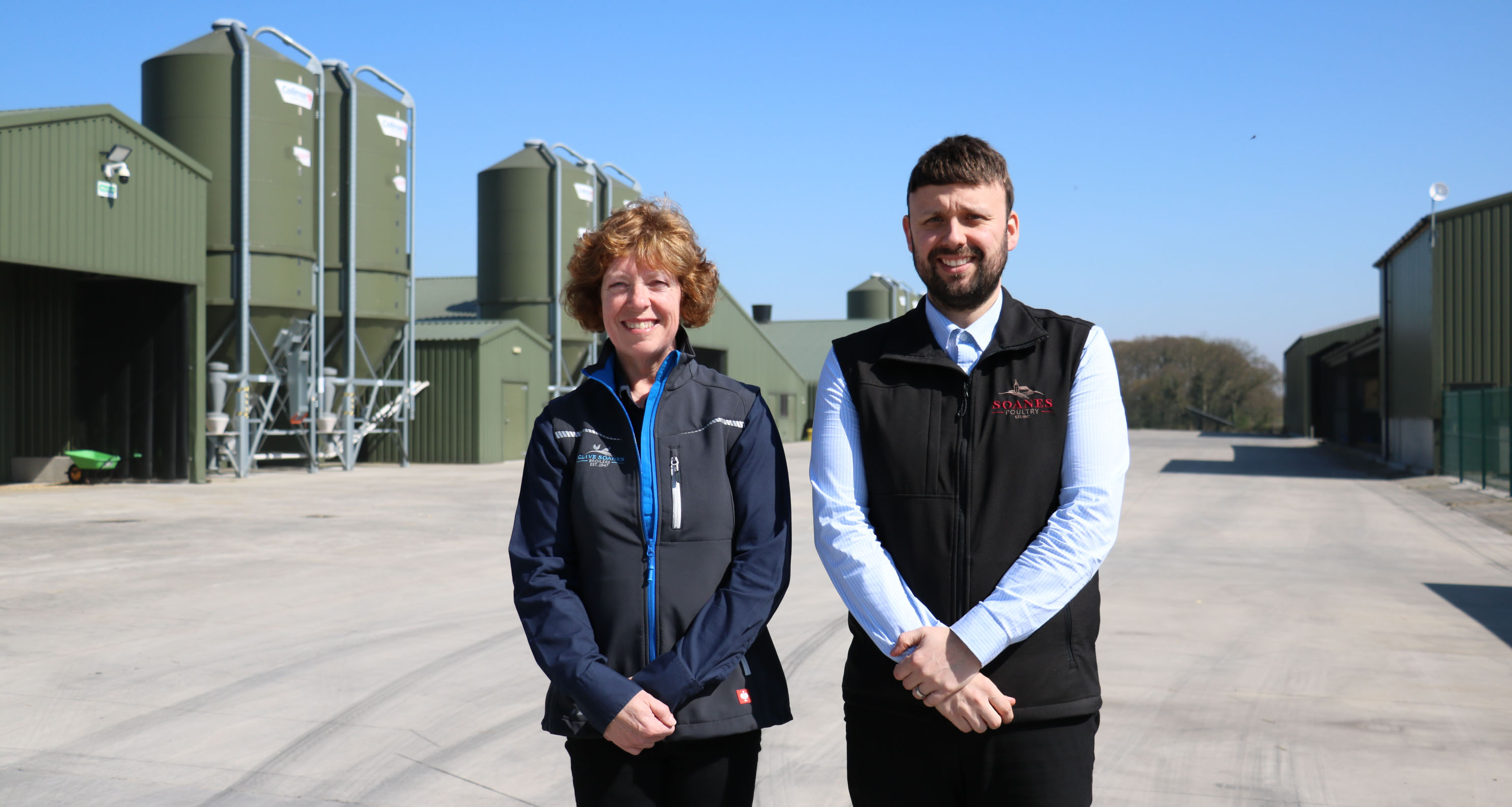
“As our marketing says, we’re 100% family owned and everything has a local provenance,” said Ben Lee, MD of Soanes Poultry. “That’s a truly authentic story and that’s what makes us special. At a time when many in the meat industry are getting bigger and spreading out, we’re proud that we’ve been able to keep that local business feel, even as we’ve expanded – we’re still very much a family firm.
“We do look to scale the business, but one of the main parameters is always where our farms are located. The key thing for us is rearing our own birds as close to the factory as possible and minimising the effects of catching, handling and transportation. Our closest sites are three or four miles away and the furthest is around 24 – the average is under 10.
“We have our own catch teams, our own vehicles and everything’s done in-house which makes a huge difference to stress levels, which ultimately affects both welfare and the taste of the bird, because they’re not stressed and hurtling down motorways. They travel the short distances along rural A and B roads to reach the factory.
“Everything for us is about quality and taste. We minimise the water we use for processing and air chill them for longer, which may affect yield, but delivers a greater intensity of flavour.”
And that relentless focus upon taste continues to pay off, with the company’s higher welfare whole chicken and grain-fed skin-off chicken breast fillets winning one-star awards in the Guild of Fine Foods’ Great Taste competition 2025 last summer, and its grain-fed bone-in thighs winning a two-star award.
Ben said: “We’re delighted and proud to have won more Great Taste awards, which prove how tasty our chicken is. During the past 10 years, our chicken has won 22 of these prestigious awards that are dubbed the Oscars of the food industry.”
The journey of Soanes Poultry
The journey of Soanes Poultry, based at Church Hill Farm, near Driffield, began in 1947 when Tom Soanes set up on a smallholding in Middleton-on-the-Wolds, raising sheep, cows, pigs and chickens, and selling eggs.
Tom’s son Clive was a natural entrepreneur and expanded the chicken-rearing business in the 1950s, spending the next 20 years selling chickens to butchers in local towns. He built four broiler sheds housing 1,000 birds each at Church Hill Farm, later investing in more farmland and then a processing factory as Clive Soanes Broilers was set up as a separate business and began to grow.
Clive’s son Andrew later followed him into the family firm as the family grew their arable operation, T Soanes Farming. Andrew and his son John now run the Soanes arable side – which they manage day-to-day as a family business, with mixed arable, potatoes and other enterprises linked to that.
The company currently employs around 200 people, and the chicken-rearing business – Clive Soanes Broilers – has six farms with nine full-time staff. The business also works with three contract growers to help supply its higher welfare and grain-fed chickens, along with another farm that supplies free-range chickens.
“We normally have around 650,000 birds on the floor at any one time and a similar number with our contractors,” said Clive Soanes Broilers Managing Director Claire Wright. “Our standard Red Tractor and higher welfare lines use a Ross 308 bird and we purchase Hubbard JA87 birds from our free-range contractor.
“We also offer a contract processing facility at our factory of up to 15,000 free-range chickens for another grower, where we slaughter, process, box and deliver on his behalf.”
The factory currently processes around 145,000 birds each week. Soanes sells to national wholesalers, despatching their own transport four days a week to locations as far afield as Preston, North Wales, London and Newcastle, as well as supplying a range of butchers, delicatessens, meal box brands including Slimming World, and Cook frozen meals.
“We’ve just got a listing with Booths, the high-end regional supermarket chain. That’s our first dip into multiple retail outlets and probably as far as we want to go, but they’re a family business and share our ethos and outlook,” said Ben. “Our focus is upon customers who are actually buying the bird because they know our story and appreciate what we’re doing, not just because they simply want to buy a chicken.”
Welfare of the birds is a real priority and all farms and contractors are Red Tractor approved with the expected Red Tractor enrichments, along with additional bales for perching.
“We do keep trialling innovations to improve welfare and enrichment where we can,” added Claire. “We’ve introduced oxygenated nanobubbles in the water and just concluded a trial on a probiotic, looking at whether it reduced ammonia emissions. We’re also about to start stage two of a trial where we’ve been using beans to replace soya in the feed rations.”
The process goes full circle
Sustainability is important to Soanes both as a driver of business resilience and because customers expect it. Wheat grown by the Soanes arable business is milled nearby, and their ration is then fed to the birds at Clive Soanes Broilers.
The poultry farms all have biomass boilers and use solar technology to help generate power.
“Our farms have biomass boilers and we’ve developed from pellet to using straw. We harvest our own wheat and the straw from the fields goes into the biomass boilers now – then the ash goes back on as fertiliser,” said Ben. “The process goes full circle. We’ve also just installed a large solar array near to the factory. It has 1,648 panels which creates enough to power around 350 homes, which goes straight into the factory to offset our energy usage.
“It’s situated east to west so it starts early in the morning and runs through to late evening and we utilise about 90% of the power generated.”
The company recently invested in a new refrigeration unit in the factory, replacing a number of 30-year-old systems running on F gases with a single efficient ammonia glycol system running through the whole factory. The next step will be a heat recovery system which will run all the factory’s scald tanks and hot water systems, reducing LPG usage by an estimated 95%. All water used at the factory, which comes from a borehole and the mains supply, is cleaned in a treatment plant and decanted back into a natural soakaway.
An authentic story
Spreading the word about Soanes Poultry is important to Ben and he is happy to engage with social media and online to promote the brand to the public. “Claire is a bit more hesitant about raising our profile online because she’s running our farms and the situation there is a bit different,” he said. “But from a marketing point of view I think it’s vital. We’re proud of our farms and have an authentic story to tell about how we rear our birds, produce our chicken meat and what we believe in.
“It’s great to celebrate winning our awards on social media, but it’s also about reminding the consumer about why we are different – we’re not the cheapest and we don’t pretend to be, but there’s a lot of effort that goes into getting that great-tasting chicken to them,” he added.
Despite her caution, Claire agreed that social media does have its uses. “Our staff at the farms work really hard and it’s lovely to be able to publicly acknowledge their dedication and show that they are appreciated.”
Both Ben and Claire have taken their desire to engage with the public further by becoming NFU Farmers for Schools Ambassadors. “I’m always surprised how little children know about farming, even those who live in rural communities,” said Claire. “These are the customers and farmers of the future so it’s so important to engage with them.”
Ben added: “Most children probably get their information about farming online and a lot will be from an American perspective. That is so far removed from what Soanes Poultry is about. We’re proud of our high standards and the quality of our products and want people to understand where their food really comes from.”