

EU sugar policy developments
Free trade in beet sugar between the EU and the UK means that what happens in mainland Europe is critical for the UK sugar market.
EU sugar prices have remained very low over the past month. Spot prices are reported to still be around €400/tonne, ex-works in Northwest EU, unchanged from last month, although it remains the case that most 2025/26 sugar was sold earlier at higher prices. The latest reported price of sugar sold in December in the EU was €518/tonne. While UK prices are not reported, ex-works prices normally trade around €50-60/tonne above prices in the EU.
The difficult market situation continues to be driven by low world prices and above-average yields, which have supported beet sugar production across the EU. The consensus is that EU-27+UK production is expected to total around 17 million tonnes in 2025/26, very slightly more than consumption.
With imports expected to outstrip exports, this means that stocks continue to build inside the EU+UK market.
However, we reported last month that CIBE (the European beet growers association) along with CEFS (the beet processors association) have sent an open letter to European institutions to alert them to the worrying situation in the EU sugar market. In this regard, there have been some important developments.
EU Commissioner proposes suspension of inward processing regime
One challenge facing EU processors over the past year has been the amount of sugar being imported under the IPR (inward processing regime), which can enter without paying import duties.
The inward processing regime is designed to ensure that food manufacturers are not disadvantaged when exporting their products outside of the EU.
Under the regime, sugar can enter in two ways. Firstly, when sugar is exported from the EU or UK market in a processed product (eg, chocolate or confectionery), it generates a certificate, which allows an equivalent amount of sugar to be imported duty-free. These certificates have a value and can be sold to importers and refiners who use them to bring sugar into the market without paying duties.
However, certificates are also generated when sugar per se is exported (ie, not in a processed product). This means that an equivalent amount of surplus sugar that is exported from northern Europe can then be imported into the EU without paying duties. This means that attempts by producers to clear surplus sugar out of the market are undermined.
It is this second stream that is causing problems for the EU industry. The CGB (the French sugar beet association) estimates that, depending on the campaign, the IPR regime leads to a loss of around €50 to €80/tonne on each tonne of sugar produced in the EU.
Positive news for the sector came on 27 January, when the EU Commissioner proposed that IPR be suspended to give some respite to producers. While the timeframe has not been confirmed, such a move would reduce the amount of duty-free sugar that can enter the EU market. Around 0.7-0.8 million tonnes of IPR sugar entered the EU in 2024/25.
Mercosur-EU trade agreement in limbo
On top of this, the implementation of the Mercosur-EU trade agreement is faced with a significant delay.
The Mercosur-EU trade deal was signed by the European Commission on 17 January this year. For sugar, it grants 190,000 tonnes of duty-free access to the EU market (180,000 tonnes for Brazil and 10,000 tonnes for Paraguay). However, to enter into force, the deal must be approved by the European Parliament.
MEPs recently voted to refer the Mercosur-EU agreement to the EU Court of Justice for a legal review. This could take up to a year. From a producer point of view, the delay is helpful because it means this sugar will not enter duty-free for some time to come.
What does this mean for sugar prices?
EU prices have been depressed by the low price at which sugar can enter the bloc. By reducing the amount of sugar that the EU can import without paying duties, it makes it more likely that the planned area reductions will have an upward effect on prices.
Most analysts expect area is set to fall by 6-7% in 2026/27. Assuming normal yields, this would push the EU+UK market into deficit again, drawing down stocks and raising the EU’s import requirement to around the level where duty-paying imports set the price, thereby helping prices to recover from their current lows.
World market update: Prices remain stuck
October 2026 No.11 sugar prices remain in the region of 14.5 cents/lb, broadly at the same level as when the index-linked beet price was launched in mid-November 2025. However, the index-linked beet price is now quite a bit lower than its launch price. This is because the UK pound has strengthened against the dollar, rising from £1.31/US$ to £1.38/US$ (Diagram 1).
While this does not sound like a big move, it has been enough to push the index-linked beet price down below £23/tonne at the time of writing.
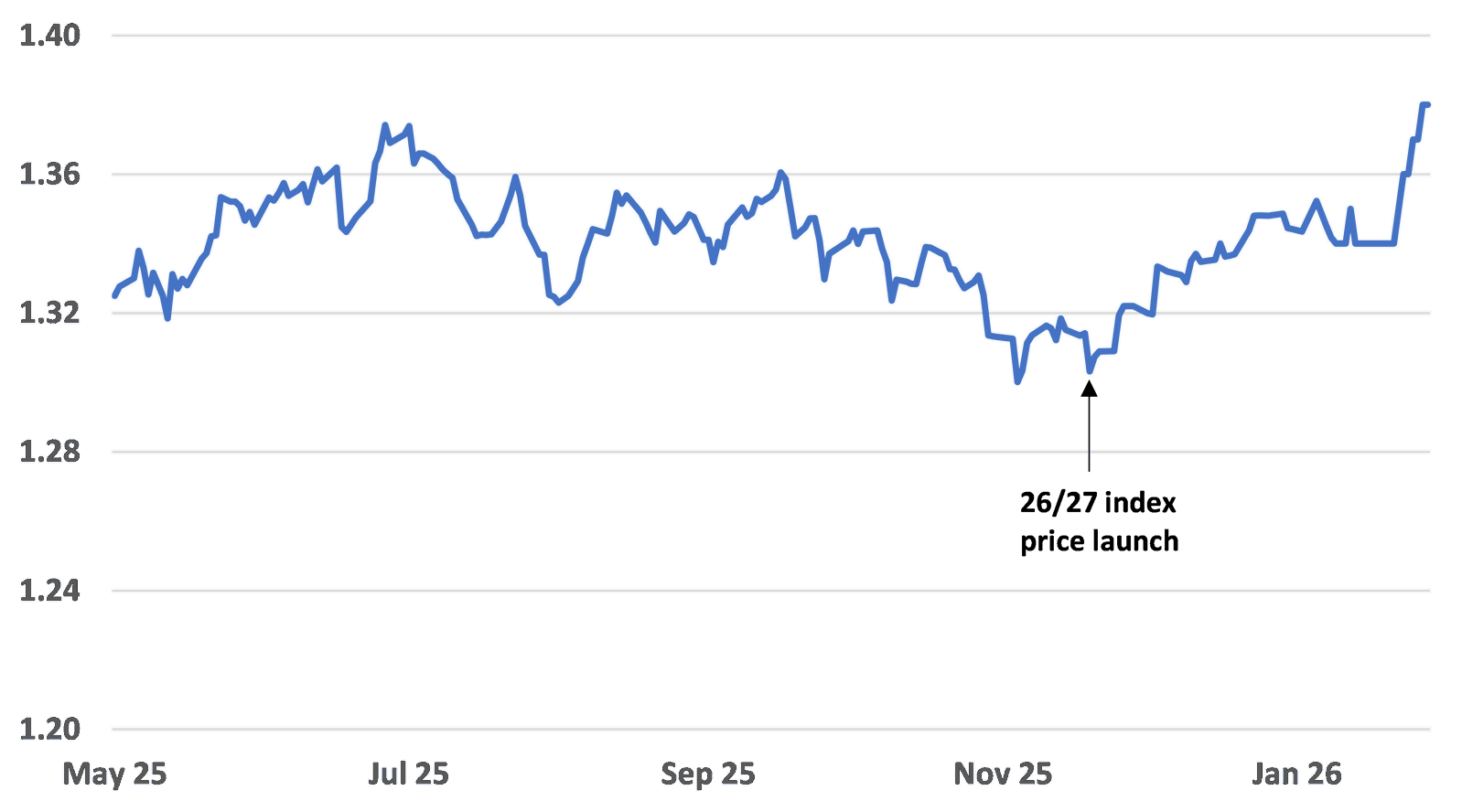
The reasons for a stronger exchange rate are a combination of UK pound strength and US dollar weakness, which are summarised in the table below. Most expect the dollar to remain weak this year, but with so much global uncertainty, it is hard to offer a clear view. A lot depends on the actions of President Trump.
Factors strengthening the UK pound vs. the US dollar
| Pound strength | Dollar weakness |
|
|
Returning to the sugar market, the northern hemisphere cane harvests continue to go broadly according to plan in the major countries and the prospect of a surplus in 2026 continues to be forecast. In the near term, one point to watch is the potential for tight stocks in Brazil in the next couple of months prior to the start of the 2026 campaign. This remains the most likely source of support for prices in the near term. However, for the moment at least, the upside for prices continues to be capped by heavy selling when No.11 prices approach 15 cents/lb, which translates into a beet price of around £23.50/tonne at £1.38/US$.
A trader’s view
NFU Sugar Board appointee and sugar trader Paul Harper shares his thoughts on the current market situation.

NFU Sugar Board appointee Paul Harper
Paul has spent his entire career in commodities and has been in sugar since 1976. He joined C Czarnikow in 1973 working in their London, New York and Singapore offices. Paul has a huge amount of consultancy experience, having consulted for a hedge fund, major bank and a large trade house in sugar during that time.
The market continues to trade in a narrow range; 14 cents/lb appears to be too low and 15 cents/lb too high for the spot March contract for the time being.
Crops around the world continue without much interruption and the expected surplus is likely to appear sooner rather than later assuming this continues.
Physical sugar values for prompt shipment remain steady which is giving the market some support and the speculative element in the market, having reduced their short position towards the end of the year, have begun to sell again and currently sit close to 10 million tonnes short in the No.11 market.
If any tightness were to occur as we head towards the end of the Brazil 2025/26 harvest, it could provide the catalyst for the market to rally.
If this were to happen, it could provoke covering from the shorts. As we have mentioned before, this rally, should it occur, would likely be short and sharp because, moving forward, it is likely that the market will be on the defensive as the surplus becomes more apparent.
Policy perspective
- The analysis by The Andersons Centre, commissioned by CropLife UK, shows how one potential scenario under a future SPS (Sanitary and Phytosanitary) agreement, where the UK aligns with the EU on pesticide approvals and MRLs (Maximum Residue Limits) in mid-2027, could potentially cost the arable, horticulture and sugar sectors between £500-810 million in the first year alone.
- Since January 2021, four new pesticides have been approved in Great Britain that are not yet available in the EU. Immediate alignment with EU rules in June 2027 could lead to the sudden loss of access to these and other key plant protection products.
- NFU President Tom Bradshaw said: “Implementing appropriate transition periods is absolutely vital to enable farm businesses to adapt. For plant protection products, the best option would be for British farmers to retain access to GB-approved plant protection products until the EU rules are next reviewed, rather than being pushed towards a cliff-edge because of an arbitrary deadline.”