The Beet Brief: European crop losses tighten the market, but Brazil keeps a lid on prices


James Thompson
NFU Senior Commercial and Market Analyst
In this month’s Beet Brief, NFU Senior Commercial and Market Analyst James Thompson looks at what the first harvest signals mean for the UK and European crop, why European sugar prices are moving higher, and why the global market remains finely balanced between near-term disruption and the prospect of more Brazilian sugar later on.
Highlights:
The European beet crop is expected to be much smaller than normal – the latest forecast is 11% below the five-year average and 17% below 2025.
Dry weather, small roots and greater pest and disease pressure have reduced crop expectations in the UK and across western Europe.
European sugar prices are rising – current reports put white sugar at around €590/t ex-works Northwest Europe.
World sugar prices have continued to rise. Poor weather is supporting prices now, although a better Brazilian crop next year could hold them back later.
World market developments: prices pause after the summer rise
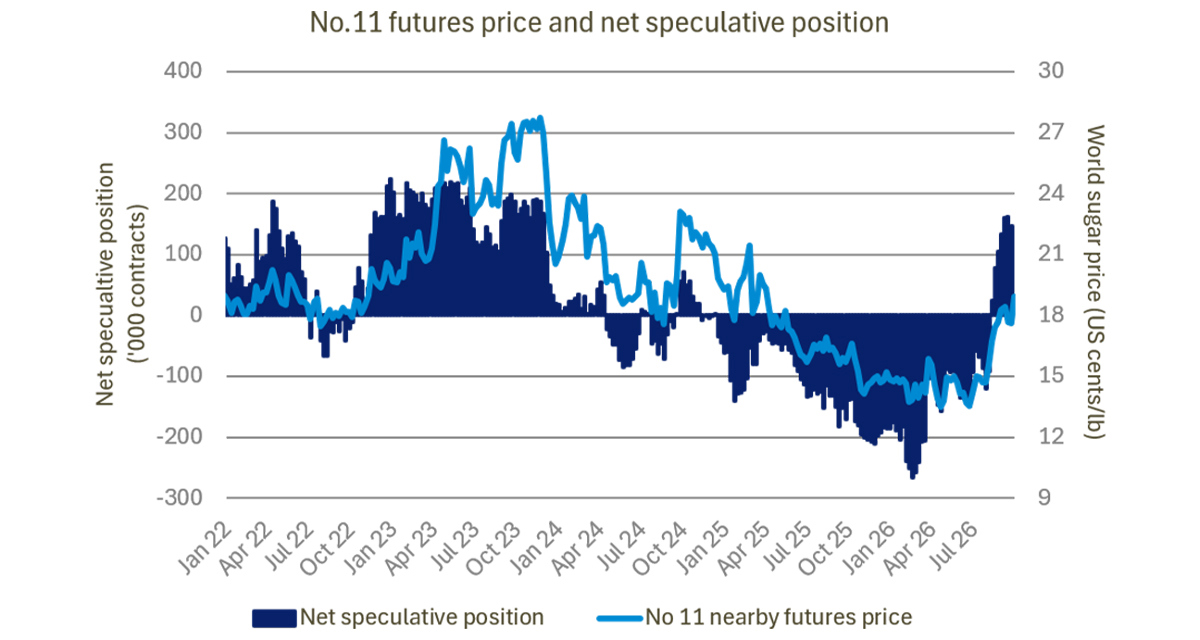
The strong rise in world sugar prices during August has now slowed. Raw sugar rose from around 14c/lb in late July to almost 19c/lb in early September. Prices had subsequently fallen back slightly but began rising sharply again at the start of the month.
Poor weather remains a concern in India and Thailand. Heavy rain has also slowed cane harvesting, sugar production and exports in Brazil. This has helped to support prices in the short term.
However, Brazil produced plenty of sugar in August when the weather allowed mills to run. The recent rain may also help Brazil grow a better crop next year. More Brazilian sugar would make it harder for world prices to rise much further. The risks are also now better recognised by the market, with speculative funds already having made the move from a large net short position to a sizeable net long position.
For growers, the recent rises should encourage growers to remind themselves of the 27/28 forward index linked contract, which remains open until the main contracting window opens for the 27/28 crop. Having launched in February at under £14/tonne, it now offers close to £25. If current rises in the No.11 continue it may offer the opportunity to lock in a good price for a proportion of tonnage. Worth keeping an eye on.
EU/UK crop outlook: From forecast to harvest reality
The latest European crop evidence is materially weaker than it was a month ago. The September JRC MARS estimate puts the EU beet yield at 67.4t/ha, 11% below the five-year average, 17% below 2025 and 7% below the previous month’s forecast. France is forecast at 65.0t/ha, 21% below average; Germany at 69.3t/ha, 13% below average; and the Netherlands at 82.3t/ha, 2% below average. Belgium is an exception, with an 85.7t/ha forecast broadly in line with its five-year average.
The damage is not only the result of dry weather. Hot conditions have increased pressure from diseases and pests, including cercospora, virus yellows and beet moth. In the worst fields, small roots may also be difficult or uneconomic to lift.
In the UK, rain has helped root growth in some fields, but sugar content has fallen and pest and disease pressure remains high.
EU + UK Market: Higher imports will be needed
The European market entered the new campaign with high stocks, estimated at a little over 3.2 million tonnes across the EU and UK. Those stocks provide an important buffer, but they will not replace the production lost this year. Current balance estimates imply imports of around 2.6 million tonnes in 2026/27, even after allowing stocks to fall and exports to drop sharply.
The key question is how high European prices need to rise before additional, CXL duty paying imports become worthwhile. Once import charges, shipping and refining are included, this is currently estimated at around €640-660/t on an ex-works Northwest Europe equivalent basis.
Current spot indications remain mixed but are moving in that direction. White sugar is reported at €590/t ex-works Northwest Europe and €670/t delivered UK. The UK premium reflects freight, handling and the UK’s structural deficit. The level is also a clear rise from the summer, although the Northwest European ex-works price remains below the theoretical level needed to attract all of the marginal imports likely to be required.
Prices do not have to rise immediately. Many buyers have already bought some of their needs and Europe still has sugar in store. Even so, if the harvest confirms a poor crop, the market is likely to tighten and depend more heavily on imports.
Looking ahead
The market looks tighter than it did at the start of the summer. In Europe, yields have fallen and stocks will be needed to make up part of the gap. Across the world, poor weather has reduced the expected surplus, although a better Brazilian crop next year could still prevent a serious shortage.
For UK growers, the clearest signal is the rise in the price of sugar delivered into the UK. With a higher spot price, the market is already responding to a smaller domestic crop and the cost of replacing it with imported sugar. Harvest results over the next few weeks will show whether prices need to rise further.
A trader’s view
Courtesy of Paul Harper, NFU Sugar board appointee and sugar trader.

The continuing strength in oil prices and weather patterns affecting global production of sugar ignited both trade and speculative buying once the nearby October No.11 raw sugar contract expired at the end of September. Rain continues to disrupt South Brazil harvesting and shipments with estimates of a 2-million-tonne reduction in the overall crop being reported.
The March No.11 raw sugar contract recently traded to a high of 21.24c/lb, a level not seen for some time. It is clear that the speculators have increased their long position considerably which will likely lead to more volatility in the market at various times. However, if the weather continues to deplete crop forecasts the market will almost certainly rise further.
White sugar prices, while still strong, have not rallied at the same level as raw sugar and the white premium lost value initially, although it has regained some ground over the past couple of days.
The Beet Brief from NFU Sugar is prepared for UK sugar beet growers only. While every reasonable effort has been made to ensure the accuracy of the information and content provided in this document at the time of publishing, no representation is made as to its correctness or completeness. The NFU and the author do not accept liability arising from any inaccuracies, be they errors or omissions, contained within this document. This document is intended for general information only and nothing within it constitutes advice. It is strongly recommended that you seek independent professional advice before making any commercial decisions.