Index-linked beet price rallies
Last month, we said that the US/Israel-Iran war could provide opportunities to lock in better prices on the index-linked beet contract. While this did not happen immediately, prices have rallied over the past two weeks; at the times of writing, the index-linked beet price is around £28-29/t, having been as low as £21/t in February.
The rally has been driven mainly by speculators buying back their short positions. As we have discussed previously, speculators were holding a very large net short position, effectively betting that prices would continue to go down. However, sharply rising oil prices changed that perception. At the end of February, the net speculative position was a huge 13 million tonnes short; it will now be much less.
On the other side of the equation, there are plenty of sugar producers who are under-hedged and looking for opportunities to sell. However, the uncertain environment meant that the buying from speculators did not meet as much resistance from producer selling as expected, allowing October No.11 futures to break through 16 cents/lb, its highest level since June last year.
Can the price recovery be sustained?
The answer to this question depends heavily on the length of the conflict, whether oil prices remain high for a long period of time and how Petrobras, Brazil’s state-owned fuel distributor, reacts to the situation.
To control inflation, Petrobras tries to smooth out volatility in Brazilian fuel prices caused by developments in the world market. This means that short-term movements in world energy prices are not always reflected at the petrol pump in Brazil. Indeed, since the start of the war, the price at which Petrobras sells gasoline to other fuel distributors has remained unchanged, meaning the gasoline price is now around 40% below the price of imports.
2026 is a presidential election year in Brazil, which amplifies the political need to keep fuel prices under control. If Petrobras keeps gasoline prices at current levels, No.11 prices around 16 cents/lb look difficult to sustain. There has not been a major change in the global sugar supply/demand outlook and No.11 prices at this level would encourage Brazilian cane millers to produce as much sugar as possible, leading to an oversupply as Brazil’s 2026 harvest ramps up in the coming months.
The alternative scenario is that Petrobras eventually succumbs to pressure to raise fuel prices. While it is majority state owned, it does have private investors and needs to make a profit. Such a move would drag up ethanol prices and allow sugar prices to be sustained at a higher level without encouraging too much supply because ethanol would be more attractive.
The final outcome is likely to depend on how long the war lasts; the longer oil prices remain high, the harder it will be to keep fuel prices at current levels.
Cost pressures also build
While the conflict in the Middle East has created an opportunity for beet growers in the short term, it is also putting pressure on costs of production. Since the war began, global urea prices are up around 40% while red diesel costs in the UK are around 70% higher, reaching around £1.20/litre compared to less than 70p in the week before the war began.
For 2026 plantings, there is thought to be a sufficient supply of fertiliser in the country, with most growers having purchased their requirements in advance. In contrast, fuel does not tend to be purchased so far in advance, meaning many farmers are more exposed to this cost increase.
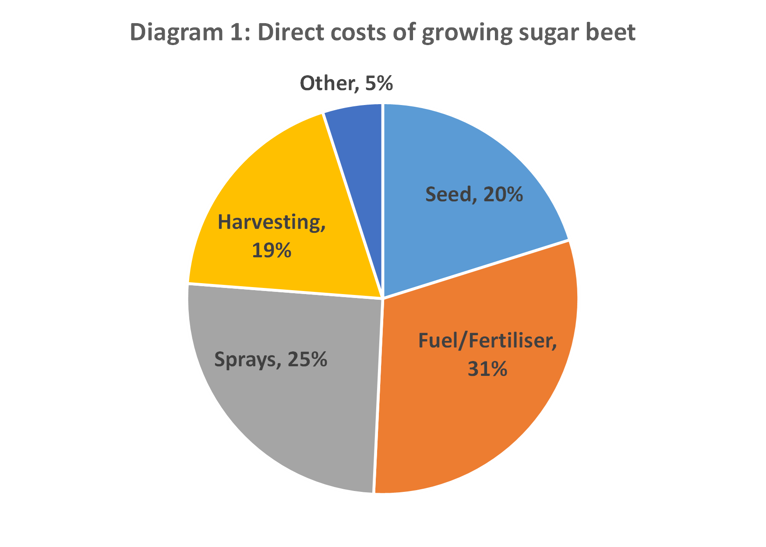
Beet is more intensive in the use of both fuel and fertiliser than cereals or rapeseed. Diagram 1 below shows that fuel and fertiliser account for more than 30% of the direct cost of growing sugar beet (this assumes a farmer owns their own land and contracts out harvesting operations to a third party.)
With so much uncertainty surrounding the future direction of the war, input prices will remain very volatile and responsive to events. However, if we assume that the recent price increases are maintained for the rest of the year and allow for 3% inflation for all other cost elements (seed, sprays etc.), it is possible that the direct costs of growing sugar beet increase by more than 15% in 2027/28 (Diagram 2).
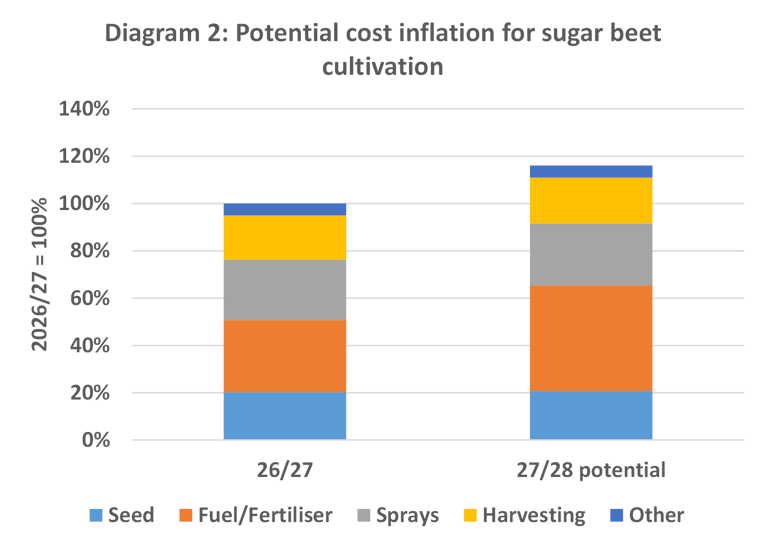
This highlights a worry for the sector; while the war is offering some support to commodity prices, there is a risk that the impact on farmers’ costs could be even greater.
EU/UK market update
The war has also led to prices in the EU starting to rise. Current spot prices are now above €450/tonne in Northwest EU, up from €400 last month. Quotes for 2026/27 sugar are around €540/tonne, which would imply a price in the UK above €600/tonne, ex-works. However, the uncertainty about future costs of production mean that some processors are withdrawing offers for sales this far ahead.
Nevertheless, high sugar stocks remain a challenge for the sector. Based on European Commission data, at the end of January, sugar stocks in the EU were around one million tonnes higher than at the same date one year earlier.
In this regard, the EU industry is continuing to lobby for support to help find a way through the current situation. Progress continues to be made towards the suspension of IPR sugar, which, as we have discussed in the past, would help reduce the market’s exposure to duty-free imports.
At the same time, however, the EU is pursuing free trade agreements. Despite opposition, the Mercosur-EU agreement will enter into force in May, which will allow 190,000 tonnes of sugar to enter duty-free. The EU has also recently signed a free trade agreement with Australia which will allow 35,000 tonnes to enter duty-free. While this sugar will not come to the UK, it is still important because it makes it harder for EU prices to rise to a level where duty-paying imports sets the price in the EU/UK market.
A trader’s view
NFU Sugar Board appointee and sugar trader Paul Harper shares his thoughts on the current market situation.

NFU Sugar Board appointee Paul Harper
Paul has spent his entire career in commodities and has been in sugar since 1976. He joined C Czarnikow in 1973 working in their London, New York and Singapore offices. Paul has a huge amount of consultancy experience, having consulted for a hedge fund, major bank and a large trade house in sugar during that time.
How quickly things change! Strikes against Iran by the USA and Israel led to a sharp increase in oil prices which in turn has encouraged further short covering from the speculative element in sugar.
Logistical problems for white sugar moving from the Middle East has given the white sugar premium a boost, while the raw sugar spot price climbed close to 16 cents/lb, a rise of almost one and a half cents since our last review.
Sugar fundamentals are little changed, although if the conflict continues or escalates and oil and fertiliser prices continue to rise, sugar is likely to react in a positive fashion. Yields for upcoming crops are likely to suffer with the potential for a lack of input with regards to fertiliser and the potential for more ethanol production will exist, at the expense of sugar, if oil prices remain at or continue to rise above current levels.
Statistically the surplus numbers are being reduced slightly, aiding the current positive sentiment in the market.
For the moment, all eyes continue to be placed on the outcome of alleged talks to settle the conflict in the Middle East, however the markets remain volatile and will react very quickly to both positive and negative news from the region.
Policy perspective
2026 Rothamsted Forecast projects considerable pressure
- This year’s Rothamsted forecast has projected that, in the absence of any control measures, 59.15% of the national sugar beet crop could become infected with Virus Yellows.
- It is important to note that this will be the highest level of projected Virus Yellows pressure that the UK sugar beet sector has faced without neonicotinoid seed treatments since the Virus Yellows pandemic of 2020.
- NFU Sugar continues to call on the government to adopt an enabling, science-led, risk-based approach to plant health.