The Beet Brief: Why falling world prices have not weakened the UK sugar market


James Thompson
NFU Senior Commercial and Market Analyst
In this month’s Beet Brief, NFU Senior Commercial and Market Analyst James Thompson looks at why Brazil’s election result caused a sharp reversal in No.11, why a weaker real encourages Brazilian sugar selling, and why the UK and European physical markets remain firm despite the fall in the world benchmark.
Highlights:
No.11 raw sugar approached 20c/lb in October before falling sharply after Brazil’s presidential election weakened the Brazilian real.
A weaker real increases the local-currency value of dollar export earnings, allowing Brazilian mills to sell sugar more competitively in US dollars.
The global price fall has not removed Europe’s physical supply problem.
Spot indications stand at €600/t ex-works Northwest Europe and €670/t delivered UK, reflecting the cost of replacing a much smaller regional crop.
World market developments: Brazil’s election reverses the rally
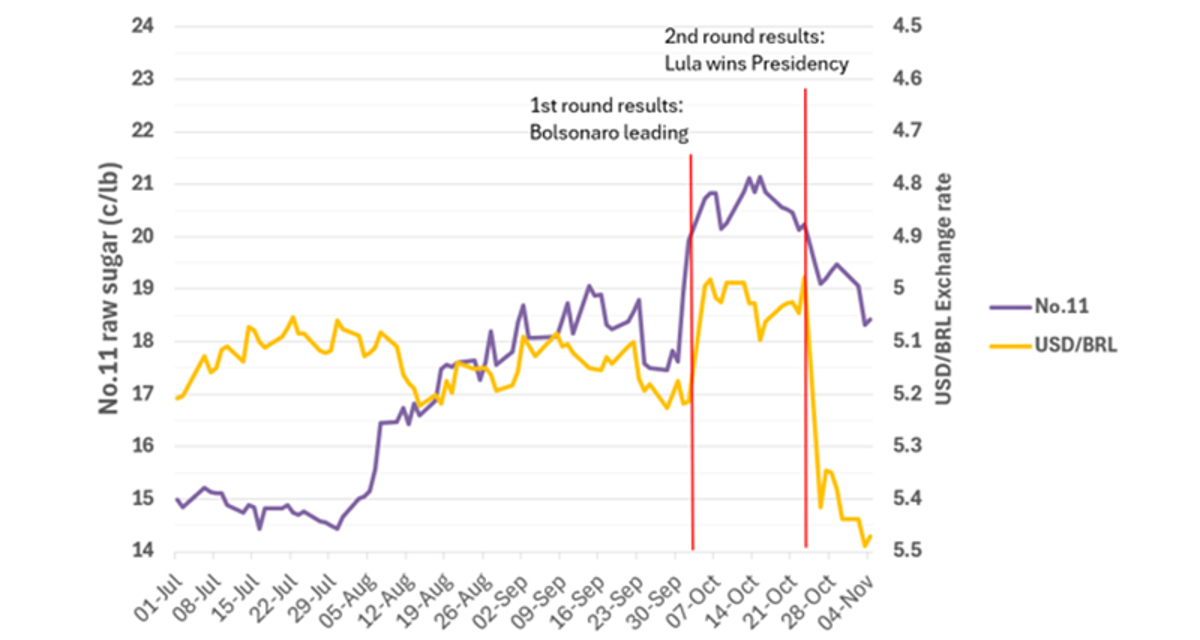
Raw sugar moved above 20c/lb during October, supported by wet weather in Brazil and weaker crop prospects in India. That rally was abruptly interrupted after Brazil’s presidential run-off on 25 October.
The more fiscally conservative Flavio Bolsonaro had won the first round of voting earlier in October, but Luiz Inácio Lula da Silva was unexpectedly re-elected in the run-off vote. This triggered a sharp sell-off in Brazilian assets, with the real initially falling by around 10% against the US dollar. No.11 raw sugar fell by roughly 5-6% in the first trading session after the result, and has fallen further in early November. By 6 November, the nearby price was around 18.4c/lb.
Why the Brazilian real matters to sugar
No.11 is quoted in US dollars, but Brazilian mills pay many of their costs in reals. When the real weakens, each dollar earned from exporting sugar converts into more local currency. A mill can therefore accept a lower dollar sugar price while protecting, or sometimes improving, its return in reals. That encourages Brazilian producers to sell or hedge more sugar and can quickly put pressure on the world benchmark.
The election changed the short-term market story even though it did not add a single tonne of sugar to global supply. Heavy rain has still disrupted harvesting and milling in Centre-South Brazil, while India’s weaker monsoon has reduced yield expectations. The currency effect explains why No.11 can fall even while the physical crop outlook remains supportive.
EU/UK crop outlook: The fall in No.11 does not remove Europe’s shortage
The currency-led fall in No.11 does not remove Europe’s physical supply problem. Across the EU and UK, early campaign results have largely confirmed the damage caused by the summer drought. Area was already around 10% lower than last year, and disappointing yields have compounded that reduction.
France and Germany account for much of the loss. France’s beet crop is now forecast at around 30% below last year, with some fields unlikely to be harvested. Poland has performed better, with yields near the five-year average and relatively good sugar content, but this is not enough to offset losses further west.
In the UK, yields are particularly variable depending on soil type after the drought, while sugar content has generally held up better than feared. The current estimate for UK sugar production is below 750,000 tonnes, which we believe is significantly below the volume British Sugar needs to supply their customers. It is not clear where the additional tonnes will come from – whether from any existing stocks or from additional imports. Cantley is expected to begin its final campaign on 09 November.
EU+UK Market: Higher imports will be needed
The market entered 2026/27 with substantial stocks, but the production loss is too large to be covered by stocks alone. Current estimates imply imports of about 2.6-2.7 million tonnes, while exports fall to a minimum and stocks are drawn down sharply.
This matters because some of the additional sugar may need to enter under the CXL quota, which carries an import duty. At current world prices, the estimated CXL import parity is around €700/t on an ex-works beet-belt equivalent basis. Import parity is not a guaranteed market price, but it is a useful indication of the level needed to attract the marginal tonne into Europe once freight, refining and duty are included.
Spot pricing has strengthened accordingly. Current reports put white sugar at €600/t ex-works Northwest Europe and €670/t delivered UK. The difference reflects the cost of moving sugar into a structurally deficit UK market, as well as differences in delivery terms. Most industrial buyers of sugar have already signed contracts for the volumes they require, which means these spot numbers apply to a relatively small part of the market, but the direction is clear: replacing the lost crop is becoming more expensive.
Looking ahead
November’s market is a reminder that the world benchmark is only one part of the price picture. Currency movements in Brazil can pull No.11 lower by encouraging producer selling, while a shortage of physical sugar in Europe pushes regional replacement costs higher. The two markets can therefore move in different directions, at least for a time.
For UK growers, the clearest local signal remains the cost of bringing replacement sugar into a structurally deficit market. The UK spot price has continued to rise even as the No.11 has retreated from its October high. Whether that strength lasts will depend on how much duty-paying sugar Europe ultimately needs, how far stocks are drawn down and whether the weaker real continues to weigh on the world market.
Attention will also turn to 2027 planting. Lower beet prices and high growing costs may limit any rebound in area across Europe. Current early estimates suggest only a 1-2% recovery in EU+UK area. Even with more normal yields, that could leave the market needing duty paying imports again in 2027/28.
A trader’s view
Courtesy of Paul Harper, NFU Sugar board appointee and sugar trader.

Early in October, the market stalled around the 21c/lb in the March No.11 raw sugar futures contract as demand was not willing to follow the rise in prices and speculators lost their appetite to add to their long positions at the new higher price.
At the end of October, the presidential victory of Lula in Brazil led to a weakness in the Brazilian real which encouraged selling of No.11 contracts from that region, which was assisted by some liquidation from the speculators, causing the market to decline very quickly. As prices moved lower, the selling accelerated. At the time of writing, the market is almost 3c/lb lower in the No.11 contract compared to the peaks of early October.
The supply and demand fundamentals have changed very little over the period with weather patterns still causing disruption globally. Prospects for the Indian crop remain poor which may force the mills to produce as much sugar as possible at the expense of ethanol. Imports into India may still be required but we won’t know until after results of the current crop become available.
Elsewhere the rains in Brazil have eased, but early European harvesting is confirming the likelihood of lower crop forecasts and expectations from Thailand still point to a reduction of availability from this region.
It is likely that current global sugar prices are toward the bottom of the recent trading range. The speculative element has reduced their long position in the No.11 considerably and producers are unlikely to need to follow the market lower, having had the opportunity to hedge at higher levels. If demand increases or further weather problems materialise, the market could easily recover much of the recent decline.
Policy perspectives
Courtesy of Lydia Ballamy, NFU Sugar Policy Adviser.

Nearly five months on from British Sugar’s announcement of proposals to cease beet processing operations at their Cantley factory site in Norfolk, NFU Sugar continues to call for long-term assurance from British Sugar about their commitment to domestically grown sugar beet.
The closure represents a critical moment for our industry as we see the effects of government trade policy that allows increasing quantities of duty-free sugar to be imported into the UK.
British Sugar’s press release specifies ‘ceasing beet processing’ at Cantley factory, which leaves open the possibility that British Sugar could continue to operate the sugar refining part of Cantley but import raw cane sugar tariff-free under the ATQ to refine into sucrose.
Staying safe this campaign
As the nights draw in and the weather gets colder, we encourage growers to keep health and safety at the forefront of their minds during the sugar beet campaign. Taking just five minutes before starting a task to assess potential risks and check in on how you are feeling can keep you and your employees safe.
From machine safety, and overhead power lines to lone working and mental health support, there are a range of resources available online with advice to help you prepare and stay safe this campaign.
Head to our farm safety landing page for more guidance and advice.
The Beet Brief from NFU Sugar is prepared for UK sugar beet growers only. While every reasonable effort has been made to ensure the accuracy of the information and content provided in this document at the time of publishing, no representation is made as to its correctness or completeness. The NFU and the author do not accept liability arising from any inaccuracies, be they errors or omissions, contained within this document. This document is intended for general information only and nothing within it constitutes advice. It is strongly recommended that you seek independent professional advice before making any commercial decisions.