Water Management Grant round 3 – advice and support
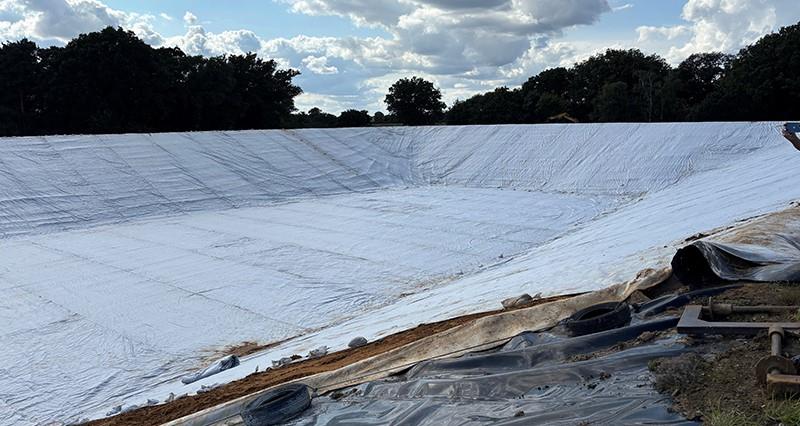
Are you looking to develop a reservoir on farm? Our guide to applying for grant funding under the Farming Investment Fund scheme for water has key information about the deadline schedule for round 3 of the Water Management Grant.
The development of more and higher capacity on-farm reservoirs is seen as a key requirement for many farm businesses in order to make food production more sustainable under conditions of drought or reduced water availability.
As we have seen with recent extreme weather, these will include areas and businesses that have not traditionally considered water storage as a necessary part of building resilience into their operation.
Water Management Grant round 3
The Rural Payments Agency has launched Water Management Grant round 3, that provides support for farmers, growers and landowners to invest in water storage and distribution infrastructure that improves resilience to drought and water scarcity.
What can the grant fund?
Eligible projects can include:
- irrigation water storage reservoirs,
- above-ground water storage tanks, and
- underground water distribution mains connected to a reservoir or storage tank.
The grant supports infrastructure used to irrigate a wide range of crops, including potatoes, onions, carrots, brassicas, soft fruit, top fruit, protected crops, ornamentals, forestry nursery stock and many arable crops.
Who can apply?
Applications are open to:
- farmers and growers,
- landowners and landlords,
- tenant farmers, and
- water management companies formed by groups of farmers, growers and landowners.
Applicants must have a valid SBI (Single Business Identifier) and be registered with the Rural Payments Service.
Funding available
The scheme offers:
- A minimum grant of £15,000 for projects involving only above-ground storage tanks.
- A minimum grant of £35,000 for reservoir or underground distribution projects.
- A maximum grant of £300,000 per SBI.
Grant support is based on reference costs, with at least 60% of project costs needing to be funded privately. Payments are made in arrears.
Differences from Water Management Grant round 2
The Water Management Grant round 3 includes the following changes:
- Funding for projects in areas where irrigation water is most needed.
- Eligible items will use reference costs – quotes are not required.
- More time to get planning permission and abstraction licences (where required) – these need to be provided at the claim stage, and means that funding agreements will be offered sooner.
- Applicants do not need to be the grower but at least one farmer or grower must use the water to irrigate crops – applicants must provide evidence of this.
- Applicants will use a new online service called the Farm and Land Service to apply for a grant.
How applications will be prioritised
The scheme is competitive and not on a first-come first-served basis. Higher-scoring applications are more likely to be funded, particularly where projects:
- Support horticultural food production.
- Are located in areas of lower water availability.
- Have planning permission and abstraction licences already secured.
- Share water resources with neighbouring farming businesses.
Projects in water-stressed areas identified on the grant priority map (PDF) will receive a higher score.
Application timeline
| Stage | Date |
| Stage 1 opens | 30 November 2026 |
| Stage 1 closes | 23 February 2027 |
| Stage 2 closes (invited applicants only) | 28 October 2027 |
Applicants can submit a Stage 1 application before planning permission or abstraction licences are in place, although these approvals must be secured before the first grant claim is made.
Key resources
- GOV.UK | About Water Management Grant round 3, who can apply, what the grant can pay for and how to apply
- GOV.UK | Water Management grant round 3
- GOV.UK | Helping farmers access more water: Water Management Grant guidance now available
WRE (Water Resources East) have produced a practical guide for farmers and planners (PDF) on design, permissions and environmental integration.
Planning
Generally, farm reservoirs are covered under permitted development rights, however, under the Habitats Directive, reservoirs which significantly impact SACs (Special Areas of Conservation) or SPAs (Special Protection Areas) will require an EIA (Environmental Impact Assessment) to ensure they don’t negatively affect protected habitats or species. This can override permitted development and trigger a full planning process.
The revised NPPF (National Planning Policy Framework) provides a positive case for allowing the development of on-farm reservoirs to LPAs (local planning authorities) for those that need to proceed to full planning.
A prior notification submission will be required in all proposed developments and LPAs may require a subsequent prior approval submission. If an EIA is triggered, a screening opinion from the LPA will need to be sought before submission of the prior notification.
There may need to be an archaeology survey with or without an EIA, which can add significant costs and delays to the planning process.
A mineral extraction licence may also be required for the development of a reservoir due to the quantity of material being excavated.
Furthermore, the waste of the excavation is treated as industrial waste, leading to expensive demonstrable recycling or disposal.
LPAs can negatively view any on-site disposal for landscape impact purposes and surface water contamination.
It is important to note that the waste disposable element can add significant cost to what should be quite a straightforward process.
LPAs also vary in their capacity to undertake these assessments with some offering in-house services and others requiring the applicant to engage with organisations such as Natural England separately.
Abstraction licensing
Abstraction licensing is required if a reservoir is to be filled with water taken from the surface or groundwater, or if the reservoir is clay-lined and holds water at or below the water table, at a rate greater than 20m3 per day.
The EA (Environment Agency) produces abstraction licensing strategies for all catchments that indicate the likelihood of obtaining a licence to take water from the environment. There are significant abstraction pressures nationally that are more acute in certain areas making obtaining a licence less likely.
For application details for an abstraction licence, visit: GOV.UK | Apply for a water abstraction or impounding licence.
From September 2026, the EA has updated its guidance on long-duration abstraction licences, making the application process more accessible for farm businesses.
Applicants still need to demonstrate a business case and funding arrangements (or funding in principle), but they will no longer be required to undertake their own assessment of long-term environmental and economic sustainability.
Instead, the EA will assess future climate and environmental risks as part of the licensing process and will include a condition that allows abstraction volumes to be reduced in the future if changes in climate conditions make the licence unsustainable. Licence holders would receive a minimum of six years’ notice before any reductions take effect.
For updated guidance on long-duration licences, visit: GOV.UK | Apply for a water abstraction or impounding licence.
Reservoir safety
Reservoir safety is currently under review with the potential for more reservoirs to become covered by regulation.
Currently, reservoirs less than 25,000m3 do not have to be registered but, whether you need to register your reservoir or not, you must follow HSE (Health and Safety Executive) regulations and local council building regulations.
Details of the requirements for those reservoirs over 25,000m3 can be found at: GOV.UK | Reservoirs: owner and operator requirements.