Having grown up in London, Daniel is now based at Thorpe Hall, Haddiscoe, where the farm comprises about 100 acres, split between marshland, grassland, and woods.
His father, Chris Johnson, farms a small number of sheep, pigs, and cattle, goats, and poultry, selling produce from the farm gate – including handmade goat’s milk soap – and with a farm shop nearing completion.
Chris said the plan was to be as “nature friendly as possible” upon moving in, with the farm now part of the ‘Nature Friendly Farming’ community. Since the move, he and Daniel have removed bracken, ragwort and hemlock from the grasslands with the use of herbicides and have now reduced the use of these herbicides to spot spraying. They never use pesticides.
The move to Norfolk coincided with Daniel undertaking an artistic blacksmithing course at Hereford College of Arts after his interest was piqued during work experience with a local blacksmith when the family were living in Bedfield, near Framlingham, on a smallholding of about six acres after first leaving London.
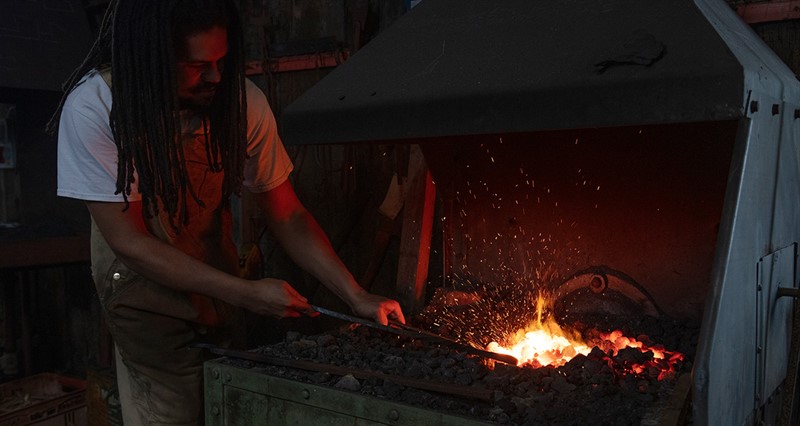
“I was stolen away by blacksmithing,” Daniel said when asked why he didn’t follow his father Chris, a qualified engineer, into farming.
The family had been looking to move to somewhere larger, ideally seeking a place with enough room for Daniel to set up his own space in which to work when he finished his training.
“We looked at lots of places, but Thorpe Hall was affordable and more than large enough for what we needed. We moved here in 2014,” Chris said.
“The idea was to have space for a workshop, merging both worlds,” Daniel noted, adding he has also trained as a welder through the course.
“Those skills and having this workshop mean if anything goes wrong on the farm, I can repair it, which is a nice cross-over.”
After completing his Artistic Blacksmithing Degree, Daniel then moved on to a Contemporary Craft Master’s, specialising in blacksmithing and metalworks – with a focus on Mokume-gane, a Japanese laminating process.
“It’s been a bit of a journey. I set up in 2019 with the ambition to do courses and got quite a few going, but then Covid came and that had to stop. I then went into commission work and it’s now striking the balance between commissions and courses.”
Daniel Johnson
“At the end of my degree course, I went to Japan and had the chance to visit Tokyo University of Arts and was shown around their metalworks facility where I got talking to a student who was studying Mokume-gane. When I started my Master’s I knew I wanted to focus on that and learn that process, and my final project was several wall lights showing form folding and Mokume-gane.”
From student to teacher
Ten years on from when he first started studying blacksmithing, or forging as it is sometimes known, Daniel is now offering day courses to learn the skills of a traditional blacksmith through his business Forgeworks.
“It’s been a bit of a journey. I set up in 2019 with the ambition to do courses and got quite a few going, but then Covid came and that had to stop,” he explained. “I then went into commission work and it’s now striking the balance between commissions and courses.”
In addition to currently working on a teapot as part of a commission for a tea set, Daniel is also working on something slightly larger – restoring the Guild Hall gates for Norwich City Council.
Becoming a published author
He is also a published author, with his book ‘Blacksmithing: A Guide to Practical Metalworking, Tools, and Techniques’ published in 2023. The book shares instructions around blacksmithing basics and includes several projects for novices to try their hand at, such as a forged knife, a forged rose, and a bottle opener.
The commission for the book came when Daniel was running a stall at Heveningham Country Fair.
“Amber Books approached my stand looking for an author for a blacksmithing book. I was away from the stall at the time, looking around at the fair, but my friend Henry spoke to them and passed on the details to me.
“They wanted 20,000 words and images which was daunting at the start but once I got into it, it reminded me of dissertations and Master’s reports, which is obviously something I have been doing for a while.”
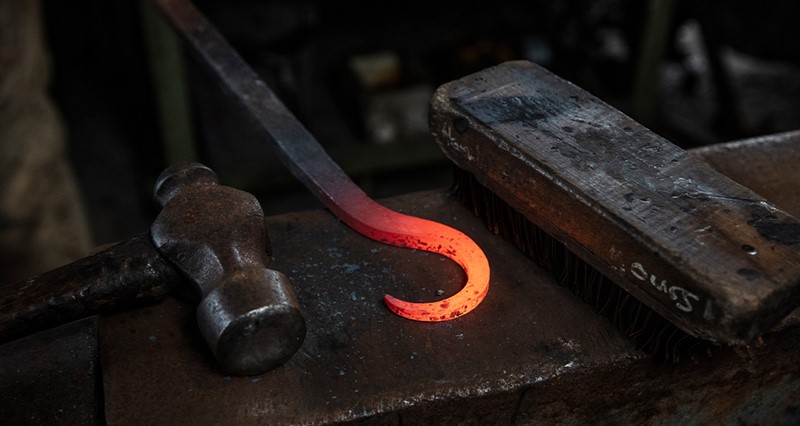
While some might baulk at the thought of writing 20,000 words alone, Daniel was also commissioned to produce all of what he called the ‘process photos’ himself. These are images of the different stages of forging and are particularly difficult to capture because the idea is to try and show how hot the metal should be at certain points of the process.
“Basically, I wanted to make sure that what I’m talking about in the book is clearly shown in each photo, and as best as possible, show the heat that should be worked at,” he explained.
“It was very tough, we had about ten seconds to take the photo and get everything organised. For the first project there was over 2,000 photos to go through.
“To be fair, it was pretty easy to pick as you get a lot with the hammer in the air so can clear a load of those straight away and then get it down to a few hundred and then, pick about ten for each project. We got there in the end. That was the most tedious bit of it all, but it was still fun.”
What’s next
With regards to what’s next, Daniel is keen to expand the teaching side of the business. “I do half-day and day courses at the minute, but I’d like to run more of a workshop where a group of people with a set goal can come and achieve that over the course of a few days from start to finish.
“I’d also still like to do day courses but teach different levels of blacksmithing because sometimes the abilities are mixed, from complete beginners to people with quite a bit of knowledge of metalworks and it would be nice to offer a bit more of an in-depth guide to blacksmithing for those individuals.
“And I don’t know how far into the future this would be, but I’d like to extend the workshop, perhaps even go into the stables, and have rental space for craft people. Having more crafts here and offering a different range of skills where we could all help each other and also help the farm.”