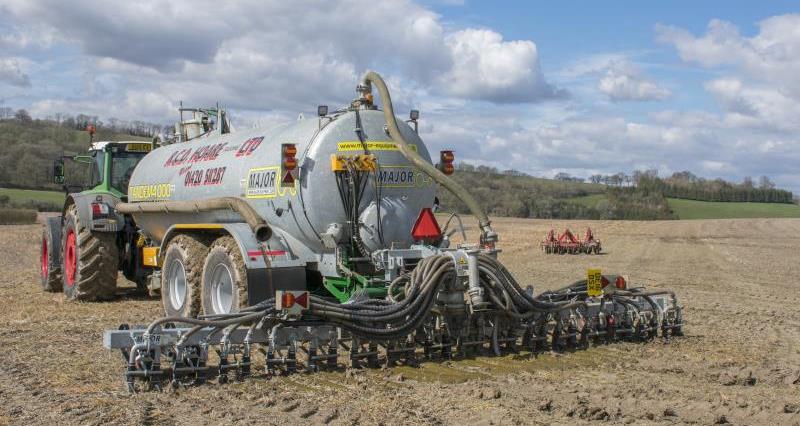
Every farming business in England must comply with the Farming Rules for Water. As well as protecting the environment, complying with these rules can help to reduce nutrient applications.
Introduced in 2018 across England, the Reduction and Prevention of Agricultural Diffuse Pollution (England) Regulations 2018, also known as the Farming Rules for Water, aim to prevent water pollution by regulating the use and storage of fertilisers and manures, and requiring that farmers take steps to prevent soil erosion.
There are 8 farming rules for water which farmers must align with where required:
Rule 1: Planning use of manures and fertilisers
Rule 2: Storing organic manures
Rule 3: Applying manures or fertilisers
Rule 4: Where not to apply organic manures
Rule 5: Where not to apply fertiliser
Rule 6: Reasonable precautions to prevent soil erosion
Rule 7: Protecting against soil erosion by livestock
Rule 8: Position of livestock feeders
As part of the inspection of on farm activities undertaken by the Environment Agency's agricultural regulatory inspection officers, compliance with the Farming Rules for Water will be assessed where applicable as part of a farm regulatory inspection. Read our guide on what to expect from an EA inspection to find out more.
The guidance to farmers on how to comply with the Farming Rules for Water and the guidance issued to the Environment Agency on how to enforce the rules have both recently changed. It is important that farmers monitor NFUonline and GOV.UK to ensure that they are familiar with the latest position.
Farmers should be aware that one of the important changes to the guidance is that manures and manufactured fertilisers should only be applied where there is an immediate crop and soil need. While this is a recent change to the guidance, it reflects what the legal position has been since the outcome of a judicial review in 2024, so it is likely that this is the approach which has been adopted by the Environment Agency since that ruling.
The 8 farming rules for water
Rule 1: Planning use of manures and fertilisers
Rule 1 requires that application of organic manures and manufactured fertilisers to cultivated land must be planned to:
- meet soil and crop nutrient needs at the time of application and not exceed these levels and
- not give rise to a significant risk of pollution.
Farmers must also take account of weather conditions and forecasts at the time of the application.
In assessing whether there is ‘significant risk of pollution’ farm managers must take into account the following factors:
- The slope of the agricultural land, especially if the slope is greater than 12 degrees.
- Any green cover.
- Proximity to inland fresh waters, coastal waters, and wetlands – You can use Magic Maps to assess proximity.
- Weather conditions and weather forecasts.
- Soil type and condition – improve organic matter to aid in nutrient retention.
- Presence and condition of agricultural land drains.
In addition, farmers must ensure that reasonable precautions are taken to prevent diffuse pollution. This includes:
- checking spreading equipment for leaks and calibration
- checking organic matter levels in, and moisture content of, soils, and
- incorporating organic manures within 12 hours of spreading, or as soon as possible, after application.
Your planning of nutrition applications must take into account where there is significant risk of pollution and the results of testing for phosphorus, potassium, magnesium, pH and nitrogen levels in the soil, which must be done at least every 5 years. You can determine soil nitrogen levels by assessing the soil nitrogen supply.
To fully understand the availability of nitrogen in your soils you can use a soil testing service to identify if there are opportunities to reduce nutrient applications which could save you money.
The NFU has partnered with NRM laboratories to offer a member exclusive discount on soil testing.
Rule 2: Storing organic manures
Organic manures must not be stored on land:
- within 10 metres of inland freshwaters or coastal waters
- where there is significant risk of pollution entering inland freshwaters or coastal waters, or
- within 50 metres of a spring, well or borehole.
Rule 3: Applying manures or fertilisers
Organic manures or manufactured fertilisers must not be applied:
- if the soil is waterlogged, flooded, or snow covered, or
- if the soil has been frozen for more than 12 hours in the previous 24 hours.
Rule 4: Where not to apply organic manures
Organic manures must not be applied:
- within 10 metres of any inland freshwaters or coastal waters, or within 6 metres of inland freshwaters or coastal waters if precision equipment is used, or
- within 50 metres of a spring, well or borehole.
Rule 5: Where not to apply fertiliser
Manufactured fertiliser must not be applied within 2 metres of inland freshwaters or coastal waters.
Rule 6: Reasonable precautions to prevent soil erosion
You should take all reasonable precautions to prevent significant soil erosion and runoff from:
- the application of organic manure and manufactured fertiliser
- land management and cultivation practices (such as seedbeds, tramlines, rows, beds, stubbles, including harvested land with haulm, polytunnels and irrigation), and
- poaching by livestock.
Rule 7: Protecting against soil erosion by livestock
Any land within 5 metres of inland freshwaters and coastal waters must be protected from significant soil erosion by preventing poaching by livestock.
Rule 8: Position of livestock feeders
Livestock feeders must not be positioned:
- within 10 metres of any inland freshwaters or coastal waters
- within 50 metres of a spring, well or borehole, or
- where there is significant risk of pollution from poaching around the feeder entering any inland freshwaters or coastal waters.
Planning applications of organic manures and inorganic fertilisers
Rule 1 requires that land managers ensure that, for each application of organic manure or manufactured fertiliser to agricultural land, the application:
- is planned so that it does not:
- exceed the needs of soil and crop on that land at the time of application, or
- give rise to a significant risk of agricultural diffuse pollution, and
- takes into account the weather conditions and forecasts for that land at the time of application.
Examples of plans include nutrient management plans or other written plans which show that you have planned applications of organic manure or inorganic fertilisers in line with the Farming Rules for Water.
Plans should:
1. Have a tailored approach
The application plan should be tailored to the specific needs of the land and crop rotation. It should support decisions regarding the timing and quantity of organic manure and manufactured fertiliser application.
2. Assess crop nutrient requirements
Assess the nutrient requirements of each cultivated land parcel. This assessment should be based on reliable sources such as AHDB’s nutrient management guide (RB209), or recognised farm software such as PLANET, MANNER-NPK, or other nutrient management tools such as those provided by Tried and Tested.
3. Consider professional expertise
You can seek guidance from a qualified professional, such as an experienced agronomist or a FACTS (Fertiliser Advisers Certification and Training Scheme) adviser. Their expertise can contribute to a scientifically sound application strategy.
4. Incorporate soil sampling and analysis
Incorporate the results of soil sampling and analysis into your plan. This information will help fine-tune the nutrient application to match the soil's existing composition and ensure efficient uptake by the crops.
The results of any soil sampling and analysis must be less than 5 years old at the time the application takes place, so it is important to ensure that sampling and analysis takes place at appropriate intervals.
5. Show nutrient content consideration
Account for the nutrient content present in the applied organic manures and manufactured fertilisers.
The nutrient content of organic manure can be identified using available and suitable nutrient management tools or manure testing, such as laboratory analysis or near infra-red sensors for liquid manures.
Statutory guidance: assessment of your crop and soil needs when planning
Land managers should plan to avoid significant risk of diffuse agricultural pollution. This includes not exceeding the needs of the soil and crop on the land, but also takes into consideration other factors including soil type, the slope of the land and weather conditions.
The EA’s view is that soil and crop need must be immediate at the time of application.
The EA will take an advice-led approach with farmers and give recommendations on how to comply with regulations and statutory guidance. Prosecution is usually left as a last resort when guidance has not improved issues on farm.
Defra’s statutory guidance says that you should plan to avoid applying organic manures that raise the soil phosphorus index (soil P index) above target levels for soil and crop on land, particularly when considering applying nutrients.
Statutory guidance: assessing the risk of agricultural diffuse pollution when planning
Plans should take account of how to avoid significant risk of agricultural diffuse pollution.
In all cases, land managers must take all appropriate reasonable precautions to help mitigate against the risk of diffuse agricultural pollution.
While this guidance is not expressly set out in the legislation, it provides some insight into the approach that the EA is likely to take when considering enforcement decisions.
Statutory guidance: assessment of reasonable precautions
To reduce the risk of soil erosion during the winter months, land managers should aim to have established green cover by 15 October each year. Green cover can include any commercial crop, green manure, or cover crop. Appropriate crops are the decision of the land manager.
Where land managers are not planning to establish green cover by 15 October, appropriate justifications must be demonstrated for leaving land bare over winter. This can include agronomic or environmental reasons, such as:
- Delaying drilling to enable activities to control persistent weeds, such as blackgrass.
- Leaving medium and heavy soils to weather before a spring root crop.
Statutory guidance: incorporation of organic manures
Land managers should incorporate organic manures into soils as soon as reasonably practicable to act as a reasonable precaution against diffuse pollution unless there are appropriate agronomic or environmental reasons not to.
If applying low RAN organic manures, you may justify delaying incorporation if it is not practical to do so within 12 hours of spreading and if you have assessed relevant risk factors as not being significant over the application and incorporation period.
The statutory guidance suggests that circumstances where the incorporation of organic manures may not be appropriate include, but are not limited to:
- If it is applied to a growing crop or grassland.
- If precision application methods for manures are used which mitigate diffuse pollution as well as, or better than, incorporation.
Farmers will need to be able to demonstrate that they have a good justification for any decision to delay incorporation or not to incorporate manures.
For the full guidance, head to: GOV.UK | Applying the farming rules for water