First launched in 2009 and conducted again in 2014, the NFU broiler shed age survey looks to provide much needed data to help inform the sectors lobbying work and policy decisions.
This latest 2025 survey highlights the need for investment in poultry housing in the UK in order to provide farmers with the best opportunities to meet animal welfare and environmental commitments, and also contribute positively towards overall food security.
What is clear, is that the UK broiler sector needs support, certainty and fairness applied across the supply chain if it is to remain strong in its production of quality, safe, nutritious and sustainably produced poultry meat.
“If the government is serious about strengthening food security, it must back British poultry with targeted investment and planning reform.”
NFU Poultry Board members Richard Williams and Matthew Donald
The results from previous surveys have been instrumental in NFU lobbying work over many years, highlighting where investment in infrastructure is needed and supporting our ongoing efforts in demonstrating the impacts of a broken planning system.
NFU Poultry Board members Richard Williams and Matthew Donald said: “The NFU’s broiler shed age survey lays bare the urgent need to build producer confidence and reassess investment in the sector.
“With the average broiler house now over 30 years old and refurbishment rates low, producers are being asked to meet higher welfare and environmental standards without any support for investment in infrastructure.
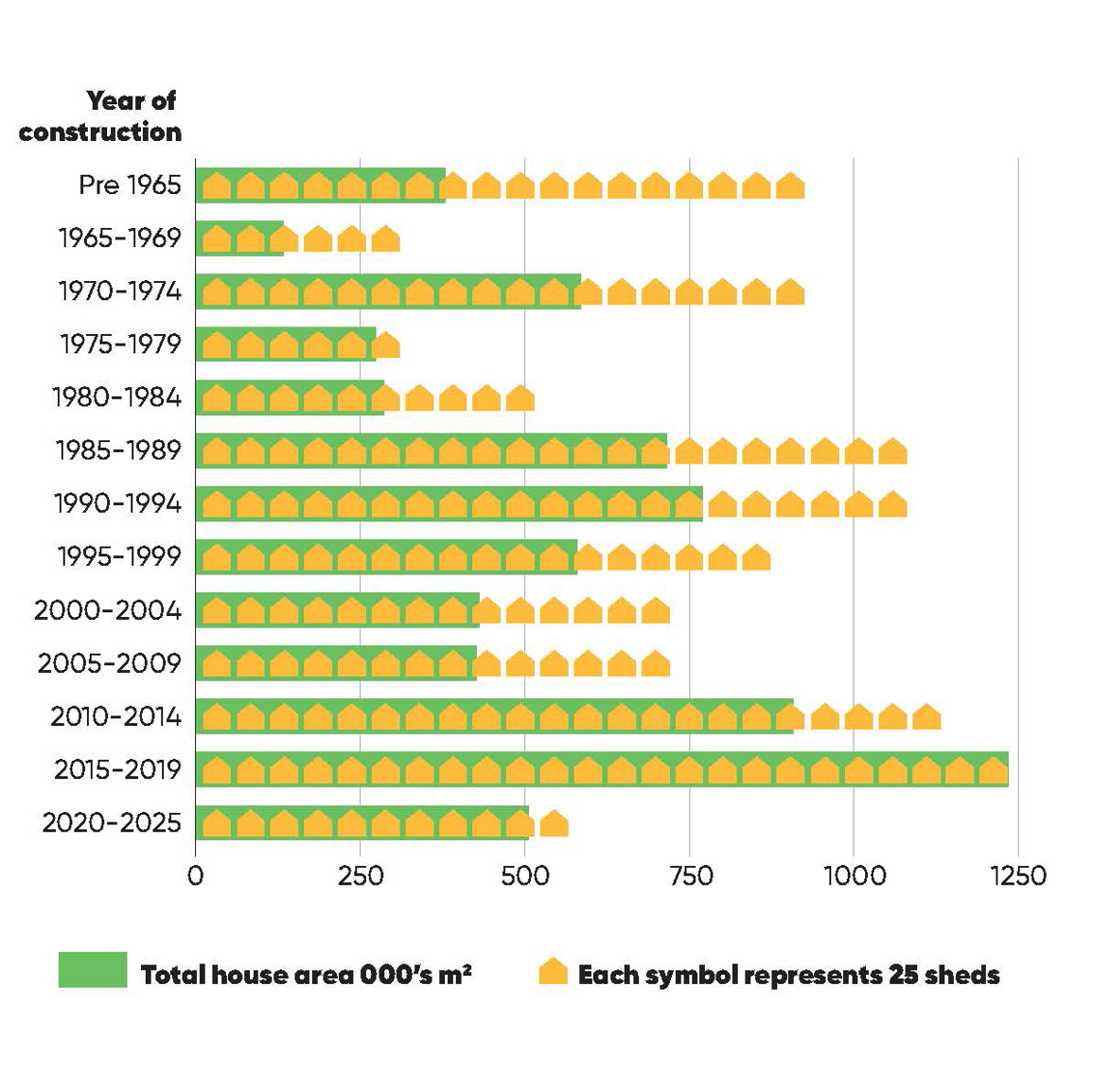
“We've seen a huge drop-off in broiler house building over the last five years which correlates with a dip in producer confidence. If left to fester this will significantly impact food security.
“If the government is serious about strengthening food security, it must back British poultry with targeted investment and planning reform. Fairness across the supply chain is also essential to rebuilding farmer confidence, enabling growers to invest in their businesses to ensure the continued production of high-quality, nutritious and sustainably produced poultry meat for the nation.”
Data gathered
The transition of much of the broiler sector in the UK to a stocking density of 30kg/m2 during the 2025 survey period has added complexity to the data.
However, given the number of houses captured and the high response rate from both the integrated and independent sectors, the NFU is confident that the survey has captured a significant proportion of the UK’s poultry houses.
The survey, which took place between February and April 2025, was the largest so far, capturing more than 5,000 poultry houses and 7.2 million m2 of productive floor space.
In comparison, our 2014 survey captured data from 3,210 houses with a combined area of 4.1 million m2.
In addition to updating the headline figures on house age, this year’s survey has also captured data on house type and house refurbishments. We also collected for the first time information on a regional basis.
These metrics all provide valuable insight which can be shared with key stakeholders when exploring various policy asks such as those related to planning, food security, grant funding and the competitiveness of UK production compared to the increasing threat of imported poultry meat produced overseas.
Productive area
Of the houses surveyed, the mean average age of a broiler house in the UK is 31 years by number of houses.
However, the survey also gathered data regarding the total floor space of each house which we felt was important as newer sheds tend to have a larger productive area than older ones.
By this metric, the average unit of productive floor space was 28 years of age.
This renewed data represents little improvement since the 2014 survey when the average poultry house was 32 years of age by number of houses or 27 years of age on the basis of productive floor space.
It also raises the question of decommissioned houses which requires further investigation.
Looking at the data in more detail shows that by productive area:
- 57% of broiler houses are at least 20 years of age,
- 51% are at least 25 years of age,
- 43% are at least 30 years of age, and
- 23% are at least 40 years of age.
Remarkably, 15% of broiler houses currently in production are at least 50 years of age.
Refurbishments
Unique to this year’s survey, we asked producers to report if and when a house had undergone a major refurbishment. The installation of windows was not regarded as a major refurbishment.
Of the 5,031 houses recorded in the survey, 876 (17.4%) had undergone refurbishment at some point in their lifetime.
Once these refurbishments have been considered:
- 44% of broiler houses are at least 20 years of age,
- 35% are at least 25 years of age,
- 27% are at least 30 years of age, and
- 11% are at least 40 years of age.
Interestingly, 7% of broiler houses currently in use have not undergone a major refurbishment since they were built at least 50 years ago.
Types of housing
Also unique to this year’s survey, we collected data identifying the different types of housing. This revealed that houses used to produce broilers for meat consumption were, on average, newer than those used to house breeding stock, as demonstrated by results shown in the table below:
| House type | Average age by number of houses (years) | Average age by house area (years) |
| Broiler houses | 30 | 27 |
| Broiler breeding houses | 33 | 30 |
Regional variation
Another first was asking participants to report where in the UK their houses were located. This information has provided valuable insight into regional variations in broiler house age across the UK.
The data shows that Northern Ireland has the newest houses across both measures, while the oldest houses were recorded in Scotland.
Within England, houses in the east of the country were notably older across both metrics than those in the north, south, or midlands.
Next steps
Moving forwards, data from this survey will help inform policy decisions and lobbying asks that centre around the sector needing supportive and proactive government decision making to allow producers to farm competitively and continue producing the nations favourite meat.
With producer confidence currently being low, this support is much needed to help promote investment in poultry businesses and future proof the sector.
While this is imperative for the profitability of poultry businesses, it is also important for those involved in poultry production to be confident to continue making a positive contribution towards the UK economy, as this will also help the government achieve its goals for food security and fairness in the supply chain.
More from NFUonline: