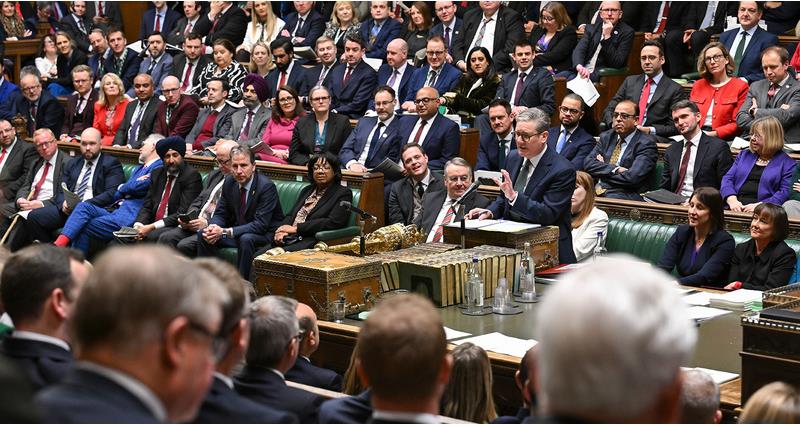
Every piece of legislation going through Parliament will have a Second Reading. This is usually the first opportunity for MPs to debate and vote on the Bill's main principles.
The Second Reading of the Finance Bill took place in the House of Commons on 16 December.
How is a Finance Bill different to other Bills?
A Finance Bill is slightly different. Because they enact Budgets, in this case the Autumn Budget, there has usually already been a few days’ debate following the Chancellor’s speech. During this year’s Budget debate for instance, plenty of Labour MPs stood up to speak out against the family farm tax.
This month’s Second Reading of the Finance Bill focused on the general principles of what the Chancellor set out in her Budget. The NFU sent a briefing to MPs to help them prepare for the debate which opened the Second Reading.
More on the Autumn Budget
Can the Bill be amended at this stage?
The crucial point for us is that no amendments to a Bill are allowed at Second Reading. Because there are no amendments to debate or vote on, there is just one vote for MPs to make – whether the Bill should proceed to the next stage on its journey into law.
As His Majesty’s Most Loyal Opposition, the Conservative Party tabled a ‘reasoned amendment’ that was voted on by MPs. Despite its name, a reasoned amendment does not change the contents of a Bill. The amendment stated that the Finance Bill should not progress further because it includes, among other things, the family farm tax.
How did MPs vote?
At Second Reading, MPs are given a yes/no (or aye/no) vote on whether a Bill progresses to the next stage. A reasoned amendment does not change that. It only allows MPs who want to stop the progress of a Bill to set out their reasons why.
In their amendment, the Conservatives said it should be stopped because of the family farm tax, changes to income tax thresholds, and increases in spending and borrowing.
While the NFU remains in close contact with Labour backbenchers on the family farm tax, we did not expect another parliamentary rebellion at this stage.
We understand that even those Labour MPs who previously abstained on Resolution 50 will still welcome the overall Budget package. It is important to remember that the Finance Bill contains lots of other changes as set out in the Chancellor’s Budget, for example, the removal of the two-child benefit cap.
It is not uncommon for MPs who vote in favour of the Bill (and against the reasoned amendment), to then back amendments at later stages.
It is at these later stages that greater protections for elderly and terminally ill farmers can be added.
Next steps
The House of Commons will rise for its Christmas Recess on 19 December. Therefore, the chance for MPs to carry out more detailed scrutiny of the Finance Bill, including the specific clauses on the family farm tax, will come in the New Year.
That means that there is still, after all this time, an opportunity for the government to act.
A rough timetable for the Bill has now been published:
Committee Stage will start on 12 January, with a deadline of 26 February.
This is the first time that MPs can put forward amendments to the Finance Bill.
Unlike most Bills, the Committee Stage for the Finance Bill will be broken down into two parts. The first – which is called Committee of the Whole House – allows all MPs to take part in the debate and to make amendments.
Usually, the most controversial elements are debated at this stage.
The second part of Committee Stage will see a handful of MPs selected to go through the Bill line-by-line. Only MPs on this committee can put forward amendments during this part.
After the Bill has gone through Committee Stage, it will have its Report Stage. This will be the final chance for all MPs to put forward amendments.
Report and Third Reading will happen on the same day. After this, the Bill will have completed its progress through the Commons.
At this point MPs will give their final approval to the Bill as amended.
NFU position
The NFU’s view remains that the Labour Party should keep its pre-election promise and reverse this tax. At the very least, the government should move its own amendment to the Finance Bill to remove the anti-forestalling clause. This clause specifically precludes elderly or terminally ill farmers from navigating these reforms.
If the government do not do the right thing, we will work with backbench MPs to put forward an amendment to the Finance Bill at Committee Stage so that the most vulnerable members of our community are protected.