Agricultural organisations from across the world have issued a joint statement calling for countries to follow best scientific practice and take a split-gas approach when reporting long- and short-lived GHG (greenhouse gas) emissions.
The statement, backed by 33 organisations from 14 countries – including the NFU – says a split-gas approach is needed to more accurately reflect the contribution of the agricultural sector to climate change.
The NFU believes the extra transparency of a split-gas approach will, over time, produce shifts in policy which better protect our future climate and more accurately reflect the contribution of the agricultural sector. GHG emissions must also be calculated as accurately as possible to help producers understand and reduce their emissions.
The letter represents unprecedented global consensus among industry groups and follows earlier similar calls from scientists.
“Accounting for agriculture’s greenhouse gas emissions is not straightforward, but our members are committed to reducing their emissions and the NFU will continue working with the government to ensure that future policy reflects both the latest science and the realities on farm.”
NFU President Tom Bradshaw
Focus on warming impact
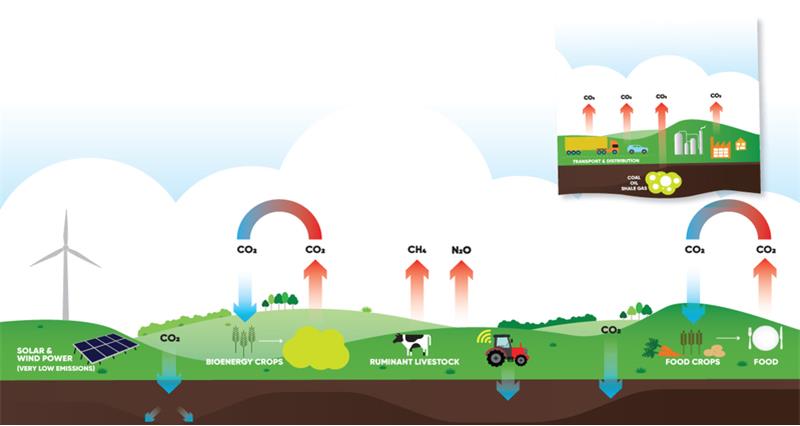
The letter, which calls on national governments to adopt a split-gas approach when reporting emissions, says the current single basket approach to convert all GHGs to a carbon dioxide equivalent (CO2e) using GWP100 ‘creates ambiguity by obscuring the warming impacts of the different gases’.
It says: “Although GWP100 works well when summing or comparing the warming impact of various long-lived GHGs (such as carbon dioxide and nitrous oxide), it does not accurately represent the warming impact of short-lived GHGs (such as biogenic methane).
“The science is clear: emissions of long-lived gases must reach net zero by reducing as far as possible and then balancing with carbon storage or removals to prevent further warming. In contrast, emissions of short-lived gases, like biogenic methane, only need to decline gradually to have the same effect. This fundamental difference in behaviour needs to be recognised in climate policy, and adopting a split gas approach is the most effective way to do so.”
The NFU sees split-gas reporting as an essential step to using a warming based metric in the future.
The letter also notes that a split gas approach does not limit the options available to policymakers, “as ambitious mitigation approaches for both long-lived and short-lived GHGs are possible with a split gas approach. Instead, it focuses policy on the warming impact of the GHGs and, therefore, on the warming impact between sectors.”
More on split-gas accounting
Transparency and accuracy
In October, the NFU updated its position on emissions reporting. The update encouraged government, industry and the wider food supply chain to report on GHG emissions using a split gas approach.
It also calls for a unified approach to dual accounting with government and industry reporting on emissions from agriculture at the national scale using GWP100 and a warming based metric.
Methane emissions reductions are a policy focus for the government and the newly published Methane Action Plan details key policies in progress and planned across agriculture, waste and fuel supply. For agriculture, farmers will be supported to 'reduce methane emissions alongside improving farmers’ productivity, resilience and help their livelihoods'.
NFU President Tom Bradshaw said: “Being part of the solution to tackling climate change has always been a priority for British farmers, and methane reduction is a key part of that.
“The NFU – alongside many other international farming organisations – advocates for a split-gas approach, which distinguishes between short-lived gases like methane and long-lived gases like carbon dioxide. This will help producers have a greater understanding of emissions on their farm allowing for better targeted mitigations, and more accurate measurements will enable science-based policy decisions that more clearly recognise the progress UK agriculture is making.
NFU Livestock Board Chair David Barton speaking from the World Meat Congress
“Government investment to allow farmers to access the tools and technology that are needed to further reduce emissions is essential. Accounting for agriculture’s greenhouse gas emissions is not straightforward, but our members are committed to reducing their emissions and the NFU will continue working with the government to ensure that future policy reflects both the latest science and the realities on farm.”
Next steps
The group is requesting that countries making commitments to reduce their GHG emissions ‘do not bundle methane and carbon dioxide together’.
‘Establishing a separate pathway for short-lived emissions opens up a new conversation about what are ‘fair and achievable’ emissions reductions for global agriculture.’
Who's signed the letter?
- Argentina – Mesa Argentina de Carne Sustenable
- Australia – Australian Wool Innovation Ltd, Cattle Australia, Sheep Producers Australia
- Cambodia – Cambodian Farmer Federation
- Canada – Canadian Cattle Association, Canadian Federation of Agriculture, Canadian Sheep Federation
- Colombia – Federacion Colombiana de Ganaderos
- Georgia – Georgian Farmers Association
- India – United Farmers Front
- Ireland – Irish Farmers Association, Meat Industry Ireland
- Kenya – Kenya National Farmers Federation
- New Zealand – Beef + Lamb New Zealand, DairyNZ, Federated Farmers of New Zealand
- South Africa – Red Meat Industry Services, Southern African Agri Initiative, TLU SA
- United Kingdom – British Meat Processors Association, National Farmers' Union, National Sheep Association, Quality Meat Scotland
- United States – Meat Institute, National Cattlemen’s Beef Association, US Roundtable for Sustainable Beef
- Uruguay – Asociacion Rural, Cooperativas Agrarias Federadas, Federación Rural
- Global/International – Global Roundtable for Sustainable Beef, International Wool Textile Organisation