
2026/27 contract options
The 2026/27 contract gives growers three price options:
- A fixed price at £30/tonne for up to 65% of contract tonnage (referred to as the fixed price in this article).
- A base price of £25/tonne plus a market linked bonus for up to 100% of the contract tonnage (referred to as the ‘market-linked’ price). This price will depend on the future direction of the UK sugar price.
- Index-linked contract (previously known as the futures-linked contract) for up to 50% of the contract tonnage (referred to as the ‘index-linked’ price). This price will depend on the future direction of the world No.11 sugar price and the £/US$ exchange rate.
In this article, we will consider the market prospects for both the world and UK markets to consider how the ‘market-linked’ and ‘index-linked’ price options stack up against the fixed price of £30/tonne, and also against each other.
Prospects for the market-linked price
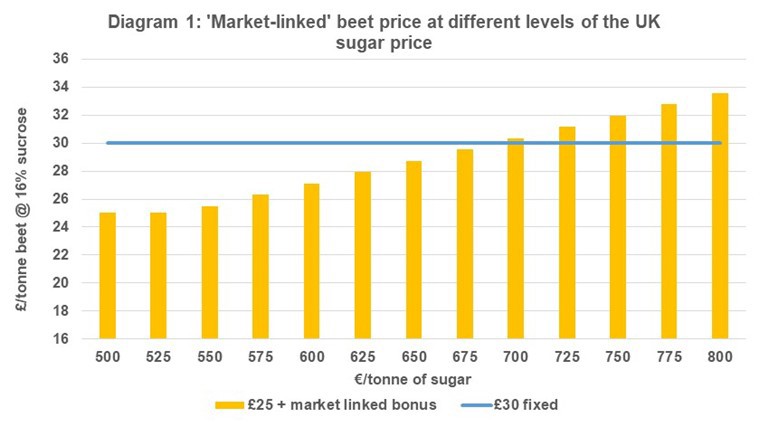
Diagram 1 compares the beet price offered, the ‘market-linked’ price at different levels of the UK sugar price and compares it to the fixed price option. It shows that this price contract will offer a price of around £30/tonne if the UK sugar price reaches €700/tonne, ex-works.
To put this figure in context, the UK price for 2025/26 has been around €600/tonne, ex-works in recent months, but has fallen below this level recently. It is also important to bear in mind that British Sugar may have already sold forward some of the tonnage for 2026/27. If it has, it is very likely that this sugar will have been sold at a price below €700. This means that future sales will need to exceed €700 in order to achieve that as an average figure.
What are the early prospects for UK prices in 2026/27?
The 2026/27 crop year is still more than 12 months away. However, early indications are that beet area is likely to fall again, albeit by less than the 9% reduction in 2025/26.
As we have discussed in previous editions of the Beet Brief, EU processors were looking for sugar prices around €600/tonne, ex-works Northwest EU for 2025/26 sugar. They argued that higher prices were needed to help improve their financial position, with several processors reporting losses in recent financial statements. However, weaker world prices and a strengthening euro have meant that imports have been able to enter the EU at prices well below €600/tonne, undermining this effort. On top of this, the prospects for this year’s beet crop on the mainland are improving with above-average yields expected in many countries. This has put some processors under pressure to sell and has pushed prices down to around €500-550/tonne, ex-works Northwest EU.
Thinking ahead to 2026/27, processors need higher prices to improve their financial results. This most likely way that this can be achieved is if area continues to fall, thereby increasing the EU’s import requirement.
Diagram 2 considers how far EU and UK area would have to fall in order for the EU and UK’s import requirement to exceed the amount of duty-free sugar that can be supplied to the market. It shows that, if the area was to fall by around 3% or more, and yield return to normal, it will be possible for processors to argue that duty-paying imports will be needed to meet demand when sugar prices for 2026/27 are negotiated in mid-2026.
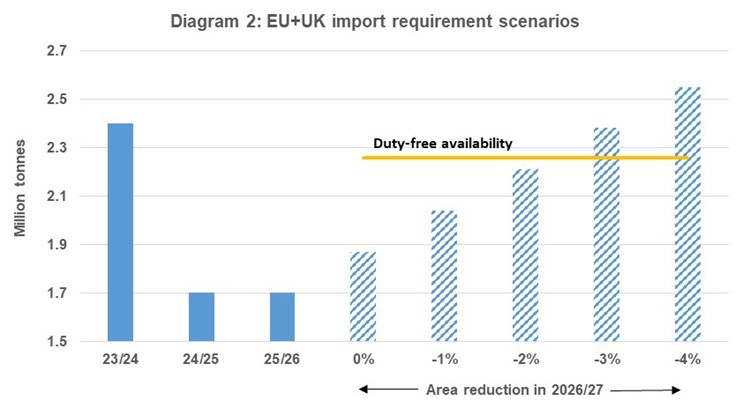
The need to pay a duty would raise the cost of imports by around €100/tonne (this is approximately the level of the import duty for so-called CXL sugar). However, at current world prices, this would only bring prices in Northwest EU towards €600/tonne, implying prices in the region of €630-650/tonne in the UK (prices in the UK are normally higher than Northwest EU because the UK is a deficit market and some sugar has to be imported from mainland Europe which incurs transport costs).
If this price level is achieved for all sugar sold, it would result in a beet price in the region of £28-29/tonne under the market-linked price option (as shown in Diagram 1). But the outcome will depend on the scale of the area response across Europe and there remains a risk that the area response will be insufficient.
Furthermore, with some 2026/27 sugar likely to have already been sold, it might be reasonable to expect a price a little below this.
In conclusion, based on the information that we have today, we would expect the market-linked bonus for 2026/27 to be triggered, but matching the £30 fixed price would require a change in world market conditions.
Prospects for the ‘Index-linked’ contract
This brings us to the prospects for the world market, which will also be the key determinant of the ‘index-linked’ contract price.
The launching price for this contract will be £25 minus the service fee. Diagram 3 shows the beet price that growers can expect under the ‘index-linked’ beet price at different levels of the No.11 world sugar price. It is important to note that the prices in the diagram assume the March 2026 No.11 price on launch day is 16 cents/lb; a different launch day price will move price up or down. However, unless market conditions change dramatically between now and launch day, it gives a reasonable estimate of the prices that a grower might expect to receive.
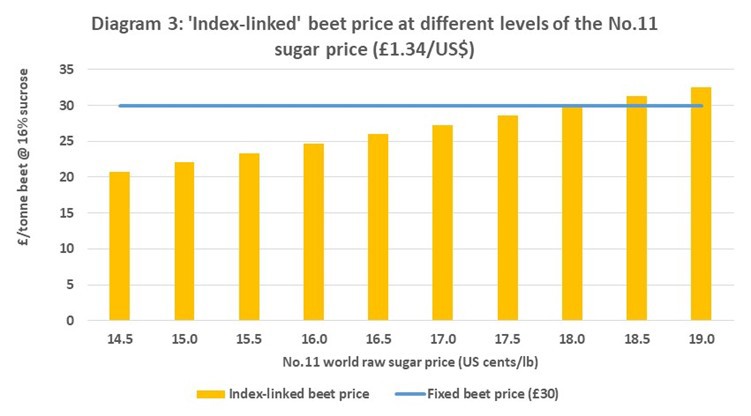
Note: Assumes that the October 2026 No.11 price on the day of launch is 16 cents/lb (in line with recent prices).
Since our last report, world sugar prices have come under pressure from crop results in Brazil, which have been better than expected. As a result, sugar production estimates have risen back above 40 million tonnes. This has pushed October 2025 prices below 16 cents/lb and back into territory where Brazil might alter its product mix in favour of ethanol.
Even looking beyond the near term, the prospects for world sugar prices in 2026 do not look particularly promising:
- Brazil has replanted a lot of cane this year following the wildfires of 2024. This area will be available to harvest in 2026/27, which is likely to increase the size of the cane crop. Some estimate that sugar production could be two million tonnes more than this year if sugar prices are more attractive than ethanol.
- Elsewhere, even with sugar prices at current levels, cane continues to look more attractive than alternative crops in India and Thailand, suggesting the cane area will continue to recover in these countries.
- While consumption will continue to grow as the world’s population increases, there remain concerns that it is growing at a slower rate than in the recent past.
In this environment, it will be difficult for sugar prices to break away from ethanol parity in Brazil and will be capped by the price at which India is willing to export sugar in 2026. Unless we see a dramatic change in oil prices or the value of the Brazilian real, this is likely mean prices spend most of their time in the 14.5-17.0 cents/lb range and current futures are already reflecting this. This gives beet prices on the index-linked contract of roughly £20-27/tonne assuming the current £/US$ exchange rate for October 2026.
At first sight, this assessment does not make the index-linked price look very attractive. However, an important difference between the index-linked price and the market-linked price is that the index-linked price allows growers to price their beet at any time giving them much greater control and, potentially, meaning they are able to capture any short-term sugar price rallies.
A close eye should also be kept on prices prior to launch; the lower March 2026 No.11 prices go in the run-up to the launch day (yet to be announced) when the price is set at £25, the better the potential price outcome for growers in the following months.
So, while the general outlook does not look particularly positive, there could still be opportunities to achieve a price above the launch price. Opportunities to price could be created by:
- The weather. It goes without saying that this is an unknown, but it can have a huge impact on sugar price levels over the course of the next 12 months. At the moment, the global weather is being characterised by ENSO-neutral conditions, but NOAA (National Oceanic and Atmospheric Administration) predict there is a 70% chance of a La Nina weather pattern emerging in Q4 of this year. A strong La Nina is associated with drier conditions during the Brazilian summer, which could affect prospects for their 2026/27 crop. However, the current forecast is for a fairly weak event
- Tightness in Q1. The world sugar market tends to be tightest in Q1, which is Brazil’s off-crop period. While 2026 could be a surplus year, there is potential for a more balanced market situation in Q1 (see 'A trader’s view' below, for further comment). If this scenario occurs, there could be opportunities to achieve a better price than indicated. However, these are likely to be capped by India, which is likely to be willing to export sugar at 17 cents/lb or so, depending on the level of domestic prices in India at the time.
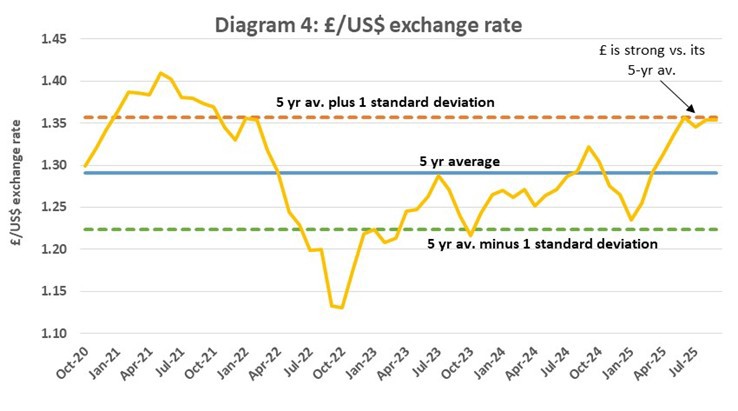
The other consideration is the £/US$ exchange rate, which also has a significant influence over the index-linked beet price. The uncertainty over the US tariff policy continues to cast a shadow over the prospects for the US economy. While some free trade agreements have been signed, there are many that have not. This has kept the US dollar under pressure and means that the UK pound is strong relative to its five-year average.
If the situation in the US improves (eg, President Trump signs more trade deals or backs down on the tariffs), the dollar could regain some of its strength. This would help the index-linked beet price. For example, if we consider a scenario where, after the index-linked beet price launch, the UK pound weakens from its current level (£1.34/US$) to its 5-year average of £1.29/US$ (the blue line on the chart), it would increase the beet price received by £1.5-2.0 per tonne with no change in the prevailing sugar price.
In conclusion, while the outlook for world market fundamentals (supply and demand) do not look supportive for sugar prices, weather volatility and exchange rate movements could provide opportunities to achieve a price above the launch price. However, to match the fixed price, a change in the market outlook is required. Growers choosing the index-linked price will need to be vigilant to world price movements; price alerts available on the Czapp pricing tool can help growers do this.
Conclusion
There are a lot of factors for growers to consider when weighing up the contract options. The table below summarises the considerations when comparing the market-linked and index-linked contract options, which will account for at least 35% of a growers tonnage.
Key features of the market linked vs. index-linked contract
| Market-linked contract | Index-linked contract |
|
|
A trader's view

NFU Sugar Board appointee Paul Harper
Paul has spent his entire career in commodities and has been in sugar since 1976. He joined C Czarnikow in 1973 working in their London, New York and Singapore offices. Paul has a huge amount of consultancy experience, having consulted for a hedge fund, major bank and a large trade house in sugar during that time.
The market has continued its downward trend since our last review with the October 2025 falling towards 15 cents/lb. Prices subsequently moved back towards 16 cents/lb but heavy selling has prevented them from recovering back above this level.
Crops around the world look to be improving with more favourable weather, especially in Europe and India, aiding production.
It would appear from statistics that supply/demand figures for the coming year show a balanced market at best and a significant surplus at worst. Weather, as always, will continue to be a threat but as things stand, a surplus looks more likely.
Fund speculation is at a significant level. They are currently 7.5 million tonnes short with effectively no sugar to deliver. In the short term, this is unlikely to be a major issue, however, should statistics tighten for any reason early next year, with the market looking more balanced in the first quarter, there is the possibility that a short covering rally may occur.
While this may be more reflective in the spot March 2026 futures price, prices further forward will likely improve too. This might offer a small window of opportunity to obtain slightly better value against the index-linked contract which is based on the October 2026 position.
Overall, sugar looks likely to remain mostly on the defensive, price wise, unless unforeseen weather problems decide otherwise. Consumption is rising at a slower rate and production continues to be strong in the major growing regions which appears likely to lead to a surplus overall for some time to come.
- Though not currently present in sugar beet in the UK, SBR disease is becoming an increasingly prominent issue on mainland Europe. It is under close surveillance by the BBRO.
- NFU Sugar continues to advocate for efficient, risk-based pesticides regulations and a comprehensive set of plant protection tools to control for existing and emerging pests.