

World market developments
No.11 sugar prices have dropped again over the past week or so, with the October 2026 contract falling from around 16 cents/lb to the low 15s.
The big picture story remains that a global production surplus is expected in 2026/27 and this continues to exert pressure on prices. While a La Niña weather event has been confirmed, the perceived threat to global production has eased with a return to neutral conditions expected during Q1 next year.
Further pressure on sugar has come from falling oil prices, which dropped on renewed trade tensions between the US and China and concern over what this could mean for global economic growth. It is likely that speculators have increased their short positions over the last couple of weeks, although this cannot be confirmed, with the US government shutdown meaning this data is not currently reported.
Falling oil means that there is now scope for Brazil to lower gasoline prices, which would be negative for ethanol, and in turn, sugar. This is because it would lower the sugar price at which Brazilian millers will switch away from sugar in favour of ethanol. This will depend on future oil price movements, but it could be as low as 14 cents/lb during the harvest next year.
Finally, the news from India is that cane-based ethanol is being displaced by ethanol produced from grains. This could increase the amount of sugar available for export, although this will only be sold if world prices rise to a level where it is close to the returns from the domestic market.
Despite the generally negative recent news flow, there remain some potential positives:
- Producers in inland states of Brazil only favour sugar when the price is 1.5 cents/lb above the ethanol price in São Paulo, the main producing region. This means Brazil will not maximise sugar production when prices are below 15.5 cents/lb (October 2026 is slightly below this at the time of writing).
- At current price levels, some analysts point to a reasonably tight trade balance for sugar over the next six months before tipping into surplus from Q2 2026 onwards.
- The market continues to carry a large net short position held by speculators, which could create upside if, for example, global weather was to become less favourable.
Lower prices now could be positive for the index-linked price later
While lower world prices are never good news, because of the way in which the index-linked beet price is set at launch, the recent drop in world prices is not necessarily a bad thing and might actually be helpful for those farmers looking to sign up for the index-linked price.
To explain, at the launch, the index-linked beet price is set at a level where it matches the base price for the market linked contract (£25/tonne minus service fee). The price then moves with the October 2026 No.11 price and the £/US$ exchange rate thereafter. While there are no guarantees, this means that the lower the October 26 price is at launch, or the stronger the UK pound, the more potential upside there is for the beet price thereafter.
The table below shows some examples of how this works. Across the top, the table shows different levels of the October 2026 No.11 price at the time of launch. On the left-hand side, it shows the same October price after launch. In each case, when the No.11 price after launch matches the No.11 price at launch, the UK beet price equals £24.66 (£25/tonne minus service fee), shown in bold in the table.
This highlights the importance of the No.11 price when the index-linked price begins. To take an extreme example, if No.11 price at launch was 14 cents/lb and the price subsequently rallied to 18 cents/lb, the UK beet price would rise from £24.66 to over £35/tonne (first column in the table). But if the rally to 18 cents/lb took place prior to launch and the October No.11 remained steady thereafter, the UK beet price would remain unchanged at £24.66 (final column). The index-linked price is also sensitive to the value of the UK pound in a similar way.
Table 1: UK beet prices at different Oct 26 No.11 prices (£/tonne beet)
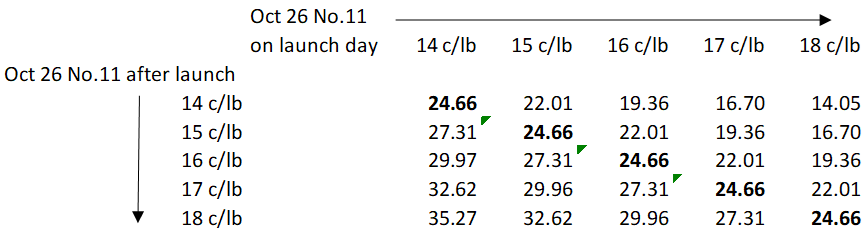
Note: The table assumes that the £/US$ exchange rate remains at £1.33/US$ in all cases.
This highlights why the recent fall in the October 26 No.11 might turn out to be a positive thing.
Diagram 1 shows the value of the index-linked beet price with a launch price of 16 cents/lb (the approximate price in early October) compared to its value if it was launched at 15.3 cents/lb (the approximate price at the time of writing). It shows that the recent price drop would raise the value of the index-linked beet price by close to £2/tonne for a given No.11 price.
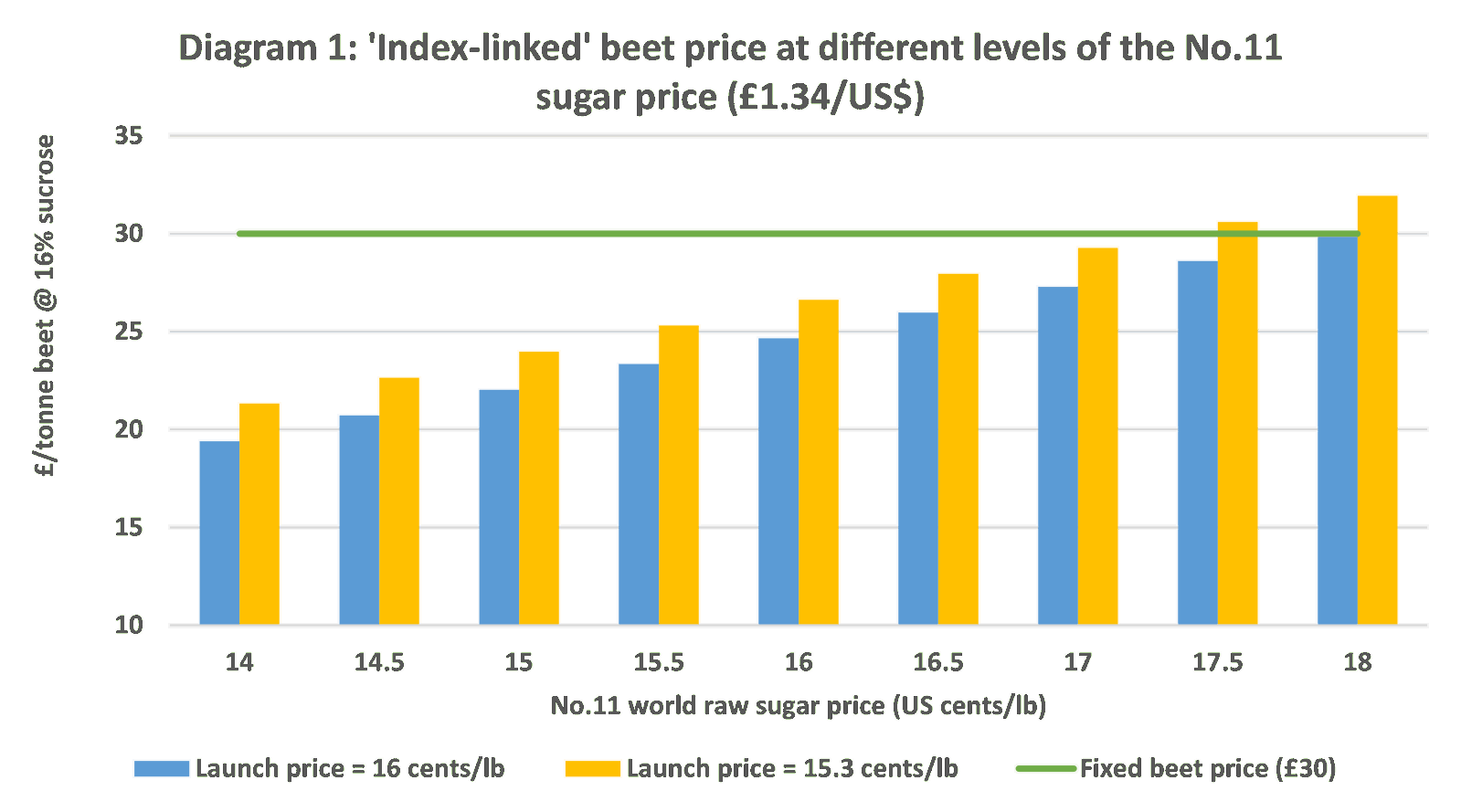
Of course, with launch day likely to be in late November (no official date has been set), there is still plenty of scope for this to change again, highlighting that growers are exposed to the risk of movements in the No.11 and £/US$ exchange rate between contracting and the launch of the index-linked price.
It is important to note that after the contracting window closes, there is a two-week cooling off period. It is possible to change your exposure to the index-linked beet price during this period. However, it is important to note that growers will always face some exposure in the 1-2 days between the cooling off period ending, upon which they are unable to make changes, and the index-linked price being launched.
EU market developments
In our last edition, we reported that EU prices had been falling on the back of improved crop prospects. This process has continued, with prices in Northwest EU falling to around or slightly below €500. As we have discussed in the past, processors had been holding out for prices around €600. However, some buyers did not bite, only covering their needs for Q4 and waiting to see what happened.
Falling world prices and a stronger euro, combined with improving crop prospects meant that the buyers eventually won, with processors having to lower their prices as it became clear they had plenty of sugar to sell.
In the UK, prices are also reported to have fallen from around €600, ex-works towards €530-540/tonne.
However, anecdotal reports continue to suggest that buyers were more heavily covered than on mainland Europe.
Falling sugar prices across the EU could help reduce area for next year. It is very early, but the current consensus is for an area reduction in the EU and UK as a whole in the region of +/- 3% in 2026/27. This would be much less the reduction in 2025/26 but, assuming a return to average yields, this could still help to support the EU price relative to the world market.
A trader's view

NFU Sugar Board appointee Paul Harper
Paul has spent his entire career in commodities and has been in sugar since 1976. He joined C Czarnikow in 1973 working in their London, New York and Singapore offices. Paul has a huge amount of consultancy experience, having consulted for a hedge fund, major bank and a large trade house in sugar during that time.
The market is firmly in a bearish pattern with any attempted rally being halted with producer selling and continued selling from speculators. This element of the market now sits at around 8.5 million tonnes short, having added an additional 1 million tonnes to their short position over the past month.
The weather is not causing any major issues around the world and early signs are that the European crop is getting off to a solid start. The white premium (the difference between the No.5 white sugar price and the No.11 raw sugar price) has experienced downward pressure, and the price of European white sugar has declined in response.
Demand, even at the lower price levels, has been sporadic and until we see more consistent interest in buying there appears to be no pressure on speculators to cover their shorts positions, with more selling appearing as new low levels are reached.
With improving crop prospects almost everywhere, it is difficult to find a reason for the market to sustain a rally. The most bullish aspect, at present, is that the short position held by speculators.
Unfortunately, for the time being, that is not enough to change either the market direction or sentiment.