The two met at Cereals 2023, where they first encountered Firewater, a plasma-activated water technology inspired by lightning. Their shared interest in practical, on-farm innovation set the foundations for an ADOPT project, which is now underway.
Both farmers were looking for ways to reduce nitrogen use, lower input costs, and improve environmental sustainability. Fertiliser prices, regulatory pressure and the need to cut carbon footprints have made alternative nutrient sources increasingly important.
But for smaller and medium-sized farms, accessing innovation can be difficult. As Tim put it, “Smaller farmers don’t know about this stuff. They don’t have managers and advisers reading everything for them.”
The ADOPT programme offered a route to trial a high-risk, high-potential technology without carrying the full financial burden.
“If you believe in it, you have to do it. ADOPT makes it possible, even if it’s clunky, it pays and it gives what you’re doing credibility.”
Staffordshire NFU member and arable farmer Tim Ellis, farming on 330 acres
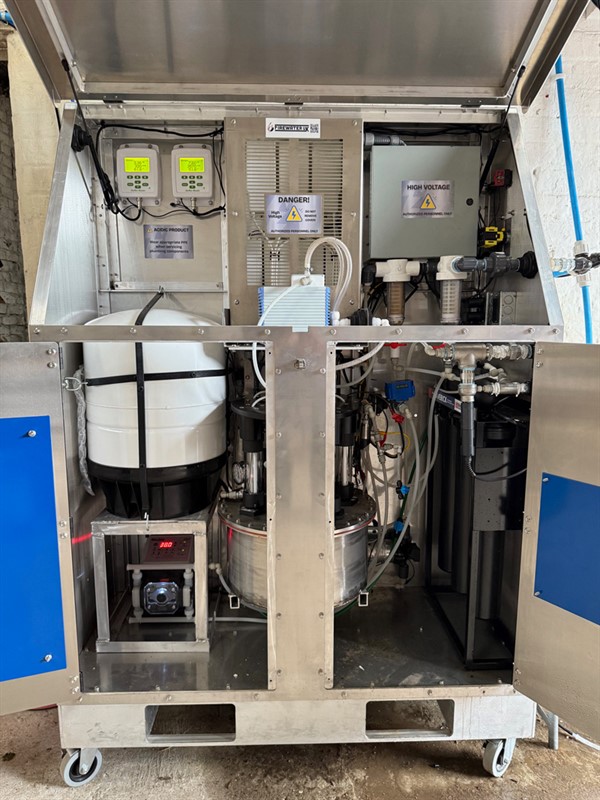
The innovation: Firewater plasma-activated water
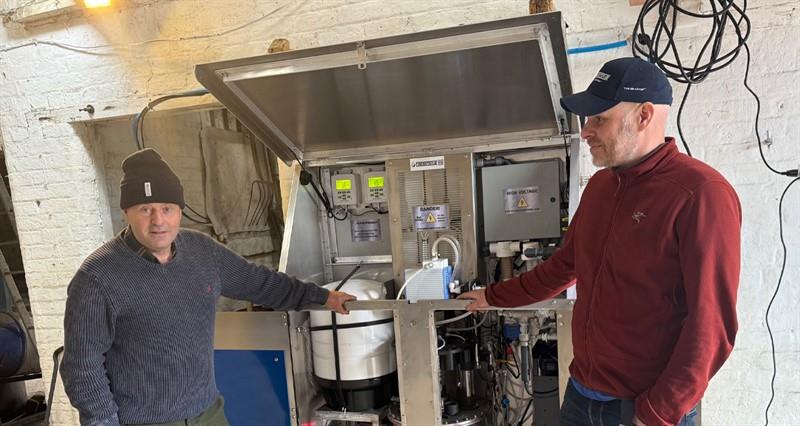
Firewater uses plasma technology to convert nitrogen from the air into a plant-available form using only water and electricity.
The system applies a controlled electrical discharge to water, creating conditions similar to those that occur during lightning.
This breaks apart atmospheric nitrogen molecules, which then combine with oxygen to form a dilute nitrogen solution that can be applied to crops.
The machine runs continuously and consumes relatively low electricity. The output is a clear, slightly acidic solution that contains small amounts of nitrate and other reactive nitrogen compounds.
Although the nitrogen concentration is low, trials in the United States have shown measurable crop responses, which is why UK farmers are now testing the technology through ADOPT.
Simon and Tim’s project represents the first Firewater machine to be brought into the UK, now in its tenth development iteration.
The ADOPT project
After hearing about ADOPT at Cereals, Tim contacted a facilitator, who helped shape a proposal to test Firewater as a nitrogen replacement and explore wider input-reduction potential.
The project successfully secured ADOPT funding for Round 2, enabling the purchase of a £36,000 machine and providing the financial safety net needed to trial something new.
The machine is currently based on Simon’s farm, and Tim hopes to secure his own machine as the trials progress.
The project includes tramline trials in spring barley and winter wheat, alongside a 10-acre potato field. The farmers are monitoring power use, water quality, nutrient interactions and crop response. Next year, ADOPT funding will support a dedicated trialist to ensure robust measurement and reduce the burden on farm staff.
Early insights showed promise
The machine has been running reliably for the past few weeks, with only minor technical refinements needed.
Early observations suggest the potential to replace around 50% of nitrogen on some crops, with particularly strong responses in potatoes.
Results on cereals are promising, though not yet at the 75% N-reduction levels reported in some US trials. Water quality is proving important, rainwater performs best, and the farmers are beginning to see crop responses that mirror those observed in America.
Barriers and challenges
One of the biggest hurdles is regulation. Plasma-activated water does not fit neatly into existing categories.
As Tim put it, “Is it water? Yes – with a little bit of N.” Regulators are unsure how to classify it, which slows commercial rollout.
Awareness is another challenge. The technology represents a “completely different way of doing things”, but is largely unknown, and farmers struggle to find reliable information.
Funding systems can also be confusing; Tim found the process manageable only because he had facilitator support. “You need a facilitator. You can’t apply without one.”
Technical refinement is ongoing, but reliability is improving with each generation of the machine.
Benefits of ADOPT
Both farmers were clear that ADOPT has been essential.
It de-risked the investment, gave the project credibility, and enabled the first UK trials of a potentially transformative technology. It also opened doors to further ADOPT applications and provided a structure for collecting meaningful data.
Environmental and productivity benefits
By reducing fertiliser use, Firewater has the potential to significantly lower carbon footprints and improve nutrient efficiency. Both farmers believe it could form part of a wider shift towards more sustainable, input-efficient farming.
“There might be hundreds of good ideas out there. This one could bring some revolution.”
Future plans
The next steps include expanding trials across more crops and soil types, working with regulators to establish a clear classification pathway, and exploring whether future machines could be eligible for grant support.
Both farmers also want to increase awareness of the technology across the wider industry, so others can follow the progress of the trials and understand how the system performs under UK conditions.