5 key Autumn Budget asks – NFU writes to the Chancellor

NFU President Tom Bradshaw told Chancellor of the Exchequer John Healey the Budget must pull farms out of survival mode and restore farming business confidence. Photgraph: Richard Townshend Photography
The Budget must be “relentlessly focused” on strengthening Britain’s food security, NFU tells Chancellor John Healey who is set to outline the government's plans for tax and spending in late October.
The NFU is urging the Chancellor to use the upcoming Budget to reduce the cost of producing food, restore farm business confidence and strengthen Britain’s food security.
In its detailed submission to HM Treasury, the NFU warns that a combination of drought, disease and geopolitical turmoil has pushed British farms “to the brink”, severely weakening the resilience of farm businesses and homegrown food production, and by extension our national security.
“For farmers and growers, this year has been bleak,” NFU President Tom Bradshaw said.
“Rising production costs due to global conflicts, the worst drought in 50 years and the largest-ever bluetongue outbreak have pushed many farm businesses to the brink.
“No sector has been left unscathed, confidence is low and investment has suffered.”
“I urge the government to use this Budget to pull farms out of survival mode, restore confidence and provide the foundations we need to produce high-quality, affordable food, whatever lies ahead.”
NFU President Tom Bradshaw
What is the NFU asking for?
The NFU submission argues that investment in farming is a direct investment in national resilience, supporting the 29 million UK households that depend on an affordable and secure food supply.
It positions farming as uniquely placed to deliver on the prime minister’s ambition of economic growth across the country, and as the backbone of a food and drink sector worth £162.3 billion, that supports 4.1m jobs.
In the submission, the NFU calls on the Chancellor to prioritise five measures that will build business confidence, unlock investment and help secure the future of British food and farming:
- Increase the Annual Investment Allowance to at least £5 million and extend its scope, supporting long-term investment in productivity, energy efficiency and water management.
- Provide funding for temporary interest-free Keep Britain Growing Loans, helping businesses hit hardest by this summer’s challenges to continue producing food next year.
- Ensure the Carbon Border Adjustment Mechanism does not put domestic food producers at a disadvantage to imports.
- Remove changes to Agricultural Property Relief and Business Property Relief, giving farm businesses greater confidence to invest, grow and plan for succession.
- Introduce enhanced capital allowances for incorporated and unincorporated businesses, encouraging investment in low-carbon technology and infrastructure.
These measures will be central to the NFU’s engagement with ministers, policymakers and party members at the Labour Party Conference.
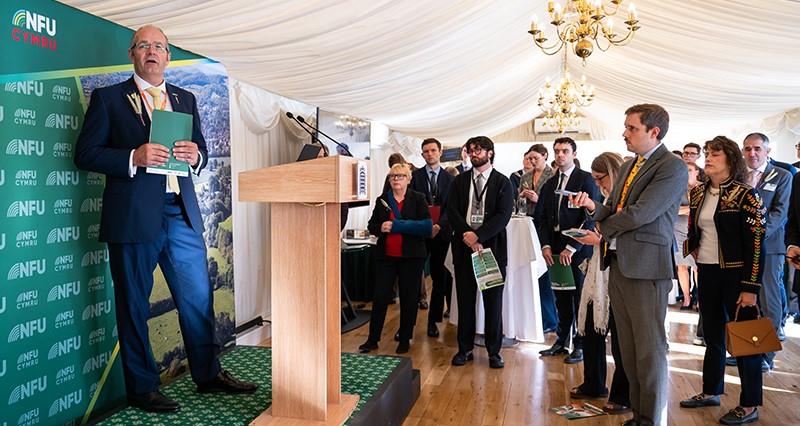
NFU President Tom Bradshaw talks at the 2026 Back British Farming Day parliamentary reception
Out of survival mode
“While we can’t control global volatility, we can take control of our food system here at home. The challenges facing farmers are neither inevitable nor irreversible,” Tom added.
The intervention comes after the NFU’s recent Ready to Grow report showed the UK’s ability to feed itself in ten out of 11 everyday food categories has declined significantly in the past 30 years.
Tom said the government had already recognised that “food security is national security”, but that the principle now needed to be backed by economic policy and investment.
“Resilient farm businesses should be considered a strategic asset. They produce the food we all depend on and, with the right fiscal policies, can help protect households from the effects of economic and climatic shocks.”
Strengthening Britain’s food security
Tom continued: “The Budget must be relentlessly focused on reducing the cost of producing food in Britain. For some businesses, this is about immediate survival and their ability to produce food next year. For others, it is about unlocking investment, building resilience and reversing the long-term decline in domestic food production.
“It’s also about giving farming families the confidence that their farm can be passed to the next generation.
“I urge the government to use this Budget to pull farms out of survival mode, restore confidence and provide the foundations we need to produce high-quality, affordable food, whatever lies ahead.”
“While we can’t control global volatility, we can take control of our food system here at home. The challenges facing farmers are neither inevitable nor irreversible.”
NFU President Tom Bradshaw
How is the Budget produced?
The Budget, due to be announced on 28 October, will outline the government’s economic strategy and present detailed tax and spending plans for the upcoming financial year.
It is a blueprint for how the government intends to raise revenue (through taxes and other means) and how it plans to allocate spending across various sectors and government departments including those relevant to farming such as Defra and the Department for Business and Trade.
The creation of the Autumn Budget is a collaborative process that involves various government departments, agencies, and consultations with independent bodies.
The Treasury, led by the Chancellor of the Exchequer, is responsible for the overall production of the Budget. Treasury officials assess current economic conditions, forecasts for growth, and the state of public finances. They also consult with key government departments and public sector bodies.
The OBR (Office for Budget Responsibility) plays a crucial role by providing independent economic forecasts and assessments of the public finances. It ensures that the government's Budget plans are based on realistic economic expectations.
Individual departments then submit their funding needs and spending plans to the Treasury.
The UK Government’s Autumn Budget is more than just a financial statement – it’s a comprehensive plan that sets the course for the nation’s economy. For businesses, families, and individuals across the UK, the Budget shapes everything from household finances to national economic health. This is why it remains one of the most closely watched political and financial events of the year.