Biosecurity and AI – essential information for poultry keepers
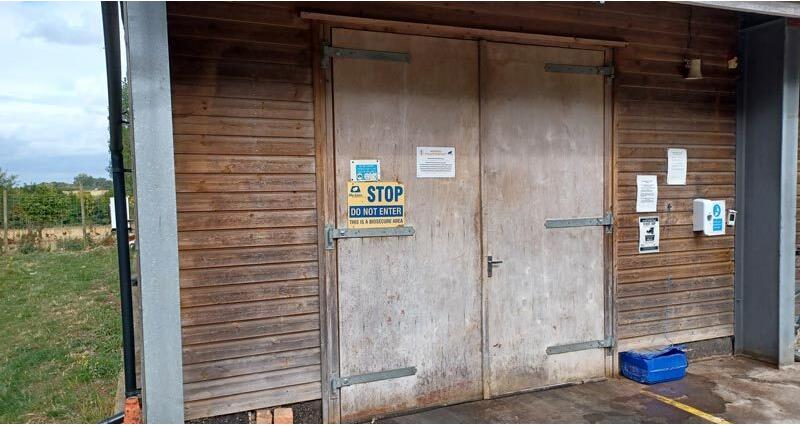
It's important all poultry keepers exercise stringent biosecurity to reduce the risk of avian influenza incursion in their birds. These tips will help you to review your biosecurity protocols.
With migratory bird patterns expected to heighten the risk of AI cases during the winter months, it is vital to ensure all biosecurity measures are robust and strictly followed.
Biosecurity checklist
Only 1g of infected faeces is required to cause one million birds to die, and testing from 2021 demonstrated that the virus could survive in the environment for 21 days at 4°C.
It's therefore vital that every step is taken to guard against infection entering a poultry site.
The most common disease incursion routes are:
- Contaminated litter/bedding materials
- Movement of people and equipment
- Poor building maintenance
Keep your birds safe by following these top tips:
- Regularly clean and disinfect hard areas your birds can access.
- Practice good rodent control.
- Feed and water your birds in an area which wild birds cannot access.
- Keep an eye out for mites and worms and treat as necessary.
- Avoid sharing water courses with wild birds.
- Keep yourself clean by wearing clean boots and clothes and by washing your hands.
- Keep the poultry house and equipment clean.
- If you are worried about the health or welfare of your birds, call your vet.
This checklist of measures from the APHA includes tips that will help reduce the likelihood of disease incursion, which could prevent your flock from becoming a tracing or dangerous contact.
Maintenance factors
- Regularly inspect roof and building maintenance including ventilation shafts/ducts.
- Avoid leaking roofs.
- Replace any undersized guttering and blocked or damaged downpipes as this may lead to water ingress.
- Keep moss/vegetation off the roof as it can attract wild birds who eat insects beneath.
- Prevent small holes that could allow access by wild birds/rodents.
- Keep site clear of vegetation to reduce cover for rodents/reduce attractiveness to wild birds.
- Clear up spillages of feed as it can attract rodents or wild birds.
Bedding considerations
- Consider whether you are appropriately using and storing bedding materials.
- Avoid bedding and bale wrapping/storage outside.
- Remove bale wrapping outside the shed.
- If carrying wrapped bales into the shed, clean and disinfect the outer wrapping first.
- Don’t enter the shed with vehicles unless they’ve been cleaned and disinfected.
Staff considerations
- Conduct regular training to raise awareness to disease incursion – particularly weekend and holiday cover.
- Ensure the consistent use of site-specific boots and clothing.
- Use site specific PPE including boots and overalls, dedicated, disposable gloves etc which can be disinfected/disposed of and used for all visits (such as egg collections/feed deliveries/ABP collections).
- Employ dedicated staff.
- Have a management procedure with step-over partitions for clean and dirty areas at the building entrance.
Record keeping pointers
- Ensure staff are aware of importance of good, accurate record keeping. Site access records/visitors books must be maintained on site (ABP disposal and collection, feed deliveries).
- Production records should go back at least two months.
- Daily figures for production parameters are needed such as feed, water, egg numbers, mortality – ideally in a spreadsheet updated daily. If white boards are used, photograph them prior to wiping.
Additonal considerations
- Implement measures to control site access such as gates, chains and locks. Keep doors to poultry houses shut.
- Disinfectant:
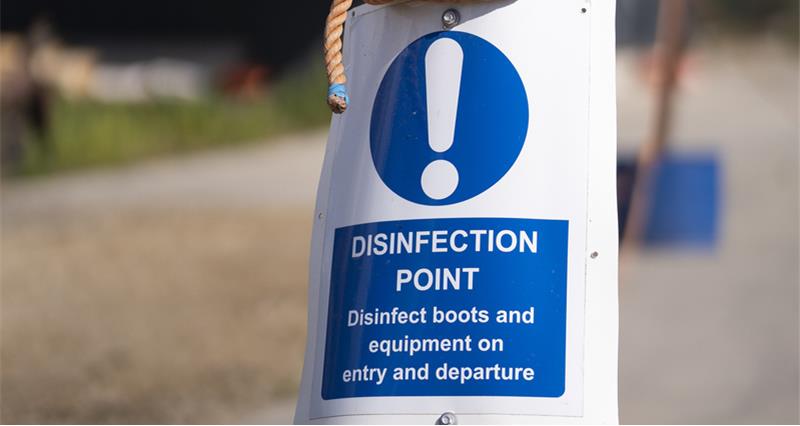
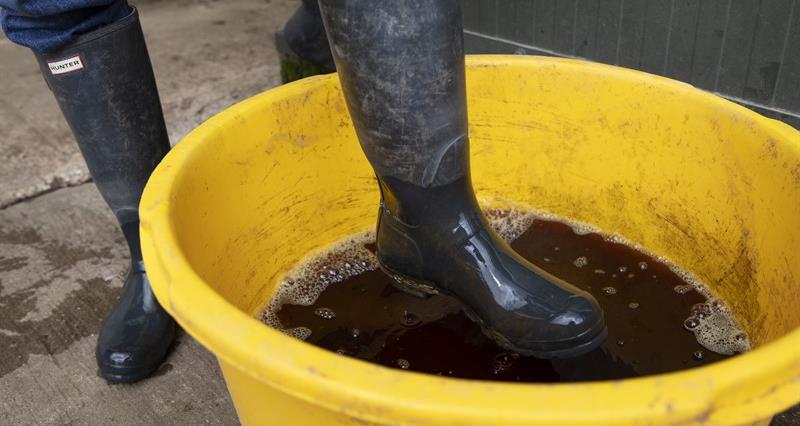
- Use approved disinfectant and use it at the correct strength.
- Cover boot dips to prevent dilution by rainwater/organic matter.
- Replenish regularly, especially if it gets contaminated with organic material.
- Ideally use a water and detergent dip to cleanse footwear before using disinfectant.
- Water bodies on or close to the site should be netted.
- Don’t have feed mills and hatcheries or egg packing plants on the same site as the birds if you want to keep them out of restrictions.
- Place ABP bins at perimeter, outside the premises boundary so vehicles don’t need to come on site.
Printable biosecurity posters
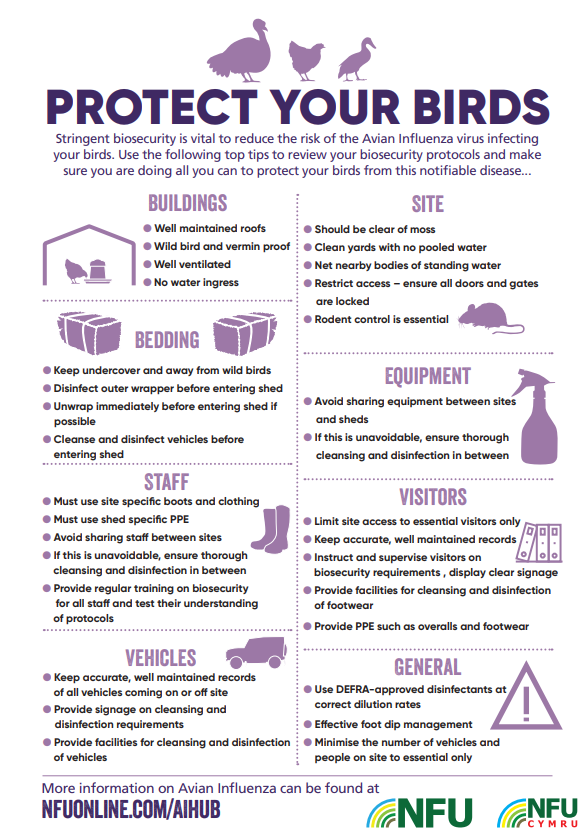
The NFU has created a poster to highlight the importance of biosecurity and the measures that all keepers should be undertaking in order to prevent their flock contracting the disease.
It highlights key biosecurity focus areas.
Visit our resources section to download, print and share this poster with other poultry keepers so they can keep their birds safe.
Good and bad biosecurity examples
Following producer feedback on sharing best practice, the APHA and Poultry Health and Welfare Group, of which the NFU is a member, have jointly compiled a photobook showing examples of biosecurity best practice.
It includes common biosecurity breaches to help poultry keepers identify potential improvements to their own biosecurity.
You can download the photobook from our resources section.
NFU resources
A closer look at the human element
Julian Sparrey, Group Technical Director at Livetec Systems, says one of the highest risk points for disease entering a shed is via human movement.
“Most know that human biosecurity is crucial, but it’s got to be done properly, or there’s no point in doing it at all,” he says.
“You can’t just wash your boots down in disinfectant, you need to change into clean boots and overalls, without contaminating them in the process, to be effective.”
Avian influenza is most likely to enter a flock through indirect wild bird contact, either via respiratory secretions, or, most commonly, through infected bird droppings. Bird and rodent proofing is also an essential process to minimise the risk of contamination.
Mr Sparrey says most producers put one inch mesh on all shed entry points during the outbreaks in 2022, but he advises these are checked for damage, as they are likely to have deteriorated over time.
“Even if wild birds aren’t infected with the disease, they can be carrying it on their feet or feathers, the same goes for rodents, so it’s imperative to do everything in your power to stop them accessing sheds,” he says.
“It’s obviously harder for free-range producers to eliminate these risks altogether, but you can still take precautions.
“For example, I’d urge farmers to discourage wild birds from landing on sheds – use spike strips and deterrents on roofs to put them off perching.”
He also suggests not only looking at working to eliminate puddles and standing water on the range, but also in farmyards, as the AI virus can survive in cold water for up to 100 days, and easily be transported into sheds by wildlife or humans.
See our other biosecurity pages