UK response
Personal imports
Since Saturday 12 April 2025, travellers have been banned from bringing cattle, sheep, goat, and pig meat, as well as dairy products, from EU countries into Great Britain for personal use, to protect the health of British livestock, the security of farmers, and the UK’s food security.
This includes bringing items like sandwiches, cheese, cured meats, raw meats or milk into Great Britain – regardless of whether it is packed or packaged or whether it has been bought at duty free.
Commercial imports
Following a FMD (foot-and-mouth disease) outbreak in Greece on 17 March 2026, the UK Government has applied restrictions on certain Greek commercial imports to Great Britain.
The restrictions cover the import of hay and straw, live animals of FMD-susceptible species such cows and sheep, germplasm, fresh meat, meat products unless appropriately heat treated, milk and dairy products unless suitably treated, and animal by-products such as pet food.
Commercial imports of milk, colostrum and their products including feta and yoghurt are only permitted where the products have undergone the required heat treatment and are accompanied by the mandatory health certificate.
See: GOV.UK | Imports, exports and EU trade of animals and animal products: topical issues
The latest restrictions follow those applied in February 2026 in response to a case of FMD in Cyprus. Commercial imports of cheeses from Cyprus, including halloumi, remain permitted provided they meet the heat treatment requirements and are accompanied by the mandatory health certificate.
- Germany is now exempt from the restrictions having been officially recognised as FMD free by Great Britain, as of 14 May 2025. Visit: GOV.UK | Foot and Mouth disease controls eased for Germany
- The temporary import restrictions on relevant commodities from Austria were lifted on 24 June 2025. No cases had been confirmed in Austria – the ban had been implemented due to its proximity to cases in Hungary. Read: GOV.UK | Lifting of FMD-related commercial import restrictions for Austria
- Hungary is also exempt having been recognised by the UK as FMD-free without vaccination on 17 September 2025. Visit: GOV.UK | Recognition of foot and mouth disease freedom for Hungary
- Slovakia has been considered free of FMD since 9 December 2025. Visit: GOV.UK | Recognition of foot-and-mouth disease freedom for Slovakia
GB health certificates are no longer being issued for animals susceptible to FMD including all live animals and fresh meat and animal products.
While horses and companion animals are not susceptible to FMD, hay feed or straw bedding, if sourced from an infected area, could act as a fomite and therefore are also prevented from entering GB.
The government is taking action to prevent consignments entering Great Britain that were already in process.
Further information is available at:
For more information on EU and EFTA states approved to export animals and animal products to Great Britain (England, Scotland and Wales), visit: GOV.UK | EU and EFTA countries approved to export animals and animal products to Great Britain
‘More to do on biosecurity’
NFU Vice-President Robyn Munt said: “Twenty-five years ago, we were in the throes of the devastating foot-and-mouth outbreak. That crisis cost the UK economy billions, and I know the emotional scars still remain.
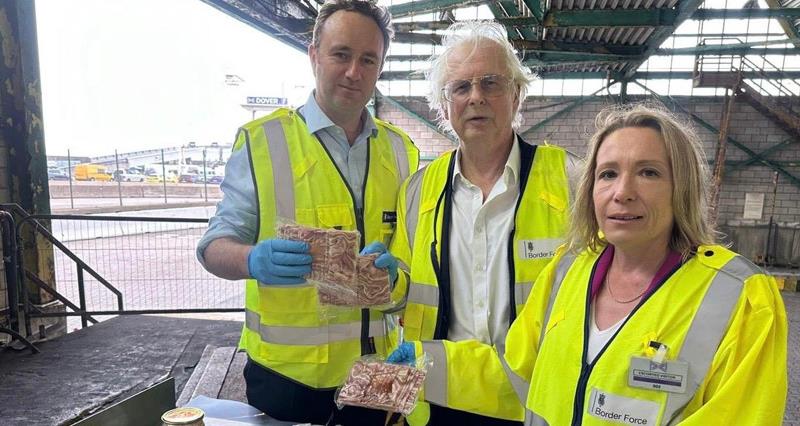
“We welcome the swift action to restrict imports from Greece but there is more to do on biosecurity. We need to see government fighting illegal meat imports, ensuring the Border Force have the resources they need to stamp out this practice.
“This is a timely reminder about the importance of border security, and I urge all UK livestock keepers to remain vigilant and report any suspicions of disease directly to the APHA (Animal and Plant Health Agency). It’s also vital that tourists and hauliers play their part and adhere to strict biosecurity and personal import rules.”
Personal import restrictions
Restrictions on personal imports of commodities from susceptible animals (primarily ruminants and porcines) from the EU in response to the FMD outbreak reflect the recent tightening of ASF controls:
- All unpackaged ruminant and porcine commodities will be restricted from the entire territory of the EU.
- All commercially packaged ruminant and porcine commodities from the EU are limited to 2kg per traveller, and must bear an identification or health mark (or commercial labelling if it is an animal by-product) to evidence it is commercially produced.
- Since Saturday 12 April, travellers can no longer bring cattle, sheep, goat, and pig meat, as well as dairy products, from EU countries into Great Britain for personal use, to protect the health of British livestock, the security of farmers, and the UK’s food security.
- Susceptible animal commodities include bovine, caprine, ovine, cervid, porcine and camelid products.
- Certain exemptions apply for infant milk, medical foods and certain composite products (eg, chocolate and biscuits).
- Live animals, germplasm and untreated wool, hair, skins and hides are not permitted for personal import under separate rules.
The new restrictions shine a greater spotlight on any illegal meat imports. The government must ensure that those fighting against illegal meat imports, including our Port Health Authorities and UK Border Force, have the resources they need to stamp out this practice and that the consequences of undertaking such illegal activity be suitably severe so as to act as a disincentive. Read: NFU calls for stronger deterrents for illegal personal imports