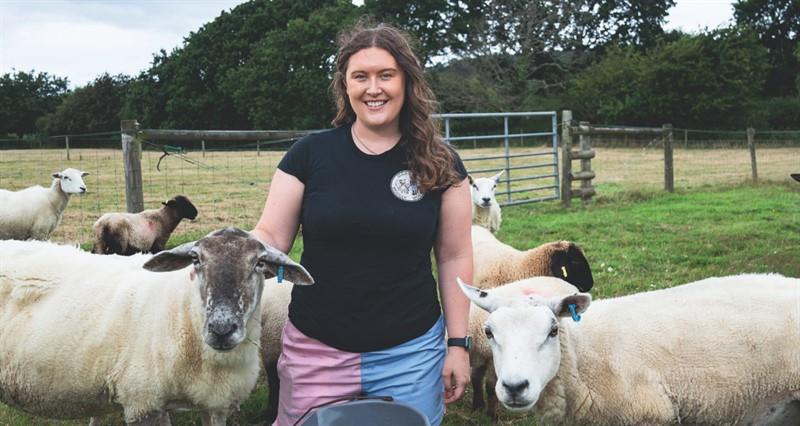
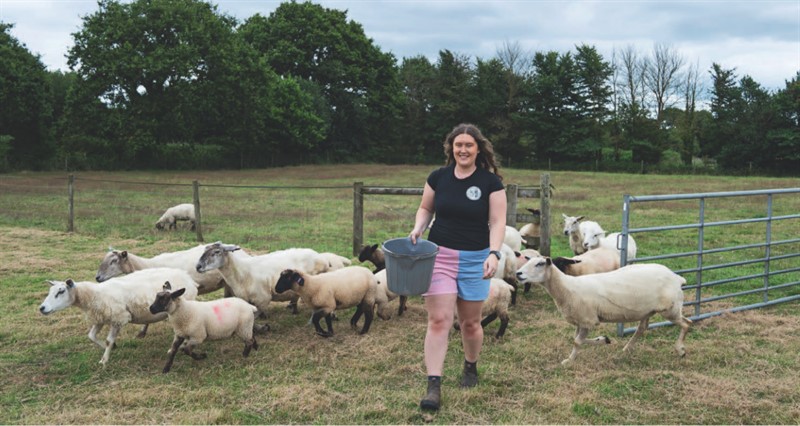
I’m a first-generation farmer – a shepherdess specifically – and I initially got into farming through my local YFC (Young Farmers Club). After graduating from the University of Chester with a degree in Bioveterinary Science BSc (Hons) and moving back home to the Isle of Wight, I didn’t have many friends close by, as a lot were still away studying on the mainland, so I joined the club to make some friends.
The connections I’ve made at YFC have been the trigger point to where my life is today.
Not only did I make friends, I also learned a lot about farming, met potential employers, made connections within the industry, and found a support system – the people I rely on to ask for help today as a fully-fledged shepherdess.
“Something that has always stuck with me is the fact that no question is too silly. A lot of the farmers I’ve met, both old and young, have been incredibly supportive, and if you don’t know something, you never will unless you ask.”
Sian Grove
Journey into farming
Joining YFC in October 2019, I befriended Paige and Kingsley, who had their own flock of sheep. I mentioned in passing that I thought sheep were “really cute” and would love to have my own. Fast-forward to March 2020, and I ended up adopting four orphan lambs and keeping them in my back garden. Lambs in lockdown.
Knowing absolutely nothing, it was daunting but exhilarating to be thrown in at the deep end looking after the lambs. Knowing I could pick up the phone at any point and ask for help, no matter how silly the question may seem, was very reassuring. No surprise that there were a LOT of phone calls!
Something that has always stuck with me is the fact that no question is too silly. A lot of the farmers I’ve met, both old and young, have been incredibly supportive, and if you don’t know something, you never will unless you ask.
In my experience, farmers can always tell when someone is keen and has that genuine enthusiasm and energy to learn. Nine times out of ten, people usually want to help guide and shape that.
Starting with four orphans in 2020, I now have a flock of 18 breeding ewes, and have done three lambing seasons. I have also set up my own Instagram account to record the ins and outs of my shepherdessing journey, and to help provide any information to someone else new/starting out. I’m paying back!
Farming on the Isle of Wight
The farming community on the island is fantastic, and something I’m incredibly proud to be a part of. The encouragement and support I’ve received has led to me becoming chair of YFC, carrying on that inclusivity, and proving you don’t need to be from a farming background to get into the sector.
While living on an island can be amazing – in summer a beach is 10 minutes away and looks like it should be in Greece – it does have some added stresses.
Our island landscape is forever changing, with the sea and weather causing land slips, making the available farmland that bit smaller. Although everyone is supportive, there is an element of awareness that we only have a certain amount of land available – the UK as a whole is an island, but the Isle of Wight even more so – once you reach the sea, there is literally nowhere else to go.
There is also currently no abattoir on the island, meaning all livestock have to go on a boat to the mainland. Not only does it add extra travel time, but it can also be tricky if a boat is cancelled due to poor weather or technical issues. It goes almost without saying that this also adds an additional expense.
For livestock sales, there is only one auction that takes place: the Gilten Market, in late November. So, to sell stock also involves a ferry trip. However, Gilten Market is a key date in the island’s farming calendar; an opportunity for local farmers to showcase their prized fat stock and to get together socially, as is the annual Ploughing Match, which takes place in late September, and provides an opportunity for the farming community to get together.
Similarly with showing, not only do we need to pay for the entry fee and petrol like everyone else, we have the added cost of the boat, with the exception being the Royal Isle of Wight County Show, which showcases the very best of the island’s produce and livestock, and is continuously growing both in size and reputation. The event also provides the perfect opportunity for the general public to interact with the local farming community, helping to bridge the gap between producer and consumer.
I’m incredibly grateful for the people that have supported me in my journey and I, quite literally, couldn’t have done it without them. My ambition is to continue to be an ambassador for British farming, and to encourage a least one person into believing that they can become a part of the farming industry, because what a fantastic and diverse industry we are.