See also:
- Managing AI on farm – general information
- What happens on your premises while an investigation is carried out
Or, download this guide as a PDF: The ‘purple book’ – AI, what you need to know
What happens if disease is confirmed on your premises?
Certain actions must be taken quickly by APHA in order to contain the disease and minimise the risk of spreading it to other poultry farms.
These include:
- Contact tracing of bird/animal and people movements on/off the premises.
- Culling.
- Disposal of carcasses and other contaminated material.
- Preliminary disinfection.
Things to think about
You will already be keeping good daily production records but it is important to ensure that you keep accurate written details of any factors affected by potentially being confirmed with AI. These additional records should be kept from the moment you suspect any signs of disease and include but are not limited to mortality, birds showing signs of illness, any movements of people, vehicles or equipment on and off site etc.
Keeping a log of any interaction related to the reporting of potential disease can also help if needed at a later date, such as times and contents of discussions with your private vet and APHA
Culling and compensation
If AI is confirmed, APHA will arrange for the birds at your premises to be humanely culled to prevent the risk of disease spread.
Compensation is payable for any healthy birds culled by the government.
APHA will assess the health status of birds no later than either the start of the planned culling or 48 hours after the decision to cull (whichever is sooner). For more detail about compensation, visit: GOV.UK | Compensation for animals culled to control animal diseases
Valuation is usually carried out by APHA or an APHA approved valuer. They use up to date, independently produced poultry valuation tables to calculate compensation.
In circumstances where this method is not possible, for example rare breeds or exotic bird species not covered by the valuation tables, a specialist consultant may be appointed to carry out the valuation.
Information about how to appeal the valuation can usually be found included in the documentation confirming your compensation from Defra. NFU members with concerns about their level of compensation can contact NFU CallFirst on 0370 845 8458
Find the latest poultry valuation tables on GOV.UK.
Disposal
APHA is responsible for the disposal of carcasses of birds culled for disease control purposes.
Where there are other carcasses, poultry meat, table and hatching eggs on the premises – which have been produced from susceptible animals originating at the IP – these must be disposed of by the owner and government compensation is not payable.
These products must be disposed of in a biosecure manner (following liaison with an APHA vet) and in compliance with Animal By-Products Regulations at a designated disposal facility. Visit: GOV.UK | Guidance for the animal by-product industry
Preliminary disinfection
Once birds at the IP have been culled, APHA will carry out and fund the preliminary disinfection.
Timing of preliminary disinfection is important since the merging and lifting of disease control zones will only happen after a defined period following this process.
They will spray an approved disinfectant on:
- All parts of the premises (other than parts where disinfectants would have no effect, such as fields).
- All equipment which poultry or other captive birds have had access to.
- Any contaminated material remaining at the IP (e.g. litter).
- Anything contaminated during culling.
Secondary cleanse and disinfection
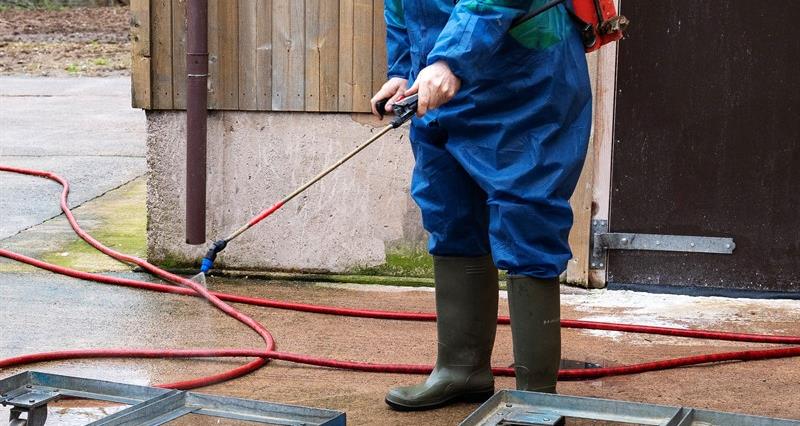
A secondary C&D (cleanse and disinfection) must be carried out at the expense of the operator of the IP before restocking can take place.
Completion of secondary C&D is also linked to when the UK can regain official disease-free status for AI from WOAH (the World Organisation for Animal Health).
Not being able to carry out secondary C&D, or delays in completing the procedure, can have serious implications for your business, the wider poultry sector, and the international trade of British poultry products.
Next steps
An IP has three options to eliminate the virus from their holding and thereby comply with international disease control requirements. The choice has an impact on how and when you can restock with poultry, and when the UK can reapply for disease-free status.
Option 1: Undertake thorough cleanse and disinfection – restocking can take place 21 days after secondary C&D is complete, this is the quickest route to restocking birds.
Option 2: Undertake C&D to the WOAH Terrestrial Code standard – restocking can take place 3 months and 21 days after secondary C&D is complete.
Option 3: If you cannot achieve option 1 or 2 then you cannot restock with poultry for 12 months and your site remains under restriction during that time. This may have an impact on any other enterprises on the same premises.
All processes need to be agreed and signed off with APHA.
It is important to note that the requirements above apply to both commercial and non-commercial premises.
Not sure which option you should take? Use our secondary C&D decision tool to help you find the best option for your farm business or holding.
Secondary C&D process
- Once preliminary disinfection is complete, APHA will serve a notice which sets out the high-level requirements that must be met.
- The IP must then submit plans to APHA for how the requirements will be achieved – established contingency plans will greatly reduce time it takes to generate plans and have them approved.
- APHA will work with the IP to agree the scope and method before setting out a detailed Schedule of Works (EXD158) which will include a target date for completion.
- APHA will monitor the progress of the work throughout the operation to ensure it is being completed to required standards and will be available to provide any advice required.
- Once APHA is satisfied that the work has been completed, sentinel birds can be introduced for restocking after 21 days and the countdown to disease freedom begins.
If APHA concludes that secondary C&D cannot be undertaken, or an IP determines not to undertake secondary C&D on the poultry housing, restrictions must remain in place on the premises for a minimum of 12 months from the date of preliminary disinfection.
This will mean that no birds can be placed in the housing for 12 months, after which restrictions will then be lifted and restocking permitted.
Work involved in secondary C&D
An external contractor may need to be employed to carry out secondary C&D due to the equipment and expertise required.
Secondary C&D is a deep clean, involving the removal of any residues such as feathers, organic matter and dust, followed by the cleansing, degreasing and disinfecting of all housing and equipment that has come into contact with the birds.
- Grease and dirt (feathers and litter) must be removed from all surfaces through the application of a degreasing agent and washed with water.
- After washing with water and leaving to dry, disinfectant should be applied.
- After seven days, points one and two will need to be repeated followed by a further rinse with water.
Defra-approved disinfectants must be used to carry out the secondary C&D at a concentration approved for treatment of AI virus.
Free-range fields must be harrowed, rotavated or ploughed and left fallow for at least 56 days. The depth will be stipulated in the protocols. This period of time could be longer if there are ponds, ditches or wetland areas on the range.
Disposal of waste material
All waste material which includes water, litter/manure and PPE (Personal Protective Equipment) is classed as hazardous when it is infectious or has been in contact with infected material.
Therefore disposal of waste has to adhere to the Hazardous Waste Regulations. Disposal costs are a significant contributor to the overall cost of secondary C&D at approximately 25% overall expenditure.
Wash water
Significant quantities can be generated during secondary C&D – it can be spread on land if it is agreed with APHA and the EA (Environment Agency) in England or NRW (Natural Resources Wales) in Wales.
The location will be considered dependent on proximity to water courses and any other environmental considerations.
Prior to the wash water being spread, it will need to be treated or held for a period of time. An environmental permit will also be required.
If the wash water cannot be spread on land it can be sent to a water treatment plant under agreement with the operator.
Used litter and manure
Must be treated by a method capable of killing the virus. This method must comprise one of the following practices:
- Incineration or steam treatment at a temperature of 70°C. The receiving site of the hazardous waste must have an appropriate permit and record the treatment or disposal. It is unlikely that a power station will continue to accept contaminated litter, therefore this may not be an option for disposal.
- Stacking and dampening (if necessary) in a field or sealed trailer, covering to keep in the heat and leaving covered for 42 days to prevent access by vermin and wild birds. The location for stacking the litter must be approved by the EA or NRW.
- If the litter needs to be moved off farm for stacking, this will need to be done under licence from APHA and may involve compliance with carriage of dangerous goods regulations. The litter can then be spread on agricultural land following best practice.
- Burial of waste on site requires an environmental permit, however it is unlikely that the EA or NRW would issue one for this activity on a farm.
Things to think about
Secondary C&D is more intensive and expensive than a normal turnaround.
Example costs for commercial broiler and laying hen sites can be found in a recent report published by Livetec Systems and NFU Mutual. Download the full report:Livetec Systems | Understanding the cost of cleaning after a disease outbreak
NFU members:Save with member exclusive offers from Livetec Systems
Movement on and off the infected premises
When AI is suspected or confirmed, the movement of people and vehicles also come under restriction during the C&D process. A licence is required to move vehicles and people off the IP.
PPE should be worn to minimise the risk to human health when people come into contact with infected birds or equipment contaminated with body fluids and faeces from infected birds. It should be suitable for the wearer and, where appropriate, should be fit-tested to the person.
Correct PPE will comprise:
- Disposable or polycotton coverall with head coverage of CE type 5 and 6 that offers protection against dusts, splashes and liquid sprays (with, as appropriate, safe disposal or cleaning after use).
- Disposable gloves of lightweight nitrile or vinyl or heavy duty rubber (not latex) gloves that can be disinfected.
- Rubber or polyurethane boots that can be cleansed and disinfected.FFP3 respirator with exhalation valve.
- Close-fitting goggles or other equipment that gives at least the same level of protection.
For more information, visit: HSE | Avian influenza
Vehicles
At any premises where vehicles come under the C&D requirement, the occupier of that premises must provide adequate facilities, proper equipment and materials. All disinfectants must be from the approved list and used at the appropriate dilution.
Any vehicle which may have been exposed to infection must have C&D carried out. This includes:
- Inside surfaces of trailer/bulker.
- Tilt/tarpaulin/top cover.
- Detachable fittings.
- Equipment within the vehicle.
- Exterior of the trailer/bulker.
- Wheels.
- Mudguards and wheel arches.
- Exterior of the vehicle and any other areas exposed to poultry or faecal matter.
Things to think about
Even if you do not have an active disease outbreak on farm, considering your options for secondary C&D can act as a good contingency planning exercise which may lead to improving biosecurity and reducing the risk of disease which will help improve business resilience
Rodent control
As part of the biosecurity measures put in place the IP is responsible for the implementation and cost associated with rodent control. It is recommended that external contractors are engaged for best effect. APHA will check that the measures in place are adequate.
Avoiding delays
There are a number of areas which can delay or even prevent secondary C&D, including what material buildings are made of, whether there are stone or earth floors, how well maintained the site is, the site layout, waste disposal routes and more. Visit Guidance on what to consider as part of your secondary C&D plan can be found on NFU Online:
Restocking
An infected premises can be restocked under a permit (from APHA) from 21 days (Option 1) or three months and 21 days (Option 2) after secondary C&D has been signed off as complete by APHA.
The premises will remain under restrictions for a further 21 days and it should be stocked at full capacity to ensure that all the areas of the premises that are usually accessed by birds are stocked.
The birds will need to be inspected by an OV (Official Veterinarian) and samples tested at an approved reference laboratory. Sampling (including the costs of packaging and transport) will need to be undertaken at the producer’s expense.
If any birds die within the 21-day period, diagnostic tests must be carried out on them. The producer is responsible for recording information of any mortality and must keep production data. If there are any concerns about the health of the birds this must be reported to APHA immediately.
If the birds remain healthy, mortality rates are normal and test results are negative after the 21 days, then all remaining restrictions will be lifted. If secondary C&D has not been carried out, the premises can only be restocked after restrictions have been lifted 12 months after the preliminary disinfection has been completed.