NFU looks to the future of the sector at UK Dairy Day 2026
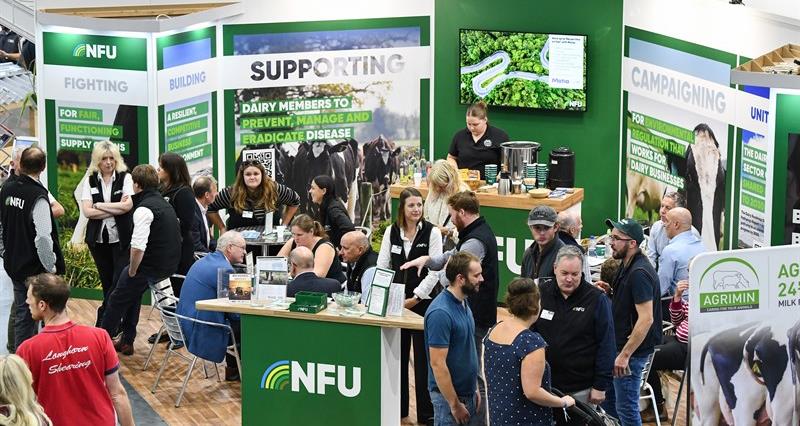
Photograph: Simon Hadley
Minds at UK Dairy Day 2026 were firmly focused on the future of the sector – looking at both the immediate challenges and the long-term opportunities. Deputy Editor of British Farmer and Grower Gary Young reports.
The NFU was well represented at panel discussions during the event, at Telford International Centre on 16 September, which took in the latest updates on bluetongue, the implementation of the Dairy Roadmap and a speculative look at the future of the sector.
BTV-3: The latest situation and practical steps for dairy farmers
NFU National Dairy Board Chair Ian Harvey chaired the panel, which was united around a single core message: farmers should vaccinate, report suspected cases, and prepare for bluetongue to remain a long-term challenge rather than a one-off event.
UK Chief Veterinary Officer Christine Middlemiss disclosed that at the time of the event there were around 1,200 confirmed bluetongue cases in Great Britain, with cases now registered as far north as Cumbria, Northumberland and Dumfries and Galloway.
She recommended that farmers should vaccinate as soon as possible for protection now and into next year, as midges are still active and alive and would be overwintering in this country. “Everyone in England should consider themselves at risk,” she warned.
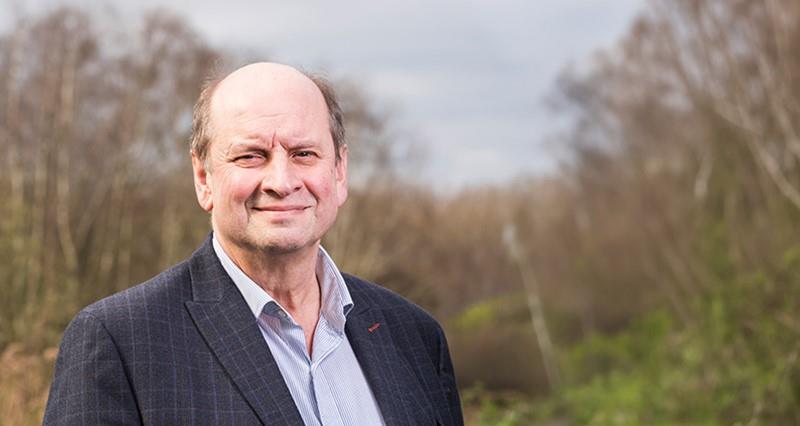
Dairy farmer and NFU Dairy Board member Sophie Gregory shared her experience of bluetongue. She said she was initially reluctant to vaccinate because of her low-input farming system and the cost concerns but following an AHDB biosecurity study tour she decided to vaccinate her cows but not all her youngstock.
As a result, her mature cows remained unaffected, but three heifers developed bluetongue. She believes two of those animals may never reach their full potential, and the losses will far exceed the cost of vaccination, which had shielded her cows from the worst effects.
She said: “I’ve got neighbours who’ve had it way more severe. I just didn’t think it would come to our part of the world, and then it was so quick – the whole neighbourhood is overrun with it now. So, for me – a low-input dairy farmer – I wouldn’t even think about not vaccinating now.”
Discussions on BTV-3’s reproductive impact
A major topic of discussion was the long-term reproductive impact of BTV-3. Vet Josh Swain, of Synergy Farm Health, said bluetongue itself poses a much greater risk to fertility than vaccination.
“We’ve had plenty of people vaccinate their rams and bulls and had no issues following vaccination, so I just want to get that message out there very clearly. We know from the continent, from some of our clients, we’ve been testing rams who have basically been subfertile or infertile for up to three to four months after having bluetongue.”
He warned that consequences from 2026 infections may continue well into 2027 due to infection during pregnancy.
Reminders on reporting and vaccination
NFU Chief Animal Health and Welfare Adviser Cat McLaughlin reminded farmers that bluetongue is a notifiable disease, and they have a legal duty to contact their vet or APHA if they suspect infection, as symptoms can resemble those of other serious diseases, particularly foot-and-mouth disease.
Reporting a bluetongue case does not currently trigger movement restrictions or additional government controls, the panel advised. The previous containment approach used in earlier outbreaks is no longer being pursued because the disease has now spread across the country and vaccination is available.
Christine warned that midges will almost certainly overwinter again this year, and that the infected area is much larger than in previous years. The risk next spring will therefore be higher and more widespread, and bluetongue should now be seen as an ongoing management issue rather than a temporary outbreak.
Following concerns over vaccine availability Christine reported that 3.5 million doses had already entered Great Britain, a further 3 million doses were on the way, and UK-specific vaccine batches were being produced.
“If you have bluetongue on your farm, please do not feel in any way that you are at fault. This is an insect-borne disease – don’t feel that you’ve got to hide away, don’t feel that you can’t go and speak to people.”
NFU Chief Animal Health and Welfare Adviser Cat McLaughlin
Josh suggested that distribution capacity rather than vaccine production had often been the bottleneck during the peak of the outbreak, with demand suddenly soaring as infections spread. He warned that having returned from Europe recently he was troubled by the level of border security.
“I think it’s up to us as an industry to be very vigilant, and it is very difficult to differentiate between foot-and-mouth disease and bluetongue, so please report suspicious cases of bluetongue to make sure you can get a second opinion on that.”
The speakers repeatedly emphasised that the industry has moved beyond trying to stop bluetongue spreading. The focus is now on mitigating its impact through vaccination, surveillance and good herd management, while recognising that climate-driven vector-borne diseases are likely to become a permanent part of UK livestock farming.
Cat offered a final heartfelt message: “If you have bluetongue on your farm, please do not feel in any way that you are at fault. This is an insect-borne disease – don’t feel that you’ve got to hide away, don’t feel that you can’t go and speak to people.
“Make use of the NFU, make use of support charities and just look out for each other and look after each other because it can be pretty horrendous for those that are affected.”
For the latest information and advice, visit the NFU’s bluetongue landing page.
Help shape the NFU’s work on BTV-3 vaccine availability by completing our short survey.
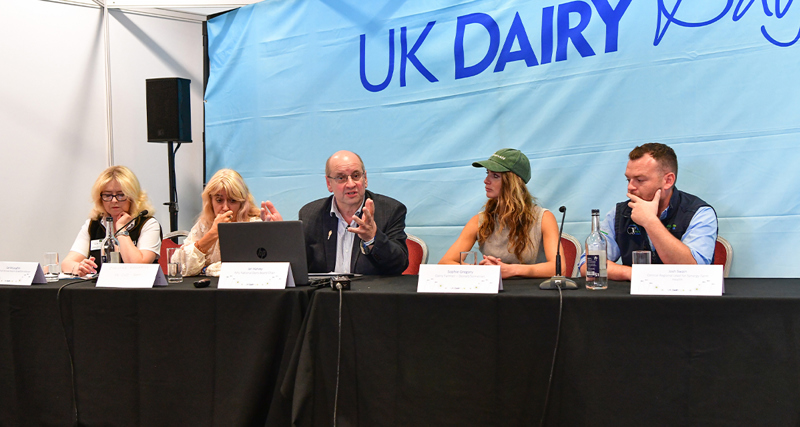
‘Leading the way’ with the Dairy Roadmap
The panel discussion focused on the newly launched Dairy Roadmap Pathways Report to 2030, examining how the UK dairy sector can accelerate sustainability progress while maintaining profitable businesses and supporting rural communities.
Chair Paul Flanagan, Dairy Sector Director for AHDB, opened by stressing that the UK dairy sector is leading globally through taking a collaborative approach. However, the panel repeatedly emphasised that farmers cannot deliver the next stage of emissions reduction alone. Government, processors, retailers, foodservice businesses, advisers and industry bodies all have a role in funding, supporting and rewarding progress.
“If we don’t take control of this narrative, government will – so we are actually leading the way with this report. It’s a really important piece of work that has been done across sector.”
Dairy farmer and NFU Dairy Board member Sophie Gregory
Dr John Newbold (SRUC) said the report concentrates on scaling practices that are already known to work rather than relying on future technologies, and continued investment in soil health, animal health and welfare, people and workforce wellbeing and farm profitability would be key.
Farmer Sophie Gregory argued that the Dairy Roadmap is important because it allows the industry to shape its own future rather than having solutions imposed by government.
“If we don’t take control of this narrative, government will – so we are actually leading the way with this report. It’s a really important piece of work that has been done across sector. And the great thing is that we have subgroups and there are farmers involved in every subgroup, so it’s very much taken back to the farm, which is really important when we’re talking about things that we can change on farm.”
Lyndon Edwards, of AHDB, said many sustainability actions, such as genetics, soil pH management, animal health and longevity improvements are already “win-wins” that improve farm profitability and environmental outcomes. But measures such as slurry store upgrades and slurry covers deliver environmental benefits create significant costs for farmers. The whole industry would have to decide how progress will be funded, he warned.
Rob Hutchison, CEO of Muller, argued that while measuring progress was important, excessive focus on comparing farms was unhelpful, and the emphasis should be on continuous improvement rather than competition over having the lowest carbon footprint.
Asked whether environmental gains could be monetised and retained on farm, the panel agreed that carbon metrics are not yet accurate enough for robust payment systems, and improvement over time may be a better basis for incentives than absolute carbon scores.
The panel repeatedly stressed that delivering the next stage of sustainability improvements cannot fall solely on farmers. Success will depend on coordinated action, investment and risk-sharing across the entire dairy supply chain.
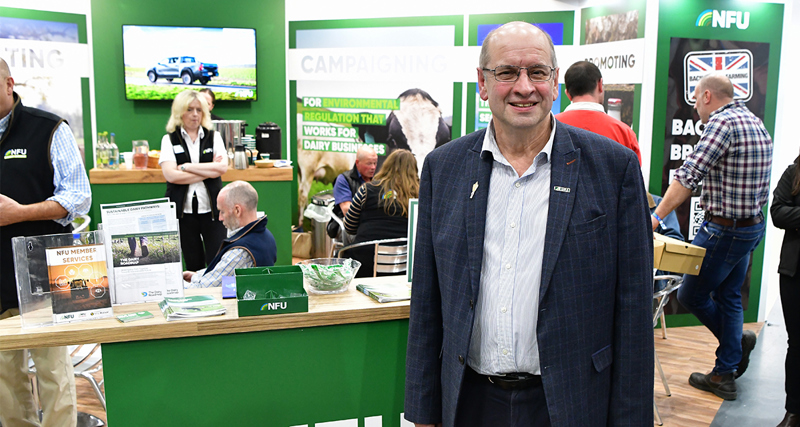
Looking to the future of the sector
During the ‘Building the Future’ panel, Farmer Fraser Jones, of Calcourt Farms, argued that successful businesses would need adequate slurry storage capacity, sufficient land to utilise nutrients responsibly, strong management, renewable energy investments and long-term planning for tighter environmental regulation.
Ian Harvey said planning was a significant ‘choke point’ that was preventing investment from reaching farms, and that the NFU was lobbying to speed up planning processes, unlock investment pipelines and support environmental improvements through practical regulation.
Planning Consultant Richard Corbett advised farmers to focus on smaller, more numerous planning projects as larger applications inevitably attracted more scrutiny, more objections and greater involvement from campaign groups. He noted that large dairy developments increasingly face objections similar to those long experienced by the poultry sector.
Mel Shipley, of Oxbury Bank, warned that many farmers underestimate current project costs because they base budgets on previous builds completed before major inflation in steel and concrete prices. She also suggested that investment isn’t always about milk production assets, adding that sometimes investing in slurry or forage storage and energy resilience can be more valuable than adding cows.
Looking to the next few years, the panel agreed that future dairy businesses would be judged as much by their environmental infrastructure, resilience and compliance as by production performance, and farmers who plan well ahead will be best placed to grow successfully.