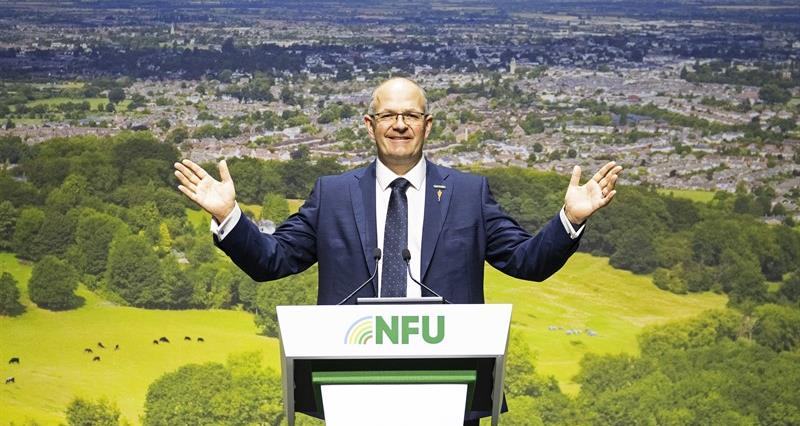
Thank you very much, Conference.
On behalf of your officeholders, I welcome you back to Birmingham, to your Conference.
Later, we will be welcoming Emma Reynolds, the Defra Secretary, and Dame Angela Eagle, the Farming Minister. We’ll also be joined by Victoria Atkins and Robbie Moore from the opposition parties.
As the voice of English and Welsh farming, we value your support and commitment to securing the future of a profitable farming industry.
Today I want to focus on the future, for a resilient farming industry.

Building pressure
But we cannot ignore what has happened since we last met here in Birmingham two years ago. It has been a difficult period for all of us.
Today, as you would expect, I’m going to talk about the challenges we have faced as an industry.
When we step back and think of those challenges, you can understand how the pressure builds. That pressure is financial. It’s physical. It’s psychological.
Standing with Ukraine
But Conference, it’s four years since Russia’s devastating invasion of Ukraine.
Of course, that invasion has impacts we feel here. But Ukrainian farmers have seen their fields mined, their machinery stolen, and their livestock destroyed.
Many have lost everything.
Conference, our thoughts continue to be with all those affected by this devasting conflict.
Keeping the NFU in the room
Ultimately, part of my job is to bring the challenges you face, to Westminster. Some of these challenges have been felt on our own farm at home, just like everyone here:
- Global commodity prices in a trough.
- Energy costs spiralling.
- Disease outbreaks – avian influenza and bluetongue.
- Trade deals undermining our marketplace.
- Uncertainty around environmental schemes and the future of BPS.
- Extreme weather worsening; consecutive harvests impacted by flooding and then record-breaking dry weather, and now many members are once again facing flooded fields.
And of course, the changes to inheritance tax.
Farmer confidence has been the lowest on record, because, for many businesses, investment, and growth – even survival – have felt almost impossible.
Through all those headwinds, your job has remained the same – to get up, day in, day out, whatever the weather, to keep producing food, the most important job we do, on behalf of the nation.
It's fair to say the last two years has also been a difficult period in Westminster.
Not a single one of us wanted to spend 14 months fighting with the government.
And here I think it’s important that we draw the distinction between the government and Labour MPs, many of whom have bravely spoken out on your behalf.
As I said, when the going gets tough in Westminster, my job is to keep the NFU in the room, helping to provide solutions for our industry.
This government loves to talk about helping working people. But all too often it’s felt at times that farmers have simply been left behind.
Over those 14 months, I know there are some who wanted the NFU to walk away from the table.
Conference, I make no apology for saying that for as long as I am your President, the NFU stay in the room.
The power of the NFU
Through a long 14 months of professional campaigning and solid lobbying, we’ve sought solutions.
From the centre, yes, from Westminster, yes. The NFU convening the wider supply chain and retailers, yes. But, crucially, through conversation after conversation that you, NFU members, have had with MPs and councillors from all political parties, but, crucially, with Labour MPs.
Last year, NFU members hosted 239 MP meetings on farm. Moving the dial, bit by bit. Bringing the terrible impact of this policy to life.
And when we needed Labour MPs to put their head above the parapet, to abstain on the progress of this policy, they answered our call.
That’s the power of the NFU, with members at its heart.
This didn’t happen by accident.
I said at our conference last year that the government thought the fight on the family farm tax would go away after a couple of weeks.
The sheer unfairness of this policy, coupled with our determination to stay in the room, and your determination to keep up the fight, made sure that didn’t happen.
Hard-yards lobbying, day in and day out, building our relationships, turning sceptics into advocates.
Repeatedly, we were told change wouldn’t happen.
But, the sustained pressure finally paid off.
IHT thresholds
The increase in the tax threshold from £1m to £2.5m, alongside the spousal transfer secured at the Autumn Budget, has come as a huge relief to so many.
I’ve had stoic farmers in tears.
Make no mistake, we know it's not perfect. For some, there is still tax to pay, but I know from the hundreds of messages we have received that this has secured the future for many family farms while greatly reducing the tax burden for all farms, the working people of the countryside.
When I met the Prime Minister, in December last year, it was our 568th MP meeting since the 2024 Budget.

I’ve had many conversations with the Defra Secretary of State, Emma Reynolds. She has played a key role in underlining the human impact of this tax. So has Dan Tomlinson, the Treasury Minister, who went out to visit NFU members in Northumberland last November.
I am immensely proud of all those farmers and growers who have worked with the NFU and supported our campaign. We have stood together and supported one another when it really mattered.
Work continues
To be crystal clear, the Prime Minister, Treasury, and the Secretary of State know we still believe the inheritance tax policy is fundamentally flawed.
It does nothing to disincentivise outside wealth investing in land, risks the opportunity for longer-term tenancies, and jeopardises some of our more productive farming businesses. Our lobbying and detailed policy work continues.
I would like to take this opportunity to recognise the role of opposition parties for their unwavering support in pushing to overturn the family farm tax.
And when the time comes, and we have the political opportunity, we will be back campaigning for change.
At the next general election, we will be demanding that those public promises are turned into manifesto commitments to scrap the family farm tax.
Lobbying for change
Conference, as your President, I have to deal with the reality of the world as we find it, not as we’d like it to be. But we’ve proved that when we stay in the room, we can make change happen.
That’s true on inheritance tax, but also this year we’ve been:
- Working with Defra ministers to secure the Countryside Stewardship rollover – worth more than £70m for thousands of members.
- Working with the Home Office to get the seasonal workers' numbers confirmed and toughen the law against livestock worrying, which I know has affected many in this room.
- Working with the Business Secretary to ensure investment in farm technology is now central to the UK’s Modern Industrial Strategy.
- And working with the government to consult on streamlining the planning process for agricultural development.

There are so many challenges coming down the track, so many policies that impact your ability to farm.
The role of the NFU is to make your voice heard.
So that the government can create the environment that encourages you to invest on-farm, and drive those thriving, profitable farming businesses.
Many of you have heard me say,
“Investment in food production today guarantees food security tomorrow.”
Let’s unpack that.
That means you, British farmers, having the confidence, the, dare I say, ‘fiscal headroom', to invest, to grow.
From planning reform to energy bills, from the EU reset to ELMs, I want to focus on providing solutions that give you that confidence to invest for the future.
Building Farming’s Resilience
Today we launch an important new report: ‘Building Farming’s Resilience’. It sets out the solutions that can be delivered quickly by government, to unlock investment in our industry. Investment that’s long overdue.
Now, the NFU is good at setting out our asks, as I’m sure the Secretary of State would agree.
But today, I want to speak not just about those asks. The what, but also the why.
Why should the government, MPs, the public, care about this?
Because Conference, investment in food production is critical to the nation’s future.
I want to set out a vision for why everyone – young or old, rural, or urban – needs a resilient food system.
Resilience isn’t just a word. It’s the ability to anticipate shocks, withstand the impact, and recover stronger than before.
Everything you see on the grocer’s shelf is underpinned by a farmer, or by a grower.
So yes, resilience means a supply chain where the burden of risk is shared, not just shouldered, by price-taking farmers and growers.

Confidence to invest
If we get this right, Britain’s farmers, you in this room, will invest in the on-farm infrastructure needed to deliver a resilient food system for 70 million people.
That investment will boost food production, and that investment will drive domestic growth at a local, rural level.
That investment means import substitution. Growing more here, employing more people, tackling inflation, and treading more lightly on the planet as we do so.
That last point really matters.
We cherish the overwhelming public support that British farming has. This is our social licence to operate and can never be taken for granted.
As proud UK farmers, we should aim to be in the upper quartile globally for having the lowest impact on the planet for the food we produce.
But we can only get there with government policy that builds confidence and drives investment.
A clear government commitment to produce more food here would be a key start.
Resilience across industries
Because here’s the truth. When the raw ingredients are grown here, the affiliated industries follow.
Growing more here keeps the processing capacity here, keeps the technology here, keeps the research and development here. Investment in stainless steel, in science labs, in processing facilities, all on the back of a thriving farming industry.
But there’s something even more crucial than that.
The events of the past few years have shown us we cannot keep relying on others to feed us.
It’s not just the NFU saying that. Last year, the National Preparedness Commission highlighted the ‘danger of the UK repeating past mistakes, assuming others will always feed us’.
In December, the Chief of the Defence Staff, Air Chief Marshal Sir Richard Knighton said: “For three decades, many did not have to think about the armed forces. Peace was stable. Conflict was distant. But that is no longer true.”
I think the same is true of food production.
So, Conference, one of the cornerstones to our national resilience must be a long-term plan for farming and food production.
Building farming’s resilience is critical, because if we don’t, our ability to produce food here, and therefore our food security, our national security, and our economic growth, will be under threat.
No other option
Our sector has real potential for growth. It can be a driving force behind Britain’s economic renewal and our renewed national resilience.
So that’s why this matters. A resilient food system isn’t optional.
We have a world-leading industry here, ready to deliver for the nation.
Now, let’s be clear about how we get there.
To ensure resilience and safeguard our nation’s food security, we need a clear government ambition for homegrown food production, just as we have for other sectors.
Conference – over recent years, the production of staples such as wheat, beef, poultry meat and vegetables are all down.
We need a food strategy that sets clear ambitions, sector by sector – something we can measure, something we can hold ourselves accountable for.
And by us, I mean all of us, government, retailers, processors, and yes, farmers too.
Accountability from farm to fork.
Declining food production must end
Some of this will be tough for us as farmers. Farming is a tough job. Part of farming’s resilience is the people that work on farm. Farming is a dangerous job.
2025 was another year where too many lives were tragically lost on the farm.
Conference, we cannot carry on like this. At the end of the day, we all want to go home to our loved ones, and we want our loved ones to come home to us.
It is time for us all to make a difference. We cannot let farm safety be the poor relation of running our businesses. We must do better.
And food production can no longer be the poor relation when balancing legislated targets for protecting the environment.
Ambitious targets for domestic food production can be the North Star farmers and growers need.
This is urgent. Over recent years, we’ve had major retailers worried about the continuity of food supply. When farmers, processors and retailers are saying the same thing, surely, the government must listen.
So, Conference, let’s send a clear message today, from this room.
The years of declining food production must end now.
Unlocking growth
We need the government to show ambition to reverse this. And from that should stem a cross-government commitment to unlocking growth on the farm.
Delivering the Food and Farming Board, one of the recommendations of Baroness Batters’ comprehensive profitability review, will be central to this.
Then, the whole of government can get behind the sort of solutions I’m setting out today.
Because, when government is joined up, it makes a real difference.
Just look at planning. I am really pleased that on an issue where this government and the NFU should be working hand in hand, we are.
I want to commend both Emma Reynolds and Steve Reed for bringing forward such ambitious proposals to make it easier for farmers to secure approvals for new agricultural buildings, to cut the red tape, speed up applications, and support investment in modern facilities.
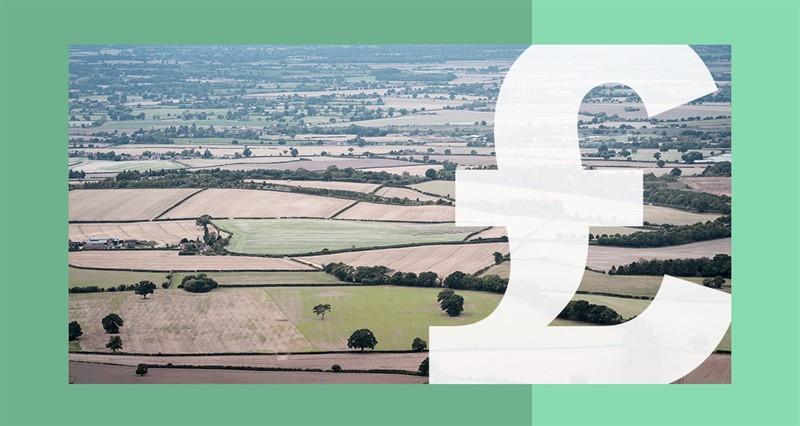
This is a really promising show of intent for domestic food production. Perhaps the strongest any government has sent for some time.
So to Steve and Emma, let me say clearly, we are behind you all the way.
Planning, procurement and water
This is exactly the sort of intent we need to see in other areas.
Look at public procurement. Why is one part of government setting ever-high standards for us, while another part is filling our schools and hospitals with food that doesn’t meet those standards?
Conference, it is time for the British government to put the public pound where its mouth is, and deliver its manifesto commitment for at least half of all food purchased across the public sector to be locally sourced.
Look at energy. Changes to standing charges this spring will hit farm businesses hard, especially our amazing horticulture sector.
Hundreds of millions of pounds of inflation are coming to a retail shelf near you, all because of poor policy.
We’ve been clear with government that it must recognise the energy intensity of farming and growing businesses. We need the same support they are giving to other industries like cement and steel.
Look at water.
This winter, we’ve seen fields flooded again. When will we recognise our river network as part of our critical national infrastructure? It needs investment, management and maintenance long term.
We need a data-led, catchment-based, approach to break this cycle and deliver a sustainable and resilient water system.
In times of drought, our ability to feed a growing population relies on access to a secure supply of water.
We need smart planning for reservoirs, remote monitoring of the pumps, flow meters in the rivers and streams, and an automated approach to water abstraction that sits beyond the Environment Agency’s bureaucratic and outdated approach.
Budget questions
Talking about bureaucratic and outdated, look at the SFI. Farmers are the original environmentalists, but to keep delivering for the environment, farms must be profitable, resilient businesses, with a clear strategy from government.
We cannot have the goalposts constantly moving. The rug endlessly pulled from under our feet.
Farming is a long-term investment, measured in years, even decades, not months.
And clarity is absolutely essential for confidence. Transparency around the farming budget is crucial to this. Without transparency, farmers and growers are unable to plan for their future.
I’ve always tried to be fair with governments, of whatever colour. I praise. I criticise.
But I am sick and tired of asking this question: Where has the £1.85bn that was going out in BPS gone?
No one can tell me.
Lead internationally
At the Oxford Farming Conference, the Secretary of State was clear that under her watch, Defra will provide certainty and transparency. I welcome that, but we need it now.
Finally Conference, clear ambitions for food production must guide the government on trade. British farmers are leading the way on sustainability and animal welfare.
Trade policy must reward that progress, not undermine it.
We cannot invest or grow more food, if imports produced to lower standards flood our market.
Instead, we should lead, internationally, in making the case for a better global food system.
Core standards
Reciprocal access that recognises our high standards, such as beef into the US, is welcome. But the out of sight, out of mind attitude to animal welfare, and the environment, has to stop.
The solution? Here at home, it’s time the government enshrined UK core standards in law, to make sure the food we eat – whether produced here or abroad – meets the high expectations of the British public.
And conference, this is only covering food imported legally into the UK; 25 years ago today, we were less than a week into the devastating Foot and Mouth outbreak.
That crisis cost the UK economy billions and I know the emotional scars still remain.
It’s unbelievable that we continue to turn a blind eye to illegal meat imports that are a risk to our biosecurity and our food safety. The government must deliver on the promise made by Steve Reed at our conference last year and crush the smuggling vans.

And while we’re talking about our borders, we welcome the principle of an improved relationship with the EU – one that reduces friction and enables better trade at a time of global instability.
But the devil will be in the detail. We have to get it right, and there is real jeopardy.
We mustn’t sacrifice our hard-won technological advantage in gene editing, or our access to GB-approved plant protection products in order to reach a deal.
Implementing appropriate transition periods is vital to enable farm businesses to plan.
These are the issues that your NFU will prioritise in the weeks and months ahead.
For the future of farmers
I believe the role of the NFU, now more than ever, is not just to provide the solutions, but to offer the vision we need for the future of our industry.
When I welcome the Secretary of State later, my message will be this – you recently said that farm profitability was vital to enable UK agriculture to grow.
I couldn’t agree more. Profit is not a dirty word. Profitability is the first step towards true sustainability.
That is the key to growth, resilience, and curbing food inflation.
I’ll say to her that we now have a stronger foundation to build on. You have so many tools already in the box, ready to help – a maritime climate, good soils, a world-class agricultural science base, a skilled workforce, a world-leading food and drink manufacturing industry.
Britain can, and should be, one of the best places on earth to produce food.
For the sake of our economy, for our planet, for our national security, and for the future of our farmers and growers, we must not take that natural advantage for granted.
Conference after two tough years, we have a great opportunity.
Let’s all of us – from farmers to food service, processors to politicians and retailers to restaurants, make 2026 the year we take shared responsibility for building a more productive and resilient food system for Britain.
Thank you.