Mr Prasad began by thanking the industry for its collaboration, saying that Tesco is “a business that is built on partnership”.
As part of his speech, he set out the conditions and support that he believes the food sector needs to grow.
The Farming Profitability Report, produced by former NFU President Minette Batters, would play a part in supporting the sector if its findings are effectively implemented by the government in its awaited food strategy. It would help to create a level-playing field and protect food standards, Mr Prasad said.
Farm innovation would also be key to development. “The rollout of innovation is one of the biggest missed opportunities,” he said.

Data driven approach
Referencing Tesco’s work in this area, Mr Prasad said the use of low-carbon fertilisers could be among the solutions for the industry, but price and availability would need looking at before this could happen.
Mr Prasad used his time on stage to highlight what the retailer and its partners are currently doing to build resilience within the food industry – which he said ultimately came down to listening to farmers.
Tesco’s Greenprint for UK Farming report, which was published in January last year, sets out several recommendations for industry and government, and Mr Prasad assured the Conference that the retailer has been acting on its four core recommendations.
The retailer is working to deliver ‘genuine financial sustainability’, ‘collaboration in practice’, ‘the rolling out and scaling of practical innovation’, and ensuring its approach is ‘underpinned by accurate, standardised data.’
“Data is essential for improving efficiency and environmental performance”, Mr Prasad said, adding that farmers were being hampered by a’ patchwork approach to data’ in the UK.
Tesco’s report found that farmers were spending too much time spent on collecting data that wasn’t being processed as part of a standardised system. Mr Prasad outlined the work of the retailer’s dairy group to standardise its approach, which he said has produced an 11% reduction in its carbon footprint as a result.
He added that they had made progress on protecting animal welfare through their LEAF certification, and were doing everything they can to support chicken, eggs and British and Irish beef producers.
“Resilience cannot mean just surviving, it has to mean ‘strengthening’ – economically as well as environmentally.”
Tesco CEO Ashwin Prasad
Shift in consumer preferences
The Tesco boss also shared his thoughts on the opportunities for the industry, which centred around stronger partnerships within the agri-food supply chain.
He said that the business was witnessing a shift in consumer preferences – the public wants healthy, home-grown food. He noted a 6.6% growth in its fresh produce category.
“To meet this growing demand,” he said, “it is vital that we that establish partnerships that grow resilience across the UK agriculture sector.”
The results of a recent Tesco survey of British farmers that found 80% said that farming is tougher now than it was a year ago.
“Resilience cannot mean just surviving,” he explained, “it has to mean ‘strengthening’ – economically as well as environmentally.”
Balancing relationships
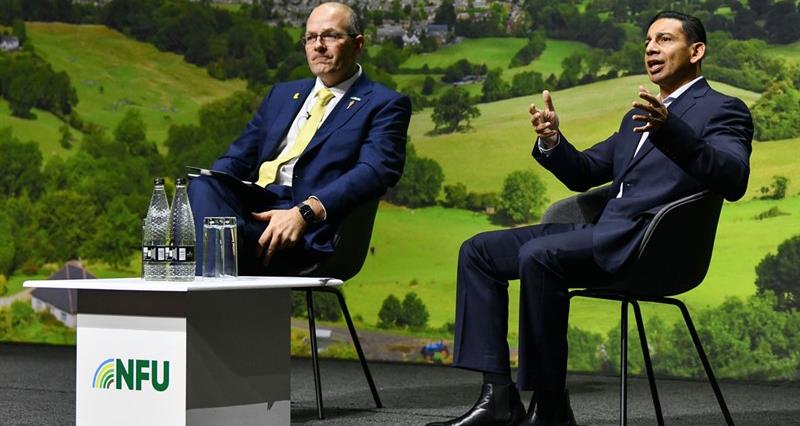
NFU President Tom Bradshaw joined Mr Prasad on stage for a question and answers session, kicking off discussion by asking about how the retailer ‘balances’ its suppliers’ profitability and ensuring the long-term supply of food.
“We have to balance our relationship with suppliers and the value that we need to deliver for customers,” Mr Prasad explained. Building long-term relationships with suppliers and having transparent pricing structures, which reflecting input costs, were key to providing that balance for the retailer.
Farmer Joe Stanley expressed his concern about farm profitability. While he agreed that resilience was needed, he claimed that farmers receive less than 10% of the value of the retail food chain.
He asked: “What will it take for the retail sector to accept that its business model is broken at the foundations and will not be able to continue loading all the risk and cost of our cheap food system onto the shoulders of farmers and growers if it wants to survive?”
Mr Prasad acknowledged his concern and speaking only on behalf of Tesco, he highlighted that the financial stability of the supply chain is important to the business. He referred to his previous point about the retailer’s emphasis on long-term relationships and transparent pricing structures.
Meet the speakers:

Ashwin Prasad
UK Chief Executive Officer, Tesco
In his previous role as chief commercial officer, Ashwin successfully led Tesco's product and customer strategy across the group, leading the business through supply chain disruptions, as well as driving our trading strategy and accelerating our digital marketing transition.
As UK CEO, he continues to oversee these areas, uniting the retail and customer and product teams.

Tom Bradshaw
NFU President
The home farm is based around arable production but has also diversified into equestrian and renewables.
Tom has represented the NFU from Local Branch Chairman through to Chair of the National Combinable Crops Board.
Tom was elected to the position of NFU President in February 2024 and re-elected in February 2026.
Responsibilities
- Fair dealing provisions
- Food chain relations (post-farmgate)
- Labour – immigration and SWS (Seasonal Workers Scheme)
- Planning/on-farm infrastructure
- Public procurement
- Regulation
- SPS (Sanitary and Phytosanitary) agreement
- Taxation and fiscal policy – IHT (inheritance tax) review
- Trade