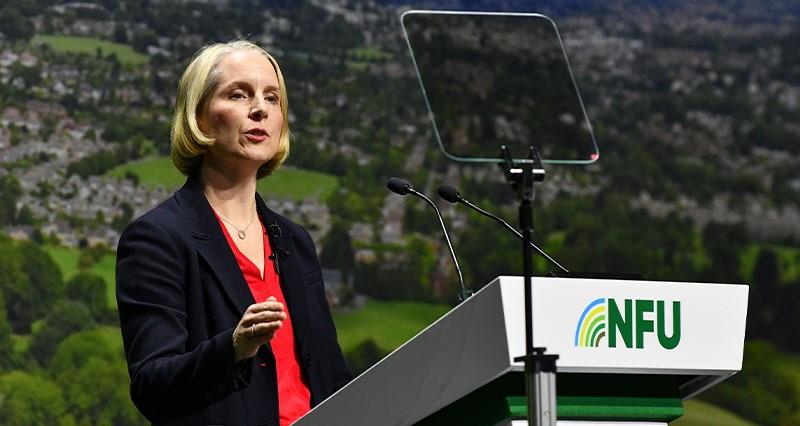
NFU Head of Trade and Business Strategy Gail Soutar set out the opportunities and sensitivities that lie ahead as the UK seeks deals with the EU, the USA, the Gulf Cooperation Council, Turkey, Switzerland and beyond.
“This has always been a trading nation,” she told NFU Conference.
“But in recent years we’ve seen imports grow rapidly in value, while export growth has lagged behind.”
She said an agri-food trade deficit of £3.5 billion a month meant plenty of “untapped potential”.

The picture has been challenging, with volumes of beef (-27.9%), lamb (-5.3%) and dairy (-8.3) exports all down on pre-Covid, pre-Brexit levels, but there were signs of a turnaround, with volumes and value up in the past 12 months.
Lamb saw double‑digit growth last year, while dairy exports hit a record £2.2bn, up 16.4%.
And more could be done. Gail told how the NFU had played a key role in securing funding for the UK’s network of 16 overseas agri-trade attaches.
They had helped to unlock £127 million of annual exports in 2025, including beef access to the US, making adequate resourcing for their work a common-sense ask.
She also called on the government to reinstate the collaborative approach of recent years under the Food and Drink Export Council – something else the NFU has had an active role in.
On the imports side of the ledger, Gail had “particular concern” over the volumes coming into sectors with declining UK self-sufficiency, like eggs and chicken meat. Meanwhile, the “troubling” decision to expand tariff‑free access to the UK’s sugar market had allowed “imports produced under conditions that would not be legal here”.
“That’s why the NFU is urging government to set up a task force to establish a set of core production standards that would apply to both domestically produced and imported food sold here in the UK,” Gail said.
“If we expect our farmers to meet ever increasing standards, it’s only right that food produced overseas also should.”
Conference heard how the NFU continues to campaign for annual reporting on the cumulative impact of trade deals on domestic agriculture, and for the Trade and Agriculture Commission to have a stronger role “especially before deals are signed”.
SPS deal critical
Looming over everything was the SPS (sanitary and phytosanitary) negotiations as part of the ‘EU reset’.
The NFU is pushing for arrangements that quickly maximise the benefits of reduced trading friction with our biggest partner, but which include the right transition periods, for example on plant protection products, maximum residue limits and organic rules.
It also wants some ‘carve outs’, relating to the UK’s leading approach to crop technology under the Precision Breeding Act, cattle vaccination rules for bovine TB, and the practicalities of producing crops in the UK’s maritime climate.
“The UK already has high standards, and while there has been divergence since Brexit, it has delivered equivalent outcomes,” Gail noted.
“That’s why how this agreement is implemented matters just as much as what is agreed.”
Turning to the US, Gail said that compromises had already been made on bioethanol access.
“UK farmers are clear – they must not be a bargaining chip for deals on steels cars and pharmaceuticals,” she added.
“If we expect our farmers to meet ever increasing standards, it’s only right that food produced overseas also should.”
NFU Head of Trade and Business Strategy Gail Soutar
Burning tongues
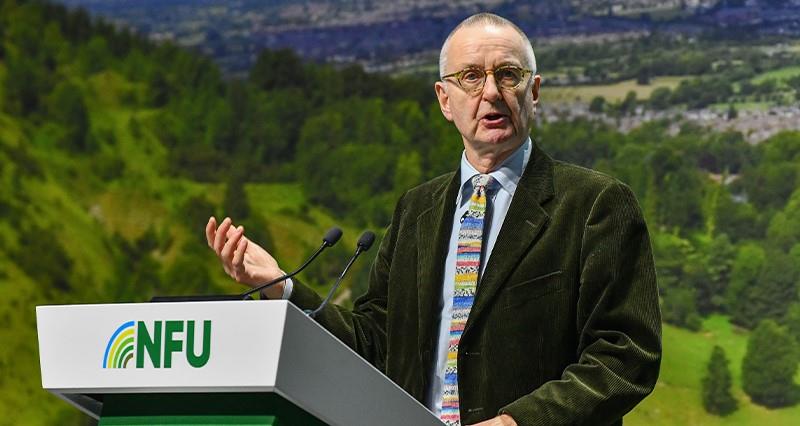
Dmitry Grozoubinski from the ExplainTrade consultancy highlighted that the course set by the UK would be buffeted by unprecedented volatility. But where the US was concerned there were some hopes of a “self-correcting mechanism”.
“It’s not seeing the benefits it hoped for,” Dmitry said.
“A range of indicators are down – just ask a US soya bean farmer about the year he has had. The hope is that having licked the stove five times, they will back off having burnt their tongues five times.”
More generally, he said governments across the world were “turning to their borders to solve more problems than they did before”.
“They are asking harder questions about the nature of international commerce,” he added.
“What that means for farmers is that moving food around the world is becoming more complicated every day.”
However, Dmitry said that standards did, in his view, stand up as a reasonable case for a competitive advantage.
“The fundamental questions farmers will be asked when they call for protections is ‘are you creating a level playing field or trying to shut out competition?’.
“Fortunately, I think UK farming has a justifiable, defendable position. It’s an argument the UK can win.
“It’s not an easy environment but there are practical steps at the ground level that can help and the UK is working harder than most governments around the world.”
Meet the speakers:

Dmitry Grozoubinski
Director, ExplainTrade
He cut his teeth as an Australian diplomat and trade negotiator, including for three years at the Permanent Mission to the World Trade Organization, where he worked on a range of issues including agriculture, aid for trade, services and trade facilitation.
Dmitry has trained hundreds of government negotiators, civil servants, and corporate officers globally on the intricacies of trade policy and the art of complex negotiations. He has been quoted on trade issues in the Financial Times, Washington Post, New York Times, the Economist and dozens of other leading publications – including Farmer's Guardian.

Gail Soutar
NFU Head of Trade & Business Strategy
She joined the NFU in 2006 as a member of our Brussels team, before returning to HQ in 2011.
Since then, Gail has led a number of high-profile policy issues for the NFU including CAP reform, Brexit and International Trade.
In February 2025, Gail took over responsibility for managing the TBS department which focuses on creating a positive business environment for our members. She leads a team of 21 policy experts spanning economic policy, taxation, international trade, science & innovation, land use, infrastructure and planning, and farm business management.
Gail grew up on the family croft on the north coast of Scotland where she loves to return to help out whenever possible. Gail is married to Alan and they have a son Cameron, who is 8.