
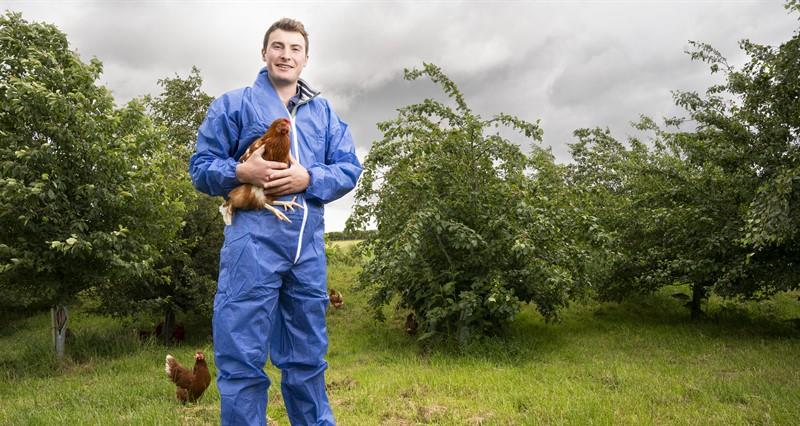
Driven by a passion for poultry, Ryan set up his egg laying business at Manor House Farm in Cheshire just six years ago, and as a relative novice in the sector he has a real enthusiasm for donning his overalls, rolling up his sleeves and getting stuck into his work.
However, Ryan is also keenly aware of the generations of experience and tradition that have come before him. Faced with an inevitable steep learning curve, Ryan feels genuine gratitude to his peers and the wider industry for their advice and encouragement.
The importance of this peer support was quickly made clear when he began his poultry enterprise. Ryan’s grandfather bought the 44ha mixed farm in 1947, and his parents turned Manor House Farm into a dairy business. But Ryan – who had 16 pet chickens as a boy – was bitten by the egg-laying bug while studying a poultry module during his Agriculture and Business Management Degree at Reaseheath College. After discussions with his parents, they decided to replace the dairy herd with 90 beef cattle and invest more than £1m into a 32,000-bird free-range unit, selling on contract to Chippindale Foods for Myton Food Group.
Work on the farm’s Big Dutchman 284 multi-tier system began in March 2020 just as Covid-19 brought much of the country to a grinding halt. “I wondered whether we’d be in trouble, but that’s when I discovered how important food production is to the country and how much we all depend on each other in the sector,” said Ryan.
“I thought we’d be told we couldn’t build our shed until lockdown was over. But everyone said: ‘No, you should go ahead, because we’ve already planned for your eggs to be on the shelf.’ We were already booked in our pullet-rearing space and Morrisons were waiting for our eggs.
“And that’s when I discovered I’d got some really, really good go-to people among farmers, suppliers and customers who will pick up the phone and respond to messages, because in this industry, if I’m not doing very well, they’re not doing very well. Everybody wants to see everybody working successfully, and I really appreciate that.”
A learning curve
The first flock of 32,000 Lohmann Brown Classic layers arrived at the new shed in November 2020, where they could emerge from popholes on both sides of the building to enjoy 16 ha of ranges planted with 1,400 trees providing 20% natural cover.
The farm’s beef cattle roam freely on the range to help deter predators.
The shed has 60kw of solar power, which Ryan says quickly paid for itself. Although the system is not large enough to justify investing in a battery, any surplus energy generates an income by being exported to the national grid.
“It was a learning curve, but as a former dairy farm used to milking twice a day, we were used to the intensity of the workload,” explained Ryan. “And like dairy, it’s about checking the numbers, always tweaking to make things better. I had to learn all about planning and flock preparation, the Lohmann breed, and about egg production. But I soon picked up when to reduce light intensity and what enrichments they liked.
“I decided I preferred layers to broilers because I’m a stock person at heart, and you have more time with the layers. My chickens – we’re now on flock five – came in February 2026 and they’re leaving in June 27 and I like that pace.
“Bird performance improves with each flock but I’m certainly not saying I’ve cracked it yet – the more you learn, the more there is you realise you can do!”
Ryan’s overriding priority is the health and welfare of his birds, and he knows there will always be challenges. Although red mite was not a concern with flock one, it became a problem with the second flock, which he tackled with a knapsack sprayer.
“It was a lot of work and we had mixed success, so I asked around for advice and soon switched to putting Exzolt in the water, which reaches all the red mites, not just the ones that are being sprayed.
“I’d like to say we’ve got a bit of a gold standard health plan now as there’s so many preventions that we do rather than just treatments. We expect a lot out of the birds, so I’ve got to give them the vaccines, the wormers, treat them for red mite, and make sure the light intensity is correct and data quality is good.”
Ryan is also trialling using pecking stones as well as lucerne in the shed to reduce stress and is getting good results from the enrichments. “As a stock person, my job is looking after the chickens and keeping them happy,” he said. “So, I’m always open to trying new things. I’m in a producer group so I have some really good contacts for advice. I’m a great believer in assurance standards – all of our eggs are Lion Code and RSPCA assured. Without good practice you don’t get good results, and they’re so important to food safety and food security.
“You have to be proactive. If I see signs of stress and pecking, I’ve got cardboard boxes ready for the birds to shred and plastic boxes ready to add. I keep an eye on the ventilation and litter quality too – if it’s nice and dry, they can dust bathe and they’re happier.”
Manure management is important as Manor House Farm is in a nitrate vulnerable zone. The shed’s muck belts are run twice a week, and the farm has a good tractor and sealed muck trailer. A weeping wall concrete lagoon, previously used in the dairy business, has been covered over to create a poultry manure store. “Arable farmers only want the manure in the spring, so this allows us to store our manure long-term. We can store more and keep it drier and more saleable.”
Ground-level perspective
Ryan joined NFU Poultry Industry Programme (PIP) in the 2021-22 cohort. “I owe everything to the PIP – I wouldn’t be where I am now without it,” he said. “I learned from the PIP that there’s more to farming and packing eggs every day. There’s such a wide range of people involved happy to help you.
“It’s great to learn what the wider industry is doing because at some point that has such an impact upon what I’m doing. It really opened my eyes and extended my knowledge.”
Ryan is also on the NFU North Poultry Board and has just joined the National Poultry Board. “I like to be involved with what’s going on so nothing comes as a shock and because I hope I can influence decision-making for the better with my ground-level perspective,” he said. “I can say: ‘I’m clean now, I’ve had a shower and gelled my hair – but this morning I was in the shed with my face mask on, covered in dust and sweat, so I can offer insight from there.
“The board is so important because we’re dealing with feed mills, egg packers and retailers and they need to know the true impact that audits, new rules or trade decisions are having further down the supply chain.
“We also need to engage with the public because they know a bit about beef, sheep and dairy but they don’t know as much about poultry and if we don’t educate them there’s always someone else willing to offer different views on us.”
Ryan was a finalist in the 2025 Farmers Weekly Poultry Farm of the Year awards and won the BFREPA Young Producer of the Year title last November. “It’s nice to be recognised and the BFREPA award was really special,” he said.
“My mum and dad were there, and my advisers were all in the room – the team from Lloyds Animal Feeds, Dave Hodson from Rose Hill Poultry and Saint David’s Vets, the people in my network, even the people who built our shed!
“So many people have influenced and helped me and still help me,” he added. “It was nice for me, and it was nice for them, and I was glad to be able to celebrate with everyone.”
Looking to the future, Ryan is in no hurry to expand just yet. “I like to do a job well and do it right. We’re a family farm – me, mum and dad – and to expand to 64,000 birds would be a real stretch. We’d have to bring in paid labour and my job would change.
“I enjoy being in the shed, being hands-on and I like the routine of looking after the birds, so for now – numbers-wise – we don’t need to grow. I’d rather have the time to keep learning and getting the most out of the birds we already have.”