Latest news
NFU co-signs letter on common land agreements
As the current IT system will not allow common land agreements to apply for SFI and CSHT, the NFU joins forces with national organisations in a letter to Farming Minister Dame Angela Eagle, asking for a solution to be put in place.
Land Use Framework publishes targets
The government’s Land Use Framework signals that, by 2030, ELM schemes, where appropriate, will be spatially targeted. For SFI 2027, an approach will be developed that focuses payments for a selection of SFI actions in areas of greatest impact; other actions will continue. More information will follow later this year.
Defra Secretary outlines 2026 offer
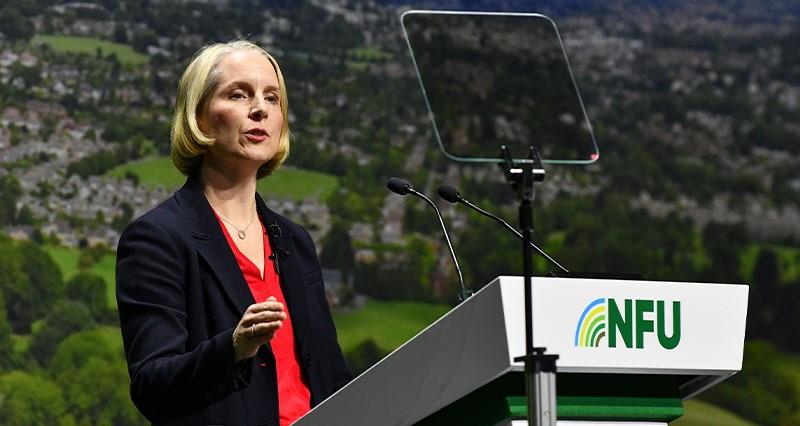
At NFU Conference, Defra Secretary Emma Reynolds announced that the reformed SFI offer for 2026 will consist of 71 actions, rather than the 102 previously available in the SFI24 extended offer. To manage budget pressures, there will be an agreement cap of £100,000 per annum.
There will be two SFI application windows in the coming year. The first will open in June for small farms (50ha in size) and/or those without an ELM agreement. The second widow will open in September for other farmers.
Applicants will be restricted to one SFI26 application per farm business.
The additional changes are:
- The area of a rotational action will be limited to the amount or value entered in year one. In years two and three, areas can decrease, but not increase above the area or value in year one.
- Moorland payment rates will increase. The new payment rate will be applied to existing SFI agreements with these actions.
- Payment rates for herbal leys, legume fallows and winter bird food on arable land will decrease. Defra says these payments still reflect income forgone plus cost payment calculations. These reductions will only apply to SFI26.
- All management payments including CSAM1 (soils), CNUM1 (nutrients), CIPM1, CMOR1 (moorland), management payment have been removed.
- Enhanced winter stubble (AHW7) has been added to the actions limited to 25% of the SBI.
- Five-year actions will be reduced to three years in length and you can only apply for the base action and supplement together.
Key resources
- The Defra handbook for the Sustainable Farming Incentive scheme can be found at: GOV.UK | Sustainable Farming Incentive guidance for applicants and agreement holders.
- Defra has launched a FIND tool to help farmers search through the actions.
- Defra has published an SFI limited area actions calculator to help calculate your eligible area across multiple agreements.
- What to expect from an SFI guidance visit
Timeline for applications
The application window is due to open in June 2026 for small farmers and/or those without an agri-environment agreement. A second application window will open in September for all other farmers.
The SFI offer and payments
You have free choice of which actions you take and how much you include in your SFI agreement. Some actions do have area constraints. Most actions can be on part of the field. A few are a whole field. Where the action is ‘whole field’, this is the available area of the field after incompatible areas have been removed.
For each of the SFI actions, there are eligibility requirements, payment rates, and instructions on what you must or must not do. Each action contains advice to help you deliver the actions.
They are written in a way to be flexible for your farm, allowing you to use appropriate seed mixes for your soil, for example. The actions outline other actions that can be stacked on the same area; when you apply, the online system should identify this for you.
Additional payments
For SFI 2026, there will not be a management payment.
For agreements entered into in SF23 or the SFI expanded offer (SFI24), there is a management payment. The first-year payment, for agreements starting by March 2025, will be £40/ha for the first 50ha entered into agreement. After the first year, this will reduce to £20/ha. This is based on option area. There is only one payment per SBI. Your first SFI agreement will be used to calculate the payment.
Premium payments
Premium payments are being introduced. These are to encourage uptake of action with the biggest environmental impact or combinations of actions that deliver benefits at scale. Premium payments are supporting the increased payments for the moorland actions and the current payment rates for agro-forestry.
Area limits
Defra has limited the combined area of ten actions to 25% of the farmed land. This limit is applied across all SFI agreements attached to the holding that started from 26 March 2024. The list has been extended for SFI 2026 applicants, with enhanced overwinter stubble (AHW7) added.
The actions limited are:
- CIPM2: Flower-rich grass margins, blocks, or in-field strips.
- CAHL1: Pollen and nectar flower mix.
- CAHL2: Winter bird food on arable and horticultural land.
- CAHL3: Grassy field corners or blocks.
- CIGL1: Take improved grassland field corners or blocks out of management.
- CIGL2: Winter bird food on improved grassland.
- WBD3: In-field grass strips.
- AHW1: Bumblebird mix.
- AHW9: Unharvested cereal headland.
- AHW11: Cultivated areas for arable plants.
- AHW7: Enhanced overwinter stubble (added for SFI26 applicants).
For an SFI26 applicant, without an existing SFI agreement, the actions limited by area are CIPM2, CAHL1, CAHL2, CAHL3. CIGL1, CIGL2, WBD3, and AHW7.
Defra has published an SFI limited area actions calculator to help calculate your eligible area across multiple agreements.
Eligibility
You need to have management control of the land to deliver the actions to be eligible for SFI.
To be eligible for SFI26 (for both windows one and two) farmers should have at least 3ha of agricultural land. You will only be able to apply once per farm business in 2026.
Then there are eligibility requirements for the SFI actions. Broadly, these require the land to be recorded on Rural Payments with the appropriate cover. For example, for SFI arable actions, the field needs to have arable crops recorded. In addition, you need to have management control to be able to deliver the required actions.
Exceptions to the March 2025 SFI closure
The RPA has written to all those it believes qualify for the exemption, following the sudden closure of SFI on 11 March 2025. By February 2026, the RPA had issued all agreement offers and was awaiting responses from the last few customers.
Tenants
Tenants can apply for SFI without seeking their landlord’s consent (subject to the terms of their tenancy agreement). The tenant needs to be confident that they will have management control for the three-year term of the SFI agreement.
Tenants on short-term rolling tenancy agreements can enter SFI, provided they expect to have management control for three years. Defra has a more lenient penalty regime which means if land has to be removed in year two, due to issues outside of your control, it will not lead to penalties. At most, you may need to repay monies received for the year in question.
Common land and shared grazing
Areas of common land or shared grazing will have their own agreement. The common will need to have its own SBI and meet the basic eligibility requirements. In addition, it will need to be set up as a single entity which has legal arrangements in place to manage the agreement, and have its own bank account.
Agreement management
The length of the agreement will mirror the longest action included (usually 3 or 5 years). Some actions could be shorter than the length of the agreement. Agreements are managed online through the Rural Payments service, and there is a rolling application window. Agreements will start on 1st of the month. RPA support will be available for applicants who are not online.
Payments will be made quarterly, starting in the fourth month after your agreement starts. This will be for a quarter of the annual value of the agreement.
You will be required to complete an annual declaration confirming that you have completed the actions. This declaration will be needed to release the final quarterly payment for the year.
Once an agreement has started, it will not be possible to add new actions to that agreement. Removal of land or actions will not normally be allowed.
It is possible to have multiple SFI agreements on the same area of ground, provided the actions are compatible. This allows you to increase SFI actions over time.
It is not possible to transfer the agreement to another person. If you do need to end your agreement on an area of ground Defra may ask for repayments. There will be no penalties applied to the remainder of the agreement.
Crop rotations
Within SFI some actions can be rotated. For SFI26, it will not be possible to increase the area or value of a rotational action above the area you have in year one of your agreement. It will be possible to decrease the area.
The rules are different for existing SFI23 and SFI24 agreements. In the second and third years of your agreement you can enter a larger area than you entered into agreement for. Alternatively you can decrease the area claimed, as long as it is at least 50% of the first year area. So, if your agreement has 10ha in year one for a rotational action, in year two that area could be 5ha and in year three it could be increased to 11ha.
Annual declarations
The annual declaration is how SFI agreement holders confirm that they have delivered against their agreement for that year. The final quarterly payment will be released after the declaration has been submitted.
Agreement holders are required to submit an annual declaration during the last two months of each relevant agreement year. The RPA will notify agreement holders when the submission period opens.
Before submitting an annual declaration, you should download a copy of the current year’s agreement.
Rotational declarations
The RPA requires you to tell it the location and area of your rotational actions for the second and third years of your SFI agreement. You need to do this even if you’re not making any changes to the location or area of these actions.
Your rotational actions declaration will be available in the RPA’s rural payments service once you’ve submitted your annual declaration.
For more information on annual declarations and rotational annual declarations for SFI23 and SFI24, visit: GOV.UK | Sustainable Farming Incentive: guidance for applicants and agreement holders.
The RPA has set out the rules for annual and rotational declarations via the following series of blogs:
- SFI24 annual declaration: GOV.UK | SFI 2024: understanding the annual declaration.
- SFI24 rotational annual declaration: GOV.UK | SFI 2024: understanding the rotational actions declaration.
- SFI23 annual declaration: GOV.UK | Understanding the SFI 2023 Annual Declaration.
- SFI23 rotational annual declaration: GOV.UK | Understanding the SFI rotational actions declaration.
Monitoring and compliance
Each SFI action has its own record keeping requirements.
Defra says it wants to use different methods to assess agreement delivery, including remote sensing. The scheme moves away from inspectors to field officers. If they find something is not as it should be they have a role of being more supportive and advising how to improve delivery. Defra will not withhold payments on suspicion of any breach.
Where a breach is found, Defra can seek repayments. However, in most cases, Defra will only apply a reclaim to the area of the breach and it could be a one-year repayment, rather than multiple years.
SSSIs and other regulations
It is your responsibility to make sure the relevant consents are in place. Therefore, if you have land you wish to include with an SSSI or a scheduled monument, you need to have consents from Natural England or Historic England respectively.
Some SFI actions cannot be carried out on land containing a SSSI, historic or archaeological features. An SFI HEFER (Historic Environment Farmed Environment Record) will be required for land to be included where there are historic or archaeological features. This is available online through a HEFER portal.
Where SSSI consent is required for moorland actions, (UPL1-10) or low input grassland (CLIG3), Natural England will ask for additional information, stocking information and how you will manage the land. It is advisable to talk to Natural England or an expert adviser prior to applying for consent.
Compatibility with other schemes
You can have different schemes on the same parcel of land provided you are not being paid for the same action twice (known as double funding).
The scheme rules set out which SFI action is compatible with Countryside Stewardship or Environmental Stewardship options and SFI pilot standards, allowing them to be co-located. The Rural Payments service application system will calculate the available area in each for SFI action, removing areas with incompatible options or actions.
Land attracting private finance, such as carbon or natural flood management payments, can be entered into SFI. Defra will keep this under review. Be aware, the private finance provider may prevent SFI being stacked on the same area as they are supporting.