When Hannah Buisman returned from university to her family farm in 2021, she became frustrated by the wariness within the cereal and arable sector, which she felt was stunting growth and ignoring opportunity.
“When I went back to the farm, I said to my dad, ‘let’s grow quinoa, let’s grow buckwheat, let’s grow something random’. His answer was always the same: ‘What if it doesn’t work and we lose all that potential income?’
“We’d gotten ourselves onto a hamster wheel, and it was scary to think about stepping off.”
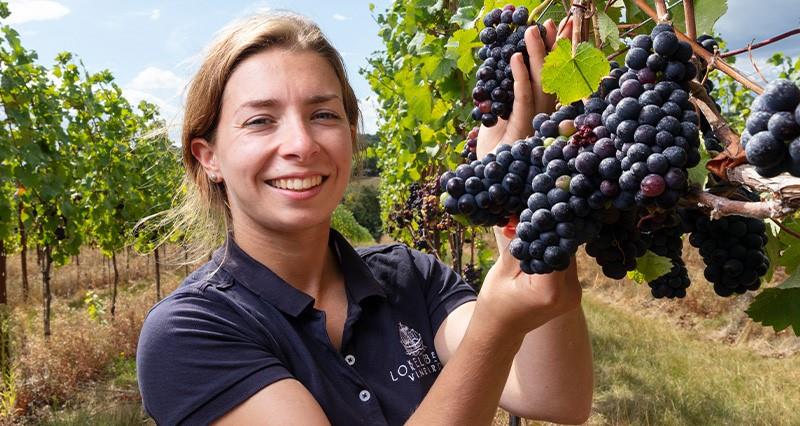
That’s when the SFI came along, and Hannah saw a chance to use the funding to do something different. In 2022, the family planted the first of their vines and today, Hannah and fiancé Zack co-manage a 15-acre vineyard, growing Pinot Noir, Chardonnay, Pinot Meunier and Pinot Noir Précose.
Planting a vineyard in England sounds unusual, but, as Hannah insists, the move into viticulture was rooted in both market demand and the soil itself. Lockley Farm’s southernly location in Welwyn, just outside of London, has proven to be a viable zone for grape cultivation. The family needed a crop better adapted to the changing environment, and so grapes seemed like a natural choice.
That’s not to say that moving into grapes from cereals has come naturally. Hannah acknowledges the hard work (and a bit of luck) that is involved in a project like this.
“If I had to, I would certainly do it again, but I would say to anyone interested in starting a vineyard – do not take it likely. It is not an easy project; there is a serious amount of manual labour involved and its very expensive,” she explains.
“Do not assume that just because you grow a crop that you will know how to grow a vine, because we had no clue what we were doing and have leaned heavily on our consultants, who have shaped this vineyard.”
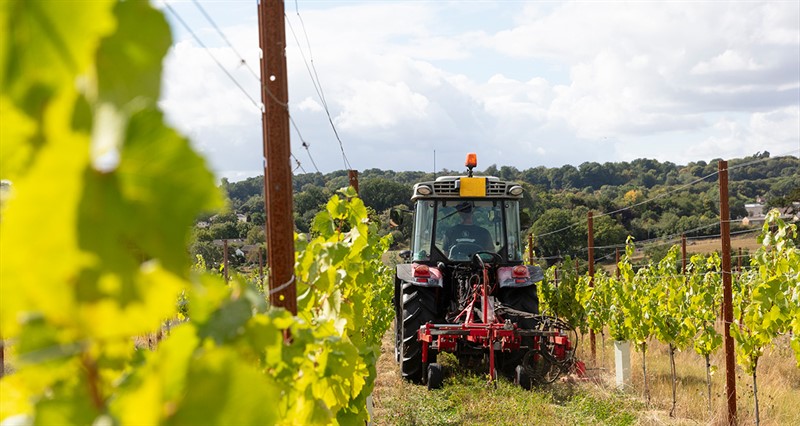
Not every farm that wants to grow a vineyard will be able to due to financial reasons or site restrictions, but Hannah says there are options out there for people who want to take the leap.
“With the right data and the right consultants behind you, I would absolutely recommend it for businesses in a similar situation, but what I would say is to do your research. Also, be sure to invest in knowledge elsewhere because it can be a very expensive mistake.”
Within the past 10 years, grape growing for wine production has grown by 123% in the UK, cementing itself as a new and booming sector. In an emerging market, it is to be expected that businesses will make mistakes – but in viticulture, when things go wrong, it can go very wrong, as Hannah found out.
She quite literally heard through the grapevine that another grower, who planted their vines seven years ago, was still not producing any grapes; and, because they didn’t invest early on in their venture, they had to dig up the whole vineyard and start again.
The risk of seeing no return on her investment came with significant challenges – and that's exactly where the SFI would come in handy.
“I really pushed for us to use the SFI,” Hannah says. “It has given us some time out and the vineyard is now at its expenditure dip, so it couldn’t be a better time for us to not have the inputs and volatility of arable. The SFI also allows us to rest our soil and gives us time to research what our next products are going to be.
“We’ve talked about growing barley for whiskey or beer, and my mum loves the idea of lavender fields. We’ve got a lot of ideas.”
Hannah says the vineyard has been one of the best things to have happened to the business: “It has given us a new vitality and energy, a realisation that we have so much potential in the arable side of our business too.”
Building a brand
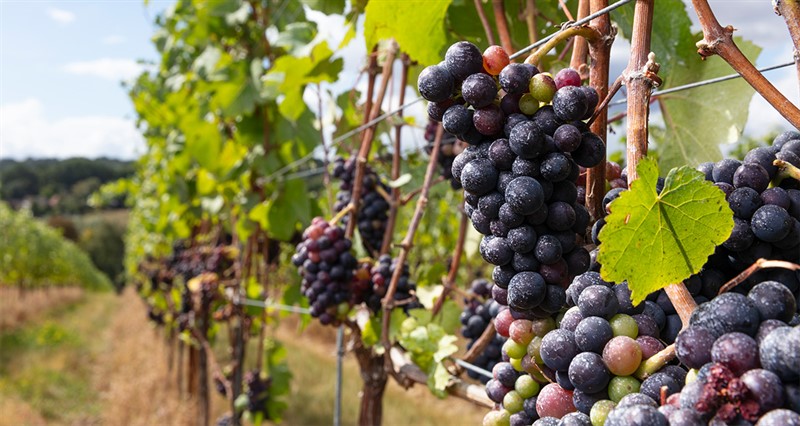
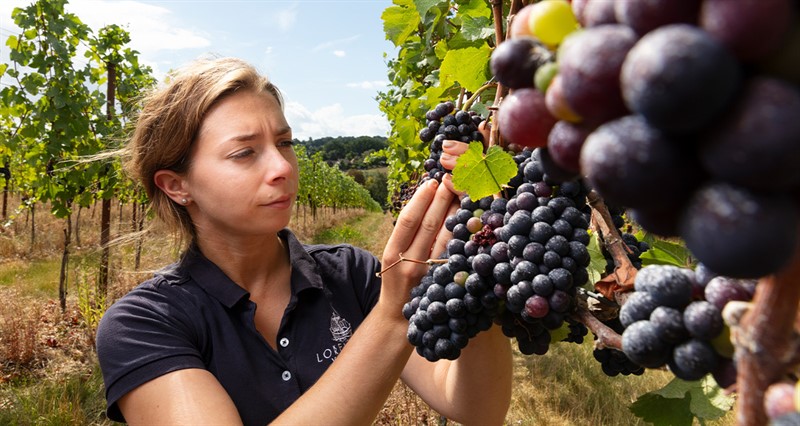
When we spoke to Hannah at the end of August, she and the team at Lokkelebery Vineyard were only weeks away from harvest. This is their second harvest, but more importantly, the first in which the fruit of their labour will become a saleable product.
Hannah decided early on that she wanted to make her own produce instead of selling the crop wholesale to other producers. That’s why she’s working with a winery called The Grange, in Hampshire to produce her product.
“Once the grapes are ready to be picked, they are harvested and put on a lorry to deliver them to the winery, where they’ll be pressed and fermented,” Hannah explained. “Head winemaker Harry and his team will work with us to create our blends and make our wine.”
“The vineyard has given us a new vitality and energy, a realisation that we have so much potential in the arable side of our business too.”
Hannah Buisman
A lot of the hard work to get the business to where it is today has not only come from organising the logistics, but also developing the Lokkelebery brand that the wine will sell under.
“The challenges we’ve faced haven’t just been with the vines,” Hannah says. “The whole venture has been an exercise in rebranding.
“Since we launched, we’ve taken on marketing staff and learned a lot of new skills. I’ve had to learn a lot about building a brand. I feel like some of it is intuitive though. We’re authentic, we’re not trying to be something we’re not and our audience thanks us for it. Social media has been massively important to the venture.
“Again, we’ve found working with consultants to be really beneficial. It means we don’t have any of the financial burdens of bringing this work in house. Using expertise that is already out there and dropping it where we need it has been essential for us.”
Bridging the gap
Since its launch, Lokkelebery Vineyard has been hosting tours and special events to help raise awareness of its produce amongst the local market. One of which is a ‘wine safari’ where visitors are invited to try wines from around the world through ‘the Lokkelebery lens’. The idea here is that customers get a hint or (quite literally) a flavour for what Hannah’s wine will taste like when it's ready for sale.
The other purpose of these events, for Hannah, is very much about ‘bridging the gap’ between local producers and consumers. Her plan, going forward, is to provide a springboard for producers to get their products in front of the vineyard’s audience.
“We’ve found that people are really intrigued by what we do,” Hannah explained. “We’ve run a range of events this summer that have been a great success, all championing local producers, and at these events we’ve provided local produce.
“We had a platter made up of charcuterie from a local pig processor, British cheese, rapeseed oil from Bedfordshire, balsamic vinegar from Devon – and the boards themselves were made from wood from the farm by my fiancé Zack. There wasn’t anything on that board that wasn’t produced in England, never mind the UK! We even had a chalkboard that stated the food miles, and people loved it.
“This is just the tip of the iceberg of what these events are going to be about, and we’re really excited to develop them further,” she added.
Part of Hannah’s ‘bridging the gap’ manifesto also involves making more direct-to-consumer products, which she plans to sell through the vineyard and its brand.
“One thing that I find absolutely crazy is that we grow barley, oats and beans, and yet I have to go to the supermarket to buy flour. I’ve never eaten any of my own products,” she says. “I want to get us to the point where we’re self-sufficient, so that we’re true advocates of our product because we’re eating it ourselves.
“That’s led me down the path of potentially milling our own wheat, and the idea that we can work on beverages. For example, we planted a number of small orchards because we found that we were buying in a lot of apple juice for our events. We saw the cost of buying it in and said ‘let’s just produce our own’. Eventually, the idea will be that anything that goes through the vineyard – whether that’s juice or cakes – most of their ingredients will be produced here.”
Supporting young farmers
In 2022, Hannah joined the NFU’s Student and Young Farmer Ambassador Programme, which she says helped her build confidence as a farmer at the helm of a new business venture.
When she joined the programme, she wasn’t long back into farming and was struggling to know where she fit into the family business. “What I loved about the ambassador programme was that I was surrounded by people who were going through the same experience as I was, trying to navigate the same challenges.
“There was a feeling of community, and I really felt like I had found my people. Starting out in farming can be quite a lonely and isolating place, so it couldn’t have come at a better time for me.”
Hannah’s experience on the ambassadors’ programme has clearly influenced her business values, as she loves the prospect of creating a space for other young farmers or new entrants to the market to explore their business ideas.
“I’d love to set up a micro dairy here,” she explains. “We don’t have any dairy experience, but there are many youngsters out there that want the opportunity, but don’t have the land or the space to make it happen – and it would be great to be involved in that.”
While it’s clear she has plenty of ideas to explore, Hannah’s focus for now is on the vineyard and the upcoming harvest. How is she feeling about it? It’s certainly nerve-wracking, but ultimately very exciting.
“It makes me very proud indeed to have stepped out of the hamster wheel that we’ve ended up in,” she says. “Some may say that what we’re doing is quite risky, but hopefully it will make the business more resilient. If anything goes wrong, it’s on us. We can’t blame it on difficult markets like we’re prone to doing. We’re taking our destiny into our own hands.”