How to better manage stress in the dairy herd is a key concern for many farmers and their vets.
Less pressure means higher productivity, improved longevity and better health…but perhaps we’re not just talking about the cows.
In an always-on production environment with fewer and fewer staff, anything that makes life easier for the stock also reduces worry and work for the stock-keeper. Handfield Farm near Congleton in Cheshire has the badge to prove it.
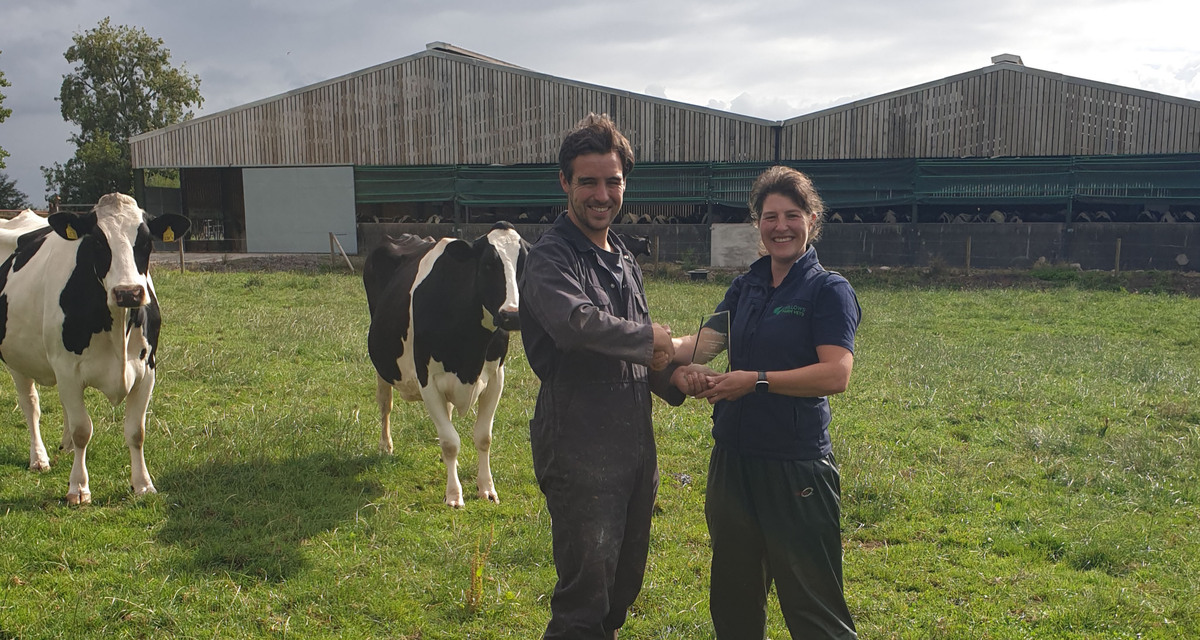
It won VetPartners’ Sustainable Farming Health and Welfare Award this year for best practice in managing its high-performing 215-strong homebred herd of Holstein Friesians. The acknowledgement wasn’t for a single investment, change of policy or event. Rather it reflected more than a decade of improvements that began with the introduction of automated milking in 2008 and, most recently, saw the farm move to health monitoring using smaXtec recticulum boluses and make a significant upgrade to its cow housing. It also took the opportunity to add another robot to reduce the ratio of milkers to machines.
Embracing technology
Isobel Johnston of Willows Farm Vets, who’s worked with the Handfield Farm for 15 years and nominated it for the award, has witnessed the improvements first hand.
“To me, what sets the farm apart is that they think first ‘how can I make my animals more comfortable, relaxed and healthy?’, rather than start with thinking how much more can we get out of them? Everything on the farm puts cow welfare first because they understand that a healthy, happy cow naturally results in more milk,” she says.
And as the cows relaxed, so did Richard and Rob Yarwood.
“We like to be in control. We don’t like to leave anything to chance,” says Richard’s son Rob. By embracing technology and following the science, they managed to remove much of that anxiety.
“The health monitoring system gives us another set of eyes on the cows, which is especially important in a robotic system when you don’t employ a herdsman and you don’t have that close contact with the cows in the parlour two or three times a day,” says Rob.
“And having the extra robot took pressure off us as well as the cows,” he continues. “The fourth machine gives the milkers more freedom and the other three older machines aren’t worked as hard. So it also means you can afford not to get up in the middle of the night to fix it if one of the robots breaks down!”
Early detection, early intervention
The smaXtec boluses monitor an animal’s internal body temperature and water intake, sending real-time alerts of any unusual variations to Rob and Richard – and, in this case, initially to the Yarwoods’ vet. It gives them a 24-hour head start on treating any potential problem and dispenses with the need for expensive but perhaps unnecessary prophylactics. The farm’s use of anti-inflammatories as a first line of defence has gone up dramatically, but, at the same time, that of antibiotics has fallen.
“Rob and I talked quite a lot at the beginning about the best way to use the data from the boluses for decision-making,” says Isobel. “We put in some protocols – what examinations he should do on a cow whose temperature was consistently high, for example… checking for mastitis, how she was eating. And, if he couldn’t find any obvious sign of infection, he’d treat with an anti-inflammatory rather than, as he would have done historically, an antibiotic, then wait 24 hours to see what response he got. If there wasn’t any improvement, he might ring me or WhatsApp me for advice. Now the system is up and running, they’re more confident looking at that data themselves… and I no longer get alerts every day!”
The boluses have, in effect, given the Yarwoods more freedom and peace of mind by allowing them to be present, even when they’re not.
“You could be anywhere in the world, and as long as you have internet signal, you can check in on a cow’s health through the smaXtec system,” says Rob. “We haven’t yet – but we could be!
“These are temperature alerts that we might not have known about before – we’re in very early detection territory. And while we might not know what that temperature indicates, there has to be a reason if you have 150 cows that are not raising alerts and two that are. We have hardly any lameness and not much mastitis. Is that because we are using anti-inflammatories? We think we are preventing problems through early detection and early intervention.”
The farm’s vaccination programme was also cited in the VetPartners award as an example of a ‘robust’ approach in that it’s both strategic and timely.
The defensive programme for IBR (infectious bovine and rhinotracheitis), for example, is every six months – before turnout in April and then at housing in October.
“The point is, it’s an ever-evolving system that’s based on good communication between the farmer and the vet,” says Isobel. “Historically, the farm didn’t vax for leptospirosis, for example, but then the heifers went to a new pasture, so we did. They are communicating regularly with me to make sure we are doing what we need to do, when we need to do it.”
This year, that also meant inoculating against bluetongue early in the season before the flies were up – something the farm hadn’t done in a long time.
“We enjoyed a close working relationship with Isobel, even before the practice became part of VetPartners,” says Rob. “Our cows calve all year round and she comes every three weeks to carry out the PD tests – it’s always her and they’ve kept that relationship going.”
Accommodation upgrade
While the extra robot, the health monitoring system and a proactive vaccination programme have all played a part, Rob credits the new housing as having had the most impact on both the business and the cows. The upgrade from Travelodge to Hilton-class accommodation was reflected in a dramatic and measurable uplift in yield, which now averages 12,000 litres a cow, milking three times a day.
“The milk increased by about four litres a cow within the first few months of using the new shed. Cow comfort was the driver behind it,” says Rob.
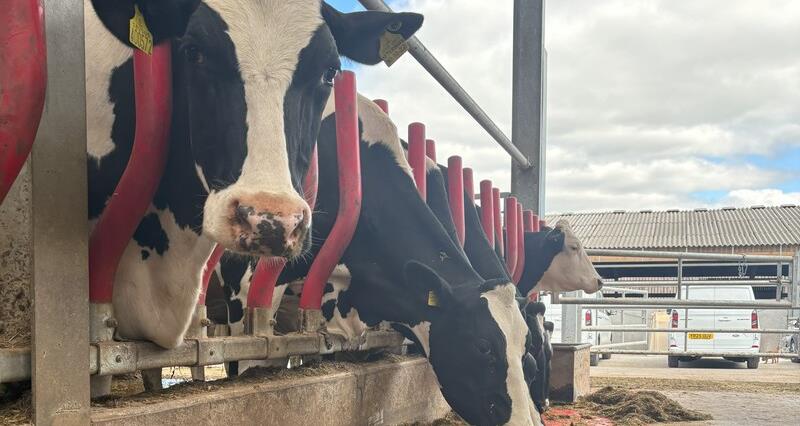
“We wanted a spacious, comfortable shed with lots of natural daylight and we put in a HeatGuard roof to reflect the heat. The cows are happy to lie down for as long as they like now – whereas in the old shed they only laid down at night and stood for long periods in the feeding areas.”
Giving big Holsteins king-sized cubicles with flexible sides didn’t allow them to pack more cows in, but it made sure every individual could be her best self.
“They’ve looked at everything holistically,” says Isobel. “The cows are super-relaxed in the new shed, while the health monitoring and vaccination programme mean their immune system is as strong as it can be. I’m really proud the Yarwoods won the Award and got well-deserved recognition as they are a great team!”
Happy cows, happy vet, happy farmers.