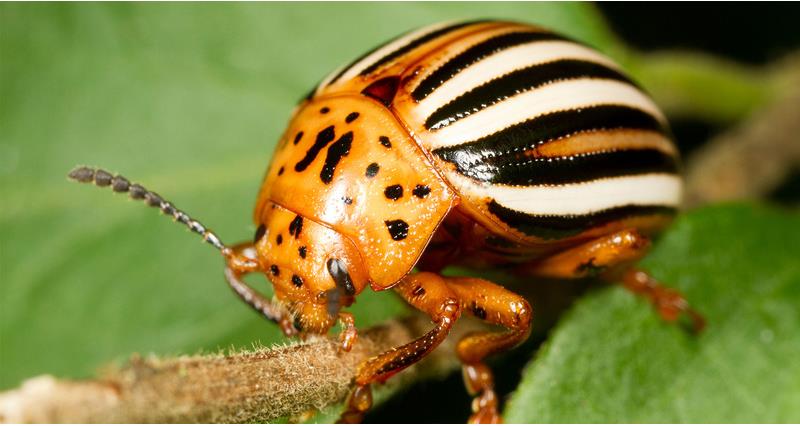
The pest is a major threat to potato crops as the adults and larvae feed on the foliage of potato and other plants in the nightshade family and can completely strip them of their leaves if left uncontrolled.
The findings led to a halt of exports to the Canary Islands, causing the loss of a significant export market for some growers.
NFU Potato Policy Group Chair Tim Rooke said potato growers would welcome the news: “We have to thank APHA and Defra for their efforts on this.
“We’re increasingly seeing new and reoccurring pests as a result of climatic changes, and it is essential that growers and the general public remain vigilant of the threat despite the recent good news. Focus must now turn to reopening important export markets such as the Canary Islands.”
Identification
The beetle is bright yellow or orange with black stripes and is usually 8.5-11.5mm in length and 3mm wide. Its larvae are a reddish brown in colour, round and globular, up to 15mm in length.
Although distinctive in appearance, there are several beetles that are frequently mistaken for them. A Defra factsheet to help with identification is available at: GOV.UK | Plant pest factsheet.
Live Colorado potato beetles are regularly intercepted, ‘hitch-hiking’ on leafy vegetables, salad leaves, fresh herbs and grains, as well as on potatoes, from continental Europe.
In the past 70 years, there have been two outbreaks of the pest in the UK, one in 1976 and one in 1977. Both were eradicated shortly after detection.
Defra said the cooperation and vigilance of farmers, gardeners and allotment holders has played a ‘key part’ in the eradication campaign, alongside APHA and Defra’s biosecurity measures.
Defra Chief Plant Health Officer Professor Nicola Spence added: “This has been a huge team effort and is good news for the potato industry, but in order to prevent further outbreaks, it is vital the public continue to be vigilant and report suspected sightings to the Animal and Plant Health Agency with a photo and location details.”
If you see a Colorado beetle in England and Wales, APHA advises to capture it in a secure container and report the sighting by calling 0300 1000 313 or emailing [email protected].