
While the survey, compiled between March 2024 to February 2025, shows an increase in income for most sectors except horticulture and specialist pig production, it doesn’t cover the challenging 2025 harvest or the impact of the summer’s drought on animal feed costs, for example.
For horticulture farms, Farm Business Income fell by 1% in 2024/25, likely due to workforce and contract costs, which more than offset an increase in agricultural output. Meanwhile, the average income for specialist pig farms fell by 6% which Defra has put down to lower revenue from diversification and the delinked Basic Payment.
The NFU has said these variations in income outlined in the latest FBI (Farm Business Income) figures make planning and investment incredibly difficult.
Peaks and falls
The data follows a longer-term trend of considerable variation, where some sectors have seen peaks in income which were immediately followed by major falls. For example, after a strong period for the arable sector between 2021 and 2023, income then plummeted by 73% due to a combination of lower yield and lower global prices.
Similarly, the dairy sector saw income fall by 68% in 2023/2024 due to reductions in the price farmers receive for their milk. While the latest figures showed some recovery, this month farmgate milk prices have once again been slashed by as much as 6 pence per litre, and those with cheese contracts are now potentially losing up to 8 pence per litre.
“If the government truly believes in growth, it cannot keep taxing businesses into the ground.”
NFU President Tom Bradshaw
Minimising volatility must form government policy
NFU President Tom Bradshaw said the new figures lay bare the volatility in the sector: “The farming sector has always had to deal with elements beyond our control which impact what we earn – from increasingly extreme weather to changing global markets.
“While farmers understand that our income will vary year to year, it doesn’t seem like the government does. Nor does it seem to recognise its role in minimising volatility at home where possible. The snap decision to implement a crippling tax on family farm businesses at the last Budget is evidence of that – many will simply not be able to afford to pay it.”
The NFU President called for greater stability in the country’s domestic policy to enable farm businesses to navigate the many challenges they face that are outside of their control. Acknowledging that arable prices will always be determined by the global market, Tom cited decisions the government has taken around the recent US trade deal and bioethanol that have “dramatically reduced demand”. Among a range of concessions on imports announced on 8 May 2025 as part of the Economic Prosperity Deal between the UK and US, tariff-free access was granted to 1.4 billion litres of ethanol from the US.
He also looked ahead to future negotiations around the EU Sanitary and Phytosanitary deal and decisions the government could take around access to scientific solutions for gene-editing and plant protection products.
“For our dairy farmers, driving exports abroad would provide another stable source of income and help build resilience,” he added.
‘Do right by Britain’s farmers’
“If the government truly believes in growth, it cannot keep taxing businesses into the ground,” Tom said. “Some horticulture businesses have seen employment costs increase by hundreds of thousands of pounds due to last year’s Budget tax rises and now face the prospect of much higher electricity standing charges.
“Meanwhile family farms across the UK are halting investment or anticipating having to sell parts or all of their farm to pay an inheritance tax bill this government promised it wouldn’t impose. How is this conducive to economic growth?”
Speaking ahead of the Autumn Budget, the NFU President called on the Chancellor to “do right by Britain’s farmers and rethink the family farm tax”. He also called for the Annual Investment Allowance to be increased and for enhanced capital allowances to be introduced to incentivise investment and support business planning.
“This would not only send a clear signal that our government understands how agriculture businesses work, but that greater stability is needed to build resilience, boost confidence and invest in the future of homegrown food,” Tom said.
Slow payment delivery adding pressure
The Farm Business Income data also shows that food production alone often isn’t the main driver of income. The figures highlight that the arable and livestock sectors in particular have, on average, struggled to make a profit from food production, and the increase in income has largely been bolstered by diversification projects and agri-environment schemes.
With the RPA (Rural Payments Agency) due to start making payments from 1 December, the NFU is calling on the agency to deliver at least 90% of Countryside Stewardship and Higher Level Stewardship payments by the end of December, with partial payments used for anyone with outstanding payments in the New Year. This is essential for farm businesses cashflow.
NFU Deputy President David Exwood said “the importance of environmental schemes in building business resilience cannot be overlooked” but warned this comes with “huge levels of uncertainty” as farmers don’t know when, at any point over a six-month period, they will receive payment for their work.
“It makes managing cashflow and planning for the future incredibly difficult,” he said.
“With cashflow already tight due to the weather, additional costly inputs and further reductions in direct payments, we are continuously making the case to the RPA that it needs to significantly improve its payment performance this year.”
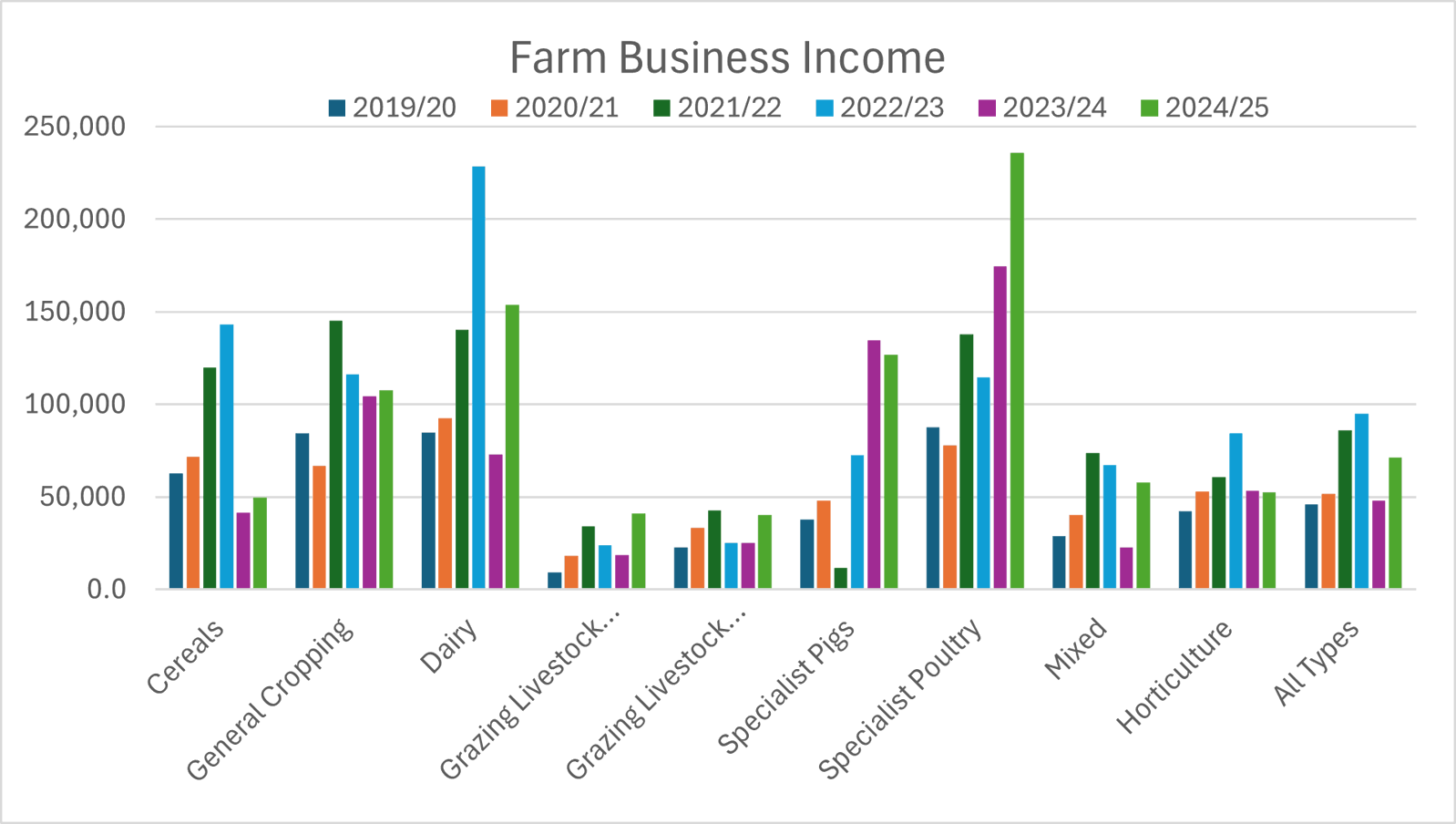
Farm Business Income figures across all sectors from 2019-2025. Data: Defra