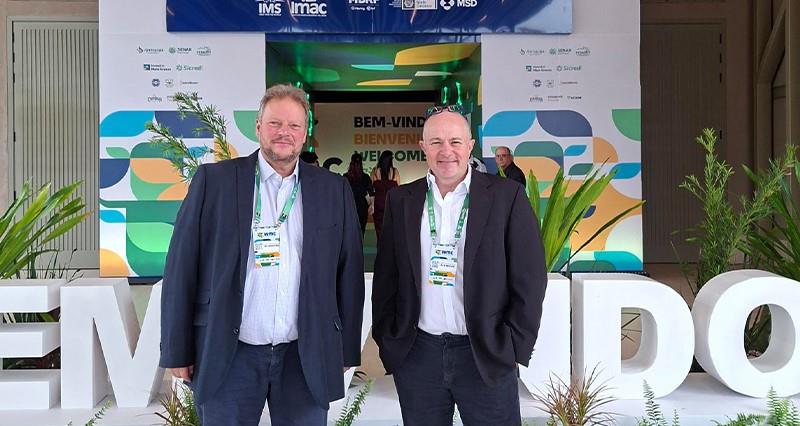
The 2025 IMS (International Meat Secretariat) World Meat Congress, held in Cuiabá, Brazil from 27-30 October brought together more than 500 industry leaders, farmers, processors, officials, and academics from more than 20 countries.
Hosted jointly by the IMS and the IMAC (Instituto Mato-Grossense da Carne), the event took place in the heart of Brazil’s largest agricultural region. Mato Grosso, home to 34.5 million cattle and exporting to 65 international markets, generated beef exports valued at $2.7 billion in 2024, providing an ideal backdrop for discussions on the global meat sector.
Global trade under pressure
A central theme throughout the congress was the evolving geopolitics of the meat trade.
Delegates highlighted how tariffs and non-tariff measures are increasingly used not only as tools of market protection but also as instruments of political leverage and national security.
John Clarke of FIPRA and Ted McKinney, former U.S. trade negotiator and NASDA (National Association of State Departments of Agriculture) CEO, underlined the unpredictability surrounding current US trade policy under President Trump’s administration, as well as uncertainty around the future direction of EU trade, environmental, GMOs (genetically modified organism), and animal welfare regulations.
“With global protein demand rising, UK producers in particular were encouraged to invest confidently in their businesses.”
NFU Chief Livestock Adviser John Royle
Despite these pressures, the outlook for global meat markets remains positive. Many regions face declining production capacity while global demand – particularly in Asia, the Middle East, and Africa – continues to grow. This imbalance is expected to sustain price strength across all major protein categories.
Sustainability and production efficiency
Sustainability, animal health, and the role of livestock in global nutrition were recurring topics across the event.
Professor Michael Lee of Harper Adams University stressed that livestock systems contribute to healthier diets and can support environmental goals when managed effectively. He emphasised the importance of improving livestock genetics, optimising feed and forage systems, strengthening animal health, and embracing nature-based solutions.
There was broad agreement that investment in technology and innovation is essential for reducing the sector’s environmental footprint.
The use of HGPs (hormone growth promotors) generated lively debate.
Although Brazil does not use HGPs, emerging research indicates that cattle finished with hormone implants can produce lower emissions due to shorter finishing times.
The challenge, especially for countries using HGPs, lies in demonstrating credible traceability and segregation throughout processing in order to retain access to markets such as the UK and EU that require non-HGP beef.
Nutrition, public perception, and communication
Speakers also addressed the role of animal protein in human health and the growing scrutiny of ultra-processed foods.
Referencing the 2024 Denver Call to Action, Frederic Leroy reiterated that livestock systems must be guided by rigorous science and should not be undermined by oversimplified or ideological narratives.
At the same time, the industry must take responsibility for nourishing a growing global population while minimising environmental impacts.
A consistent message across the congress was the need to strengthen communication with consumers. While trust in the meat industry remains relatively strong, delegates agreed that producers must become more proactive in conveying their environmental achievements and the positive contribution of livestock production.
With global protein demand rising, UK producers in particular were encouraged to invest confidently in their businesses to help meet national food security needs rather than relying on imports.
Field visit: Fazenda Aba
The congress concluded with a visit to Fazenda Aba, a 1,355-hectare beef finishing operation in Mato Grosso.
The visit offered valuable insight into the region’s production systems.