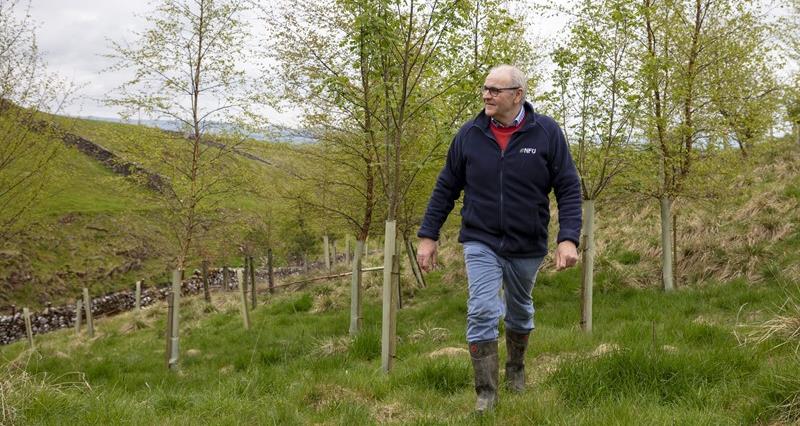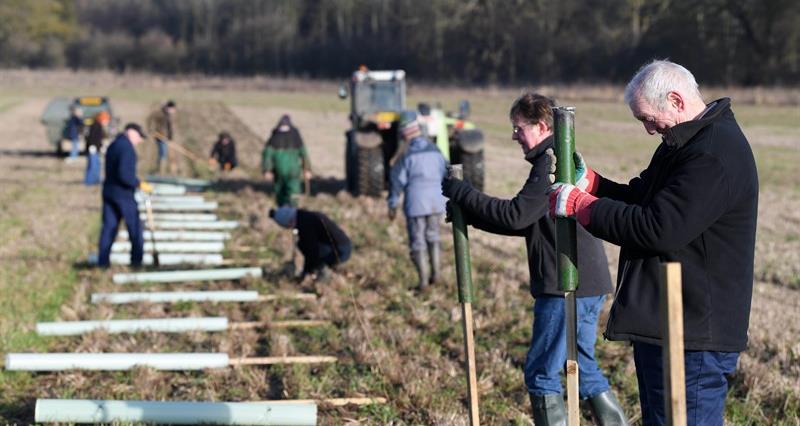
The government has set a legally binding ambitious target to increase tree canopy and woodland cover from 14.5% to 16.5% of total land area in England by 2050 – this equates to about 240,000 hectares.
Farmers and landowners will play a crucial role in helping to deliver these ambitions.
Manging existing trees on farm and planting trees can help to deliver benefits to the environment which work alongside food production and create a more resilient farming sector.
We launched the NFU tree strategy in July 2021. It sets out the opportunities and barriers of managing and integrating trees within the farmed environment and our key asks of government to ensure the right policies and incentives are in place.
The NFU has reviewed the progress that the government has made against the NFU’s tree strategy asks. Overall, good progress has been made on some of the NFU’s key tree policy asks, however, there are key outstanding asks, such as the gap in support for bringing existing woodlands back into management as well as the permanency element of trees which remains a barrier to tree planting. The NFU will continue to work with the government to help address these barriers.
Government funding options
Dry weather support
On 28 October 2025, the government opened up funding to support the replacement of trees planted under specific grant schemes in England that have been affected by the prolonged hot and dry weather. The EPREC (Extraordinary Payment for Restocking in Exceptional Circumstances) is eligible to invited agreement holders, the Forestry Commission will contact those eligible.
The support is specifically for trees planted under the England Woodland Creation Officer, Urban Tree Challenge Fund and Local Authority Treescapes Fund in the 2024/2025 planting season with a 25% failure rate due to hot and dry weather.
Those invited need to submit their application by 14 November 2025. The funding covers up to 50% of the standard costs with a £10,000 cap per agreement.
Although there are limitations to the offer, it does provide welcomed recognition and support from the government for the impact of dry weather on trees and agreement holders.
More detail about the EPREC is available at: GOV.UK | Forestry Commission Guidance: Extraordinary Payment for Restocking in Exceptional Circumstances.
England woodland creation offer
The EWCO (England woodland creation offer) is the government’s main woodland creation fund which is operated by the Forestry Commission.
It provides funding for woodland creation and maintenance on applications as small as one hectare in total; each individual area must be at least 0.1 hectares.
Support to plan the EWCO woodland is available through the WCPG (woodland creation planning grant).
More detail on the WCPG and EWCO is available on GOV.UK and can be discussed with your local Forestry Commission woodland creation team/officer. The Forestry Commission has also produced a series of YouTube videos to provide guidance on applying for the EWCO.
Applicants to the EWCO in low sensitivity areas could benefit from the Forestry Commission fast track approach to applications. This approach aims to make regulatory decisions and grant offers in 12 weeks.
This may provide a quicker route for those considering planting woodland this coming winter. Information on fast-track woodland creation applications is available on GOV.UK.
Deadline: It is recommended that EWCO applications are submitted by 30 June 2025 to secure an agreement offer ahead of the forthcoming tree planting season. This doesn’t apply to EWCO woodland creation fast track process which turns eligible proposals around in under 12 weeks. If you have any queries about new or existing EWCO applications, please contact the Forestry Commission via email on [email protected] or telephone on 0300 067 4177 or get pre-application advice from your local Forestry Commission advisor.
There are several other Forestry Commission woodland grants and incentives. An overview of these is available at: GOV.UK | Woodland grants and incentives overview table.
Farming in Protected Landscapes
The FiPL (Farming in Protected Landscapes) programme provides funding to support farmers and landowners in Protected Landscapes (National Parks, National Landscapes [AONBs] and Norfolk Broads).
The programme began in July 2021 and will run until March 2026. Although this is a Defra programme, the delivery and allocation of the funding to participants is operated by the National Park and National Landscape teams.
The programme has been designed differently to agri-environment schemes; this enables projects to be specific to the area and the landowners within it. In some places this may involve trees.
Forestry England woodland partnership programme
Forestry England offers to lease land from landowners to create and manage new woodlands and pays a rent to the landowner.
Find out more on Forestry England’s webpage on the woodland partnership programme.
Alternative funding options
Woodland Trust
The Woodland Trust is the UK’s largest woodland conservation charity. It operates several funds and grants for tree planting and woodland creation including:
- MOREwoods – Funding of up to 75% of costs is available, for where more than 500 trees are planted as woodland on at least half a hectare.
- Trees for you Farm – Plant 500+ trees to improve productivity and the environment on your farm. Funding of up to 100% of costs is available for agroforestry schemes benefiting the business of productive farms.
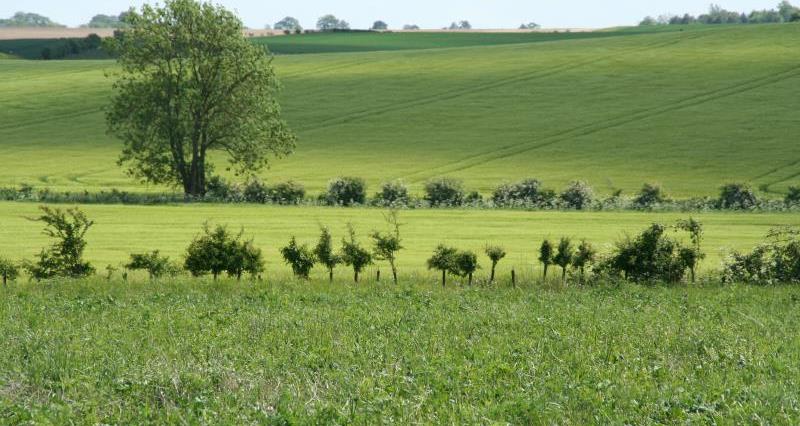
- MOREhedges – Plant 100+ metres of new hedging allowing a large tree to grow every 6 metres. Funding of up to 75% of costs is available.
Find out more about the Woodland Trust's funding.
At a regional level, the NFU sometimes runs tree giveaway initiatives with the Woodland Trust. Updates on are these are posted in regional communications.
National Highways
National Highways wants to engage with landowners to help plant 3 million trees.
National Highways will be donating up to 600,000 whips on an annual basis from UK native trees species until the 2028/2029 planting season. More detail about the opportunity is available on the National Highways website.
Tree planting advice
A local Forestry Commission woodland creation team or officer will be able to provide guidance and more information about tree planting funding and opportunities in your area. Their details can be found on GOV.UK.
Forestry Commission Woodland Ambassadors act as local advocates for woodland creation and management, sharing their knowledge with peers. To find a local ambassador visit: GOV.UK | Woodland Ambassadors.
Further tree planting and woodland creation resources are available on: GOV.UK | Tree planting and woodland creation resources.
It’s important to understand exactly what you're signing up to if you are planting trees – in most cases this is long-term permanent land use change.
If you’re unsure about any contracts or legal information when entering tree planting schemes or agreements, it is important to consider taking professional advice.
The NFU offer a legal service through our internal and external legal professionals working together for the benefit of our members. Our in-house legally qualified advisers can assist you through our NFU Legal Assistance Scheme and NFU Contract Checking Service.
The right tree needs to be planted in the right place and in the right way for it to establish and flourish. Those planting trees should familiarise themselves with practical tree planting advice and guidance.
The Tree Council planting guide sets out the main considerations when planting trees and The Woodland Trust provides advice on three ways to plant a tree.
Member stories
Find out how other members have accessed funding: