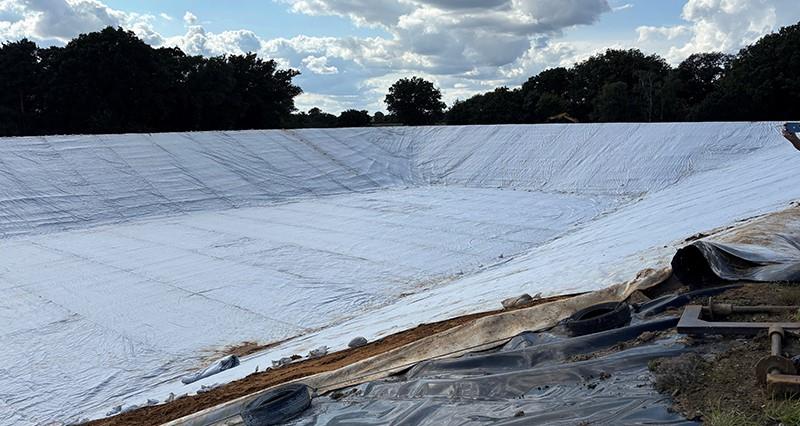
The development of more and higher capacity on-farm reservoirs is seen as a key requirement for many farm businesses in order to make food production more sustainable under conditions of drought or reduced water availability.
As we have seen with recent drought conditions, these will include areas and businesses that have not traditionally considered water storage as a necessary part of building resilience into their operation.
Development of an on-farm reservoir will require the necessary consent from the LPA (Local Planning Authority) and an abstraction licence from the EA (Environment Agency) if it is being supplied with more than 20 m3 of water per day from ground or surface water sources.
Details relating to developing a reservoir can be found on this page. The EA has also produced a guide with Cranfield University.
Funding
Currently there are no supporting schemes for investment in on-farm reservoirs. Previously, the construction of on-farm reservoirs has been supported by two rounds of the WMG (Water Management Grant), launched 2021 and 2023 respectively, both worth up to £10m.
The minimum grant value was £35k and the maximum was £500k per applicant business, per round of funding. Grant funding only contributed to 40% of the eligible costs.
Feedback from applicants where there had been issues indicated some significant challenges in getting planning permission and abstraction licences within the window for applying.
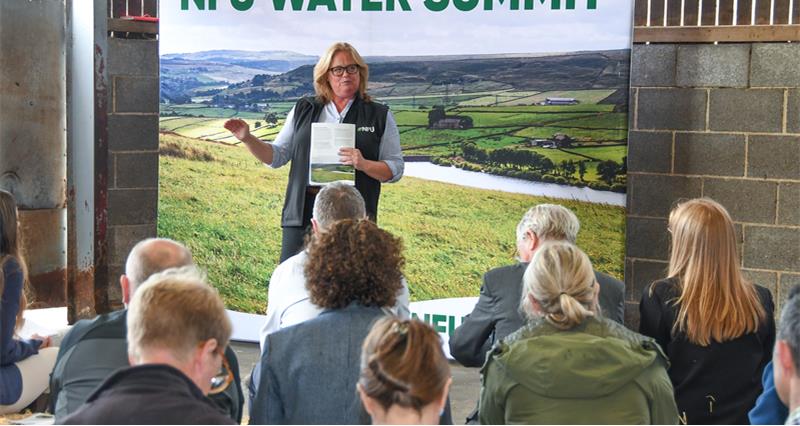
At the NFU water summit Alan Lovell, chair of the Environment Agency, suggested that changes to capital allowances for tax could enable reservoir investment to be more cost effective for these projects.
They currently come under farm structures which qualify for 3% relief, meaning a reservoir will pay for itself in tax after 33 years. Increasing relief would increase the offsetting of this qualifying investment against tax liability over fewer years.
In comparison, between the WMG and changes to capital allowances, there are different benefits:
- The benefit of the grant system is that, in the short-term, it supports the cashflow of farms looking to develop a high value capital project. In addition it gives Defra more scope to influence the development of farm reservoirs.
- The benefit of capital allowance is that it does not suffer from a limited window in which to apply with a capital grant. It will run over several years and will not have as many criteria to satisfy as a grant. In addition, while the amount of grants available are capped, capital allowances are available to all businesses.
The NFU has been calling for further rounds of the water management grant and would support additional tax incentives towards building reservoirs for on-farm resilience given future water challenges.
The EA has funded LRO (Local Resource Options) studies in 2024 and 2025 that bring groups of farmers together to assess what options are open to them to deliver water in the future and explored what challenges they face.
Planning
Generally, farm reservoirs are covered under permitted development rights, however, under the Habitats Directive, reservoirs exceeding 1ha in size, or those significantly impacting SACs (Special Areas of Conservation) or SPAs (Special Protection Areas), will require an EIA (Environmental Impact Assessment) to ensure they don't negatively affect protected habitats or species. This can override permitted development and trigger a full planning process.
A prior notification submission will be required in all cases and LPAs (local planning authorities) may require a subsequent prior approval submission. If an EIA is triggered, a 'screening opinion from the LPA will need to be sought before submission of the prior notification.
There may need to be an archaeology survey with or without an EIA, which can add significant costs and delays to the planning process.
A mineral extraction licence is also often required for the development of a reservoir. This is because it is treated as a small quarry.
Furthermore, the waste of the excavation is treated as industrial waste, leading to expensive demonstrable recycling or disposal. LPAs can negatively view any on-site disposal for landscape impact purposes and surface water contamination. It is important to note that the waste disposable element can add significant cost to what should be quite a straightforward process.
LPAs also vary in their capacity to undertake these assessments with some offering in-house services and others requiring the applicant to engage with organisations such as Natural England separately.
The NFU has recommend that the area of permitted development for an on-farm reservoir be increased from 1ha and that LPAs learn from best practice and are resourced to get surveys undertaken swiftly. We have also called for a formal designation of agricultural reservoirs in the forthcoming National Development Management Policies, as well as the General Permitted Development Order (as amended). This is to prevent confusion with planning for reservoirs being considered alongside other ‘engineering works’ that can lead to more stringent restrictions being applied than necessary.
Abstraction licencing
Abstraction licencing is required if a reservoir is to be filled with water taken from the surface or groundwater, or if the reservoir is clay-lined and holds water at or below the water table, at a rate greater than 20 m3 per day.
The EA produces abstraction licencing strategies for all catchments that indicate the likelihood of obtaining a licence to take water from the environment. There are significant abstraction pressures nationally that are more acute in certain areas making obtaining a licence less likely.
Application details for an abstraction licence can be found at: GOV.UK | Apply for a water abstraction or impounding licence.
Abstraction licencing is also undergoing significant changes now and over the next several years, which are detailed in our online article: Future changes to abstraction licences – what you need to know.
Reservoir safety
Reservoir safety is currently under review with the potential for more reservoirs to become covered by regulation. Currently, reservoirs less than 25,000 m3 do not have to be registered but, whether you need to register your reservoir or not, you must follow HSE (Health and Safety Executive) regulations and local council building regulations.
Details of the requirements for those reservoirs over 25,000 m3 can be found at: GOV.UK | Reservoirs: owner and operator requirements.