The government has committed to developing a series of sector growth plans, starting with horticulture. These plans are intended to boost productivity, profitability and food security.
We know that for many members, growth may feel out of reach given ongoing market pressures, high costs and supply chain disruption.
That’s why the NFU is clear that strengthening business resilience must be at the heart of any government-backed growth plan.
The NFU recently conducted a survey to gather feedback from members which has now closed.
NFU Horticulture and Potatoes Board Chair Martin Emmett said: “This is a significant moment for the horticulture sector. It is encouraging to see Defra listening to industry concerns and creating an opportunity, through the Farming and Food Partnership Board, to shape the policy changes needed to support future growth.
“UK growers continue to face an uneven playing field when competing with European counterparts. The horticulture sector growth plan provides an important opportunity to address the key barriers holding the sector back, from planning constraints to workforce uncertainty.
“I would encourage all horticulture businesses to take part in the NFU survey and share their views. By presenting a strong, evidence-based case, we can help ensure the growth plan delivers the measures needed to increase domestic production, meet consumer demand and build a resilient, profitable and confident horticulture sector.”
“The horticulture sector growth plan provides an important opportunity to address the key barriers holding the sector back, from planning constraints to workforce uncertainty.”
NFU Horticulture and Potatoes Board Chair Martin Emmett
The big picture: A joint government and industry process
Sector growth plans are not being developed solely by Defra. They are being developed through a new joint governance model between government and industry, overseen by the newly established (FFPB) Farming and Food Partnership Board.
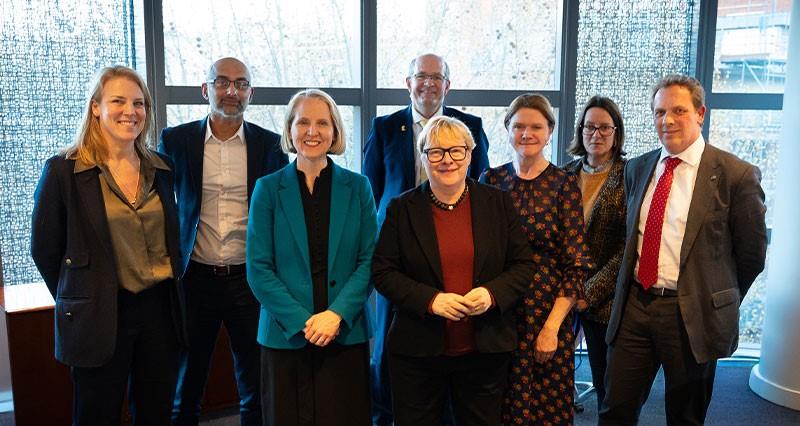
Led by Defra Secretary of State Emma Reynolds and Defra Minister for Farming Dame Angela Eagle, the FFPB brings together representatives from across the farming and food supply chain to strengthen collaboration, champion domestic production, and improve the long-term resilience of our food system. NFU President Tom Bradshaw sits at the table alongside others from AIC (Agricultural Industries Confederation), IGD (Institute of Grocery Distribution), UKH (UK Hospitality), AHDB (Agriculture and Horticulture Development Board), BRC (British Retail Consortium) and FDF (Food and Drink Federation).
Its mission is to improve productivity, profitability and food security. Crucially, it steers the direction and scope of the sector growth plan.
Shaping strategy through the Partnership Board
The NFU has a direct role in setting strategic priorities at the FFPB, agreeing which sectors are developed first and tackling, with more leverage, significant areas holding back profitability and productivity.
With key supply chain bodies represented on the Board, there is a clear market focus, which will be important for the horticulture sector plan.
Working with Defra officials
The sector growth plan is not being imposed top-down. It is being coordinated and evidenced by horticulture’s sector industry leaders, alongside Defra officials.
The NFU is part of that engagement, meeting regularly to shape the work. This includes identifying where deeper policy work is needed and supporting the development of proposals.
Expert industry groups
Detailed policy development is taking place through Defra’s established sector-specific expert groups.
This stage is critical – it’s where ideas become deliverable with a well-articulated and clear actionable policy or market intervention set out.
Defra’s Horticulture Expert Growers’ Group, the Environmental Horticulture Group and the Agroecological Group are three industry expert groups working on drafting the plan. The NFU is actively involved alongside key stakeholders, including British Growers, GB Potatoes, crop associations (British Apples and Pears, British Tomato Growers Association, British Cucumber Growers Association, and British Berry Growers), and the HTA (Horticulture Trades Association).
These groups are articulating the solutions needed, such as labour, energy, water and planning, and working through known barriers and trade-offs. This is where the substance of the growth plan is being built.
A market-led approach
The growth plan must be firmly market-led, with the FFPB identifying market opportunities.
The NFU is clear – growth should not be defined solely in terms of increasing value. Increasing the share of British produce within the domestic market through import substitution, season extension and product displacement will be equally important.
For some sectors, export opportunities may offer potential. For others, particularly where domestic supply already meets demand, strengthening business resilience will be key.
Demonstrating this strong market focus is critical in articulating the case for targeted policy interventions with HM Treasury.
Building on NFU’s own Horticulture Growth Strategy
The NFU is not starting from scratch. The NFU Horticulture and Potato Board have already set out a clear vision for growth through our own Horticulture Growth Strategy.
Revised in 2025, this identifies the key building blocks needed to unlock growth. This means the NFU is not just responding; we are setting the policy agenda.
Influencing the wider system
Many of the most significant barriers to growth sit outside Defra’s direct control.
For example, labour policy sits with the Home Office, energy policy with DESNZ (Department for Energy Security and Net Zero) and investment and trade with the DBT (Department for Business and Trade).
The NFU is therefore engaging across Whitehall to ensure policies are aligned and do not work against each other.
We have been clear that the success of the horticulture growth plan will depend on effective cross-government collaboration. Without this, progress risks being limited.
Representing your voice – have your say on the sector growth plan
The NFU gathered feedback from members through a survey which closed on 31 July 2026.
Meeting members face to face is critical and we’re doing so alongside British Growers and crop associations to hear views directly from members. We’ll also be at key shows and trade events this summer, speaking on discussion panels about the sector’s plans.
We’re keen growers have as many opportunities to feed views into the sector plan as possible.
What this means for you
In summary, the NFU is engaging at every level of Defra’s system:
- Strategic: Shaping direction through the Partnership Board.
- Policy: Highlighting where policy interventions should be progressed, with Defra officials.
- Technical: Developing detail in expert groups.
- Cross-government: Aligning action beyond Defra.
- Representative: Feeding in member experience and evidence.
The bottom line
The horticulture sector growth plan is a major opportunity to embed business resilience, unlock investment, remove long-standing barriers, grow the British market share and build confidence and profitability in the future of British horticultural businesses.
The NFU is working to ensure these plans are ambitious but deliverable, joined up across government, yet grounded in the realities of horticulture enterprises.
We will continue to engage closely with Defra and keep members updated as the work progresses.