NFU Council: Combinable crops update
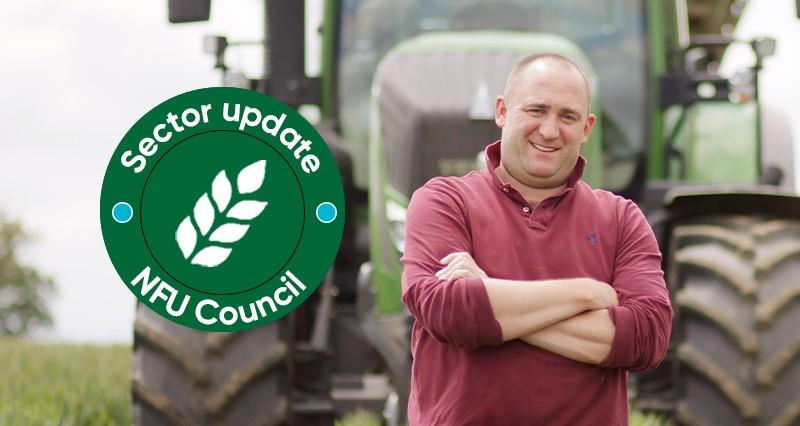

Jamie Burrows
NFU Combinable Crops Board Chair | Regional Chair (East)
NFU Combinable Crops Board Chair Jamie Burrows updates members on the Carbon Border Adjustment Mechanism, farm assurance and research and development.
While the CBAM (Carbon Border Adjustment Mechanism) remains a constant cause for concern and focus of NFU lobbying, positive developments are also on the horizon.
Working on behalf of our members, NFU Crops Board members fed into the highly anticipated proposed revisions to Red Tractor's environmental standards.
Plus, I continue to pursue opportunities in the R&D (research and development) sector to unlock resilience for farm businesses.
Carbon Border Adjustment Mechanism
From 1 January 2027, the UK CBAM will place a carbon charge on imported fertiliser and ammonia.
The UK imports approximately 60% of its nitrogen and makes the rest from imported ammonia, and so the charge will reach the price of almost all the nitrogen farmers buy.
The charge starts small because UK fertiliser producers currently receive free allowances covering roughly all of their emissions, and only a small share of those allowances is withdrawn each year to 2030.
Assuming the UK follows the same trajectory as the EU, the charge then ramps up as free allowances fall to zero in 2035 and the cost on every crop rises many times over between 2030 and 2035.
On a typical farm, a 200-hectare feed wheat farm pays circa £180 more for its nitrogen in 2027, circa £1,400 more in 2030 and circa £8,600 more a year by 2035.
As the charge grows it bears directly on farm costs and margins, and on competitiveness, because finished food made abroad with untaxed fertiliser, including from many countries outside of the EU, enters the UK market unaffected.
We have asked, including as part of our Autumn Budget submission, that the government pauses the implementation of CBAM and conducts an impact assessment, and then ringfences the money to support farmers in accessing fertilisers with a lower carbon footprint and reducing their fertiliser applications on crops through better nutrient use efficiency.
It is important to note that the removal of some tariffs on fertiliser is not related to the introduction of CBAM, which is currently still going ahead.
The government cannot control global wheat prices, but it can shape many of the costs and policies that determine whether producing the nation’s food remains viable and help ensure British farmers have a fair chance to compete. At the moment, policies such as CBAM are making this harder rather than easier for us.
“In order to build more resilient farm businesses, I would like to see new varieties come onto the market which have a greater tolerance to climate change and can achieve impressive yields with much reduced input requirements.”
NFU Combinable Crops Board Chair Jamie Burrows on research and development
Farm assurance
The Red Tractor Sector Board has met twice in the last month or so.
In September, the board met to discuss the impressive work of the TAC (Technical Advisory Committee), where the NFU Crops Board had three representatives who contributed to the streamlining and consolidation of standards. The vast majority of the standards have a clear justification attached to them which directly relate to feed and food safety legislation.
Environmental standards are now split into fertilisers, plant protection products and waste products.
Given the environmental standards do not relate to feed and feed safety, the standards required further justification from the supply chain to explain to farmers exactly why they were required of domestic growers, which the supply chain agreed to provide.
At the October meeting, with the complete justifications promised, the Sector Board should soon be able to sign off on the proposed revised standards going out to consultation.
I am incredibly proud of the work of the Board to get to this place on behalf of our members, mapping the previous 256 standards and audit points against legislation to ensure an evidence-based approach to assessing the scheme. It has been a painstaking process, resulting in a streamlined audit of about a quarter less in length, and a clear explanation for why a farmer must comply with each standard.
This is exactly what we set out to achieve, and it is testament to the depth and detail of our preparation that enabled us to deliver this change.
Members will now have the opportunity to provide feedback through the consultation, which the Sector Board will review and consider before the new standards are finalised.
Research and development
Supported by the Board, I have continued to strive for change in the R&D sector, with an essential need for bigger and better varieties being available on farm to help build resilience.
Trading our commodities on a world market, it is very difficult to mitigate the impact of shocks such as conflict and extreme weather through policy measures which don’t simply put cash into farm businesses.
In order to build more resilient farm businesses, I would like to see new varieties come onto the market which have a greater tolerance to climate change and can achieve impressive yields with much reduced input requirements.
We have looked at both cereal crops and break crops, in an attempt to bring the different innovations together into a single big picture.
A particular project which has caught my eye is the NIFTYR project, where at Rothamsted Research they have bred varieties which can achieve comparable yields with only half the fertiliser requirements.
New varieties such as these could bolster farm cash flows in the future, but are reliant on the right investment to scale up the varieties to be utilised on farm.
It has been a real challenge to understand how, between the big commercial breeders and the government’s UKRI (UK Research and Innovation) funding, they haven’t been able to capture this opportunity for us.
I have taken it upon myself to help both parties understand the potential value of these innovations, and continue to do so.
More from NFU Council: