NFU Council: Livestock update
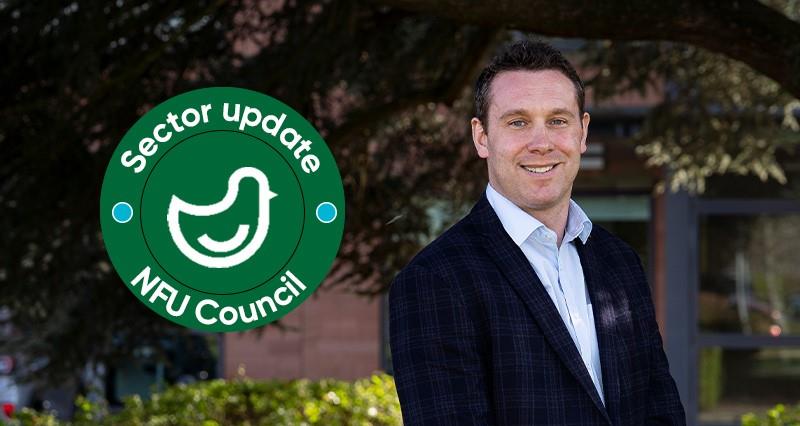
Clare Wise
NFU National Livestock Board Chair
NFU Livestock Board Chair Clare Wise updates on international trade, bluetongue, the European Commission’s proposals for animal welfare in transport and the new NFU resource being developed for Environment Agency inspections.
Strong domestic and export demand for beef and sheep meat continues, with prices over recent months staying relatively steady.
However, we are keeping an eye on several different trade dynamics that could impact both price and consumer trust.
US sheep meat imports
Firstly, in recent months, the ASI (American Sheep Industry) called a Section 201 Global Safeguard Investigation into sheep meat imports.
The ASI argues that sheep meat imports into the USA cause injury to their sector.
The NFU has fed into the UK Government’s submission to the investigation, saying that the small volume of British lamb that is sent to the USA cannot credibly be blamed for harm to American producers.
However, if injury is deemed to be found and tariffs or quotas are placed on imports, this could mean Australian and New Zealand product is diverted into our domestic and EU market, displacing our own.
“Vaccination is our best protection ahead of the next vector season, both against mortality and fertility challenges.”
NFU Livestock Board Chair Clare Wise on bluetongue
Brazilian meat imports
We also continue to ask government to ban Brazilian beef imports into the UK if government cannot prove Brazil is not misusing antibiotics.
Defra must urgently conduct an extensive, in-person audit of Brazilian production and traceability systems and a ban should remain in place until Brazil can demonstrate responsible antibiotic stewardship.
Border testing must also be strengthened. British farmers meet demanding standards, and imported food must be subject to equally credible scrutiny.
Read: Brazilian poultry and beef ban – NFU lobbying timeline
Bluetongue remains high on the agenda
Disease remains one of the greatest threats to livestock businesses.
Although bluetongue cases are now declining, conversations with vets about vaccination must continue.
Vaccination is our best protection ahead of the next vector season, both against mortality and fertility challenges.
We continue to build on our strong relationship with APHA senior leadership, who we recently hosted at National Livestock Board.
Since then, we have hosted Richard Lewis, the CEO on farm to discuss BTV.
The poultry team have hosted him as well to discuss avian influenza and a meeting specifically on bTB is being arranged.
Proposed welfare in transport rules
A large focus of NFU lobbying at the moment is the European Commission’s proposals for animal welfare in transport.
We have major concerns about space allowances, headroom heights, and restrictions on calf transport within the draft text.
We are also seeking urgent clarity that time in markets will be deemed as neutral time.
Due to our concerns, the NFU livestock team has been to Brussels twice to lobby on these proposals, including meeting the Irish Presidency and building stronger relationships with member states who also strongly oppose the drafted text.
If the text goes through as it is, the new welfare in transport rules would be unworkable for both the UK and EU’s livestock industries.
New NFU resource
On potential extensions to environmental permitting regulations, we continue to engage with Defra and the Environment Agency.
We are in the final stages of creating a resource which helps lay out what an EA (Environment Agency) inspection is assessing.
We strongly believe that this resource and a joined-up knowledge exchange programme with key stakeholders can deliver more than a costly and restrictive permitting regime ever will.
However, its success will depend on strong support and evidence of rapid uptake across the industry.
More from NFU Council: